Dmv Permit Test 118

By Teacher David Global  •  Free

1. At intersections with a "Yield" sign, you must:
A. Yield the right-of-way to cross traffic that is near enough to cause conflict.
B. Yield the right-of-way only to vehicles on your right.
C. Always slow down and proceed without stopping.
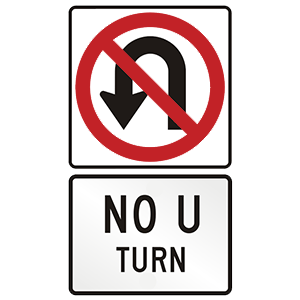
2. This road sign means:
georgia-no u turn
A. Do not enter.
B. No parking.
C. No U-turn.
3. Check your rearview mirrors:
A. Often to see how traffic is moving behind you.
B. To see if a vehicle is in your blind spot.
C. Only when you are slowing down.
4. You are driving in the far right lane of a four-lane freeway and notice thick broken white lines on the left side of your lane. You are driving in:
A. The carpool lane and must merge into the next lane.
B. A special lane for slow-moving vehicles.
C. An exit lane.
5. Which of these is a safe driving technique?
A. Using your high beam lights in the fog.
B. Staring at the road ahead of your vehicle.
C. Checking your rearview mirrors frequently.
6. When arriving to an uncontrolled intersection at the same time as vehicles to your right and left, you should:
A. Yield the right-of-way to the vehicle on your left.
B. Yield the right-of-way to the vehicle on your right.
C. Wait until there are no vehicles at the intersection before proceeding.
7. Which of the following is true about vehicles displaying a diamond-shaped sign that indicates a hazardous load?
A. They are not allowed to drive on freeways.
B. They must stop before crossing railroad tracks.
C. They are not allowed to exceed 35 mph.
8. In rainy weather, you should be most careful when turning or stopping:
A. After it has been raining all day.
B. One half hour after it stops raining.
C. During the first half hour of rain.
9. Which of the following describes the thinking of defensive drivers?
A. They know other drivers will do the right thing.
B. They consider what other drivers might do and are prepared to react.
C. They expect no breaks and give none.
10. It is against the law to enter an intersection when:
A. You can't get all the way across before the light turns red.
B. The light is flashing yellow and you didn't stop first.
C. The light is yellow and you cannot stop safely.
11. When approaching an intersection that is controlled by a flashing red traffic signal, you must:
A. Come to a complete stop, yield to oncoming traffic or pedestrians, then proceed.
B. Reduce your speed and proceed with caution.
C. Come to a complete stop and remain stopped as long as the light is red.
12. A white painted curb indicates a:
A. Loading zone for freight or passengers.
B. Loading zone for passengers or mail only.
C. Loading zone for freight only.
13. When you are merging onto the freeway, you should be driving:
A. At or near the speed of traffic on the freeway.
B. Five to 10 mph slower than the speed of traffic on the freeway.
C. The posted speed limit for freeway traffic.
14. When planning to pass another vehicle, you should:
A. Not count on other drivers to make room for you.
B. Assume the driver will let you pass if you use your turn signal.
C. Assume the driver will maintain a constant speed.
15. If you are about to be hit from the rear, you should not:
A. Release your seat belt.
B. Brace yourself.
C. Press your head against the head restraint.
16. If you park facing uphill on a street with a curb, set the parking brake and:
A. Turn the front wheels toward the curb.
B. Turn the front wheels away from the curb.
C. Leave the front wheels straight.
17. If you can see that the roadway up ahead is covered by heavy smoke, you should:
A. Turn on your four-way flashers and continue.
B. Reduce your speed, move as far to the right as possible, and stop off the roadway.
C. Turn on your high beam headlights and continue.
18. If you want to enter the freeway but you don't see a gap in traffic, you should:
A. Maintain your speed and force the other drivers to create a gap.
B. Slow down on the ramp to wait for a gap.
C. Stop at the end of the ramp to wait for a gap.
19. A red arrow pointing to the right on a traffic light means you may:
A. Turn in that direction after slowing and checking for traffic.
B. Not turn in that direction until the light turns green.
C. Turn in that direction after you come to a complete stop.
20. When driving in fog, rain, or snow, use:
A. Low beams.
B. High beams.
C. Fog lights only.
21. You are approaching an intersection at the posted speed limit when the signal turns yellow. You should:
A. Slow down and proceed through the intersection without caution.
B. Speed up to cross the intersection before the light turns red.
C. Stop before entering the intersection, if you can do so safely.
22. When is it legal for minors to use a cell phone without a hands-free device while driving?
A. When making a call while stopped at the red light
B. When making a call for emergency assistance
C. Never
23. At an intersection with a yield sign, you:
A. Must yield the right-of-way to cross traffic that is close enough to cause conflict.
B. Must yield to vehicles only on your right.
C. Should slow down but never stop.
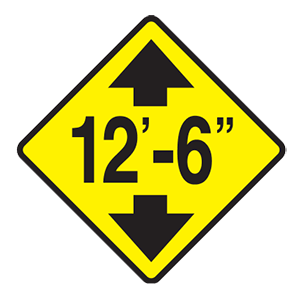
24. This sign indicates:
tennessee-low clearance
A. The distance from road surface to a bridge or overpass.
B. The maximum legal height of a vehicle allowed in this state.
C. The maximum width of a vehicle allowed on the highway.
25. California's "Basic Speed Law" says you must:
A. Keep your speed close to that of other traffic.
B. Never drive faster than is safe for current conditions.
C. Always drive at the posted speed limit.
26. If a traffic signal light is not working, you must:
A. Stop, then proceed when safe.
B. Stop before entering the intersection and let all other traffic go first.
C. Slow down or stop, only if necessary.
27. To avoid glare from the headlights of an approaching car:
A. Look briefly toward the right side of the road.
B. Stay focused on the centerline on the road.
C. Flash your high beams.
28. If you are about to be hit from the rear, you should consider each of the following, except for:
A. Applying your brakes.
B. Letting go of the steering wheel.
C. Pressing your head firmly against the head restraint.
29. You are on the freeway and traffic is merging into your lane. You should:
A. Make room for the merging traffic, if possible.
B. Assert your right-of-way by driving faster.
C. Always maintain your position.
30. If you find yourself in a skid:
A. Brake lightly.
B. Stay off the brakes.
C. Brake abruptly.
31. If your car begins to skid out of control, you should:
A. Pump the brakes.
B. Apply the brakes lightly.
C. Stay off the brakes.
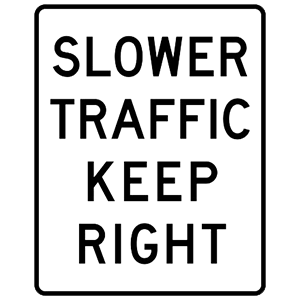
32. This white sign means:
california-slower traffic keep right
A. You should slow down and move to the right lane.
B. Stay in the right lane if you are driving more slowly than other traffic.
C. Slower traffic must exit on the right.
33. A vehicle suddenly cuts in front of you, creating a hazard. What should you do first?
A. Honk and step on the brake firmly.
B. Take your foot off the gas pedal.
C. Swerve into the lane next to you.
34. A steady red arrow displayed on a traffic light means:
A. Drivers cannot turn in the indicated direction.
B. Drivers may turn in the indicated direction after coming to a complete stop.
C. Drivers may turn in the indicated direction.
35. If you are driving and the rear end of your car starts skidding to the left, you should:
A. Steer to the right.
B. Steer to the left.
C. Tap your brakes lightly and shift into neutral.
36. It is illegal to leave a child age ____ or younger alone in a vehicle.
A. Eight
B. Seven
C. Six