Dmv Permit Test 117

By Teacher David Global  •  Free

1. Having a driver license is a:
A. Requirement.
B. Privilege.
C. Right.
2. For which of the following traffic lights must you always stop your vehicle?
A. Solid red lights, flashing red lights, and blacked out traffic signals.
B. Solid red lights, red arrows, and flashing yellow lights.
C. Solid red lights, flashing red lights, and yellow lights.
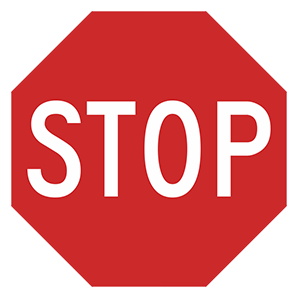
3. This road sign means:
georgia-stop
A. Slow down or stop.
B. Stop if necessary.
C. You must come to a complete stop.
4. If you approach a traffic light with a red signal and a police officer directs you to go through the intersection without stopping, you should:
A. Stop until the light turns green.
B. Go through the intersection without stopping.
C. Come to a complete stop before proceeding.
5. A flashing red traffic light at an intersection means:
A. The same thing as a yield sign.
B. The light is about to turn green.
C. The same thing as a stop sign.
6. In which of the following scenarios should your wheels not be pointed straight ahead?
A. When waiting to make a left turn at a traffic light.
B. When parked on a hill or sloping driveway.
C. When parked on the side of a level roadway where there is no curb.
7. You should not use your horn:
A. When visibility ahead is limited.
B. If you might hit another vehicle.
C. Near blind pedestrians.
8. The speed limit in any alley is:
A. 20 mph.
B. 15 mph.
C. 25 mph.
9. You reach an intersection with stop signs on all four corners at the same time as the driver on your left. Who has the right-of-way?
A. The driver on your left has the right-of-way.
B. You have the right-of-way.
C. Whoever is signaling to make a turn has the right-of-way.
10. If you park facing uphill where there is no curb, set the parking brake and:
A. Turn your wheels toward the edge of the road.
B. Turn your wheels away from the edge of the road.
C. Keep your wheels facing straight.
11. If a tire blows out, you should:
A. Apply the brake and hold it.
B. Hold the steering wheel tightly and use the brakes lightly.
C. Pull over quickly.
12. Make room for cars that are entering the freeway by:
A. Slowing down.
B. Merging into a different lane.
C. Maintaining your speed and position.
13. Driving more slowly than surrounding traffic is:
A. A good idea if the weather is bad.
B. Appropriate if you don’t know the speed limit.
C. Often a hazard because other drivers may become frustrated and try to pass you.
14. You are preparing to exit the interstate. When should you start reducing your speed?
A. About halfway through the deceleration lane.
B. As you approach the deceleration lane.
C. Immediately upon entering the deceleration lane.
15. Allow extra space in front of your vehicle when following a:
A. Station wagon.
B. Passenger vehicle.
C. Motorcycle.
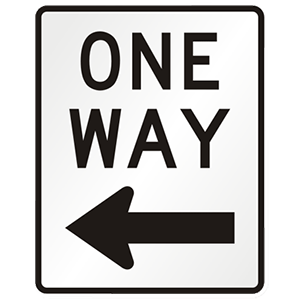
16. This road sign means:
maryland-one way
A. No right turn.
B. Drive only in the direction of the arrow.
C. Curve ahead.
17. Three of the most important times to check for traffic behind you are before:
A. Backing, making a sharp turn, or crossing an intersection.
B. Backing, changing lanes, or slowing down quickly.
C. Changing lanes, crossing intersections, or slowing down quickly.
18. You consent to take a chemical test for the alcohol content of your blood, breath, or urine:
A. Only if you have been drinking alcohol.
B. Whenever you drive in California.
C. Only if you have a collision.
19. You want to park downhill on a two-way road and there is no curb. Which way do you turn your front wheels?
A. Straight ahead
B. Right, toward the side of the road
C. Left, toward the center of the road
20. U-turns in business districts are:
A. Always illegal because they are dangerous.
B. Legal whenever oncoming vehicles are not a hazard.
C. Legal at intersections, unless a sign prohibits them.
21. If you are being followed too closely on a two-lane road:
A. Reduce your speed slowly to encourage the tailgater to drive around you.
B. Speed up to increase the distance between you and the other car.
C. Apply your brakes to slow down, then resume your original speed.
22. If you are facing a green traffic light but the intersection ahead is blocked by traffic, you should:
A. Turn left and find another route.
B. Stay out of the intersection until traffic clears.
C. Follow the other vehicles and enter the intersection.
23. If you parallel park facing downward on a hill:
A. Turn your wheels sharply toward the side of the road.
B. Turn your wheels away from the side of the road.
C. Keep your wheels straight.
24. You may make a left turn on a red light only from a:
A. One-way street onto a two-way street.
B. One-way street onto a one-way street.
C. Two-way street onto a one-way street.
25. You want to pass a bicyclist in a narrow traffic lane when an oncoming vehicle is approaching. You should:
A. Honk your horn then pass the bicyclist.
B. Slow down and let the vehicle pass you before you pass the bicyclist.
C. Wait until the bicyclist rides off the roadway.
26. If oncoming headlights are blinding you while you are driving at night, you should:
A. Look toward the right edge of the road.
B. Switch your lights to high beams.
C. Turn your lights on and off.
27. If you are being passed in a no passing zone, you should:
A. Pull off the road.
B. Maintain your speed and position.
C. Slow down and let the other driver safely return to the drive lane.
28. When driving on a multilane street with two-way traffic:
A. Drive alongside other vehicles so the drivers can see you.
B. You should drive ahead of or behind the other vehicles.
C. It is safest to drive in the lane next to the centerline.
29. You are entering a freeway. Check traffic on the freeway by:
A. Using your rearview and side mirrors.
B. Using your rearview mirror.
C. Using your side mirror and looking over your shoulder.
30. When changing lanes, you should never:
A. Cross the centerline in an intersection.
B. Check your blind spots by looking over your left or right shoulder.
C. Check for other drivers moving into the same lane.
31. You must yield the right-of-way to an emergency vehicle that is using its siren and flashing lights by:
A. Driving as closely to the right edge of the road as possible and stopping.
B. Moving into the right lane and driving slowly until it has passed.
C. Stopping immediately, even if you are within an intersection.
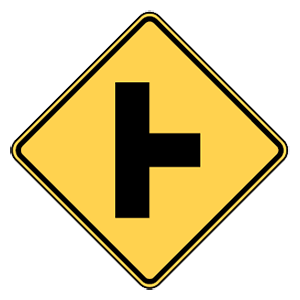
32. This road sign means:
maryland-side road enters ahead
A. All traffic must turn right.
B. All traffic must go straight.
C. A side road intersects ahead.
33. When driving at night on a dimly lit street, you should:
A. Drive slowly enough that you can stop within the area illuminated by your headlights.
B. Turn on your high beam headlights to better see the vehicles ahead of you.
C. Keep the instrument panel lights bright to be more visible to other drivers.
34. On a green arrow, you must:
A. Yield to any vehicle, bicycle, or pedestrian in the intersection.
B. Yield to pedestrians only in the intersection.
C. Wait four seconds before proceeding.
35. Flash your brake lights or turn on your emergency flashers if you:
A. Need to warn other drivers of a collision ahead.
B. Are temporarily parked in a traffic lane to make delivery.
C. Are backing out of a parking space.
36. You are getting ready to make a right turn. You should:
A. Signal and turn immediately.
B. Stop before entering the right lane and let all other traffic go first.
C. Slow down or stop, if necessary, and then make the turn.