Dmv Permit Test 115

By Teacher David Global  •  Free

1. You are approaching a green traffic light and traffic is blocking the intersection. What is the best thing to do?
A. Partially enter the intersection to establish your right-of-way.
B. Don't enter the intersection until you can get completely across.
C. Continue into the intersection and wait for traffic to clear.
2. When a pedestrian guided by a dog or carrying a white cane is crossing the street:
A. You must always yield the right-of-way.
B. You must tell them where to cross the street.
C. You only have to yield the right-of-way if you are at a corner.
3. If a traffic signal light is not working, you must:
A. Stop, then proceed when safe.
B. Stop before entering the intersection and let all other traffic go first.
C. Slow down or stop, only if necessary.
4. If you are driving and you see animals standing near the roadway:
A. Speed up to scare them away.
B. Slow down and proceed with caution.
C. Quickly swerve into the next lane.
5. When you drive through a construction zone, you should:
A. Stop to watch the workers.
B. Decrease your following distance.
C. Pass the construction zone carefully and not “rubberneck."
6. You are driving in the far right lane of a four-lane freeway and notice thick broken white lines on the left side of your lane. You are driving in:
A. The carpool lane and must merge into the next lane.
B. A special lane for slow-moving vehicles.
C. An exit lane.
7. At a red traffic light with a green arrow, you may proceed in the direction of the arrow if:
A. You first come to a complete stop.
B. You wait until the light changes.
C. You are in the proper lane and the roadway is clear.
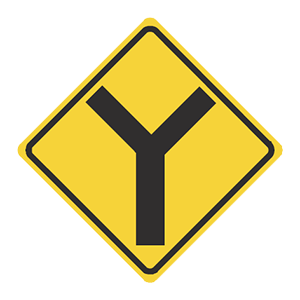
8. This road sign means:
illinois-y intersection
A. The roadway ends ahead.
B. Drivers must bear either right or left.
C. A four-way intersection is ahead.
9. When changing lanes, you should never:
A. Look over your shoulder to check your blind spot.
B. Change lanes abruptly or spontaneously.
C. Check for other vehicles moving into the same lane.
10. It is very foggy. You should slow down and:
A. Turn on your emergency flashers.
B. Turn your lights to their high beam setting.
C. Turn your lights to their low beam setting.
11. When a bicyclist is making a left turn:
A. They may use the left lane.
B. They may cut through all lanes.
C. They may wait on the side of the road.
12. To see vehicles in your blind spots, you should check:
A. The inside rearview mirror.
B. The outside rearview mirror.
C. Over your shoulders.
13. You are driving on the freeway behind a large truck. You should drive:
A. Closer behind the truck than you would if following a passenger vehicle.
B. Farther behind the truck than you would if following a passenger vehicle.
C. To the right side of the truck and wait to pass.
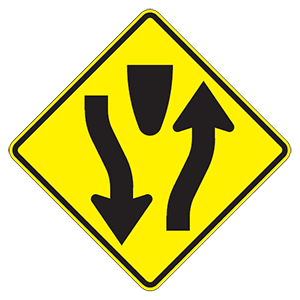
14. This sign means:
nebraska-divided highway begins
A. You are approaching the end of a divided highway.
B. You are approaching the beginning of a divided highway.
C. The road will be slippery ahead.
15. To avoid traction loss on wet roads, you should:
A. Make abrupt turns.
B. Apply the brakes firmly.
C. Slow down.
16. To pass on a two-lane road, you should:
A. Sound your horn as you pass.
B. Flash your headlights as you pass.
C. Judge the distance to any oncoming vehicles.
17. You may drive a motor vehicle in a bike lane:
A. If you drive more slowly than 15 mph.
B. No more than 200 feet before making a right turn.
C. Whenever bicyclists are not present.
18. Sudden wind gusts on highways:
A. Generally affect only the movement of large vehicles.
B. Only cause visibility problems.
C. Can cause problems for all vehicles.
19. If your vehicle starts to lose traction because of water on the road, you should:
A. Drive at a constant speed to gain better traction.
B. Apply the brakes firmly to prevent your vehicle from sliding.
C. Slow down gradually and not apply the brakes.
20. Before switching on the ignition, you should:
A. Buckle your safety belt.
B. Be sure all passengers have buckled their safety belts.
C. Both of the above.
21. This sign is a warning that you are approaching:
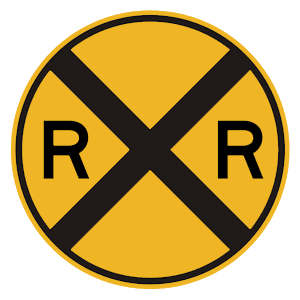
florida-railroad crossing
A. An intersection.
B. A crosswalk.
C. A railroad crossing.
22. A flashing yellow light at an intersection means you should:
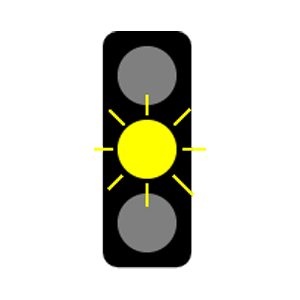
maryland-flashing yellow light
A. Slow down and proceed with caution.
B. Come to a complete stop as quickly as possible.
C. Stop and proceed only when the intersection is clear.
23. Which of these statements is true about driving and taking medications?
A. Most cold medications can make a person drowsy.
B. Over-the-counter medications cannot impair driving ability if taken in the recommended dosages.
C. Medications are safe to take at any time, if prescribed by a doctor.
24. You are driving on a city street and see an emergency vehicle with flashing lights behind you. What should you do?
A. Drive to the right edge of the road and slow down.
B. Drive to the right edge of the road and stop.
C. Stay in your lane, slow down, and let it pass.
25. If your car's suspension is bad, it can cause:
A. Vehicle control problems.
B. Squealing brakes.
C. Slack in the steering.
26. When approaching an intersection controlled by a flashing yellow light, you must:
A. Come to a complete stop at the intersection.
B. Maintain your normal speed.
C. Slow down and proceed with caution.
27. You are driving on a freeway with a posted speed limit of 65 mph. Traffic is traveling at 70 mph. You may legally drive:
A. 70 mph or faster to keep up with the speed of traffic.
B. Between 65 mph and 70 mph.
C. No faster than 65 mph.
28. A driver should:
A. Stare directly in front of their car.
B. Only focus on the middle of the road.
C. Watch beside, ahead, and to the rear of their car.
29. If weather or light conditions require you to have your lights on while driving:
A. Use your parking lights.
B. Use your high beams.
C. Use your low beams.
30. If pedestrians are illegally crossing in the middle of the street instead of in a crosswalk, you:
A. Must stop for them.
B. Do not have to stop for them.
C. Should honk your horn at them.
31. Stopping distances and severity of crashes:
A. Decrease as vehicle speed increases.
B. Are not affected by vehicle speed.
C. Increase as vehicle speed increases.
32. To make a right turn at a corner, you:
A. May not enter the bicycle lane.
B. Should only merge into the bicycle lane if you stop before turning.
C. Must merge into the bicycle lane before turning.
33. Animals may be transported in the back of a pickup truck only if:
A. The sides of the truck bed are at least 18 inches high.
B. They are properly secured.
C. The tailgate of the truck is closed.
34. To avoid last-minute moves, you should be looking down the road to where your vehicle will be in about:
A. 5 to 10 seconds.
B. 10 to 15 seconds.
C. 15 to 20 seconds.
35. If you see orange construction signs and cones on a freeway, you must:
A. Slow down because the lane ends ahead.
B. Be prepared for workers and equipment ahead.
C. Change lanes and maintain your current speed.
36. As you approach an intersection with a flashing yellow light:
A. Stop before crossing the intersection.
B. Slow down and proceed with caution.
C. Wait for a green light before proceeding.