Dmv Permit Test 113

By Teacher David Global  •  Free

1. Which of these statements is true about drinking alcohol and driving?
A. If you can walk in a straight line after drinking, it is safe to drive.
B. If you are under the legal blood alcohol concentration limit, your driving isn't impaired.
C. Alcohol affects judgement, which is needed to drive safely.
2. Drivers turning left must yield to:
A. Oncoming vehicles traveling straight or turning right.
B. Passing cars.
C. No one in particular.
3. Before you change lanes, you should check your mirrors and:
A. Never look over your right shoulder.
B. Always slow down in your traffic lane.
C. Glance over your shoulder.
4. A broken yellow line beside a solid yellow line indicates that passing is:
A. Permitted from the side next to the solid yellow line.
B. Not permitted from either direction.
C. Permitted from the side next to the broken yellow line.
5. Stopping distances and severity of crashes:
A. Decrease as vehicle speed increases.
B. Are not affected by vehicle speed.
C. Increase as vehicle speed increases.
6. While driving, you should look 10 to 15 seconds ahead of you:
A. And focus on the middle of the road.
B. Because it is a legal requirement.
C. To see potential hazards early.
7. If a road is slippery, maintain a following distance that is:
A. No different than normal.
B. Farther from the car ahead than normal.
C. Closer to the car ahead than normal.
8. When driving under low-visibility conditions due to fog, you should:
A. Turn on your high beam headlights.
B. Slow down and use your low beam headlights.
C. Increase your speed so you do not cause an accident.
9. Which of the following factors affect an individual's absorption of alcohol?
A. Weight
B. Height
C. Intelligence
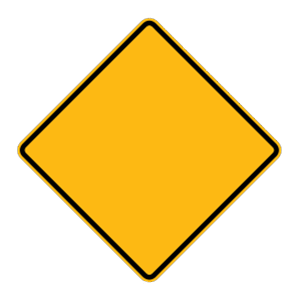
10. A diamond-shaped sign means:
washington-warning
A. Yield.
B. Stop.
C. Warning.
11. It is more dangerous to drive at night than during the day because:
A. You cannot see as far ahead at night.
B. The road is always more slippery at night.
C. Your reaction time is slower at night.
12. Roads are slippery after it first starts to rain. When the road is slippery, you should:
A. Avoid making turns and stops while driving at high speeds.
B. Test your tires' traction while going uphill.
C. Decrease the distance you look ahead of your vehicle.
13. Sudden wind gusts on highways:
A. Generally affect only the movement of large vehicles.
B. Only cause visibility problems.
C. Can cause problems for all vehicles.
14. If you have trouble seeing other vehicles because of dust or smoke blowing across the roadway, you should drive more slowly and turn on your:
A. Emergency flashers.
B. Parking lights.
C. Headlights.
15. Allow extra space in front of your vehicle when following a:
A. Station wagon.
B. Passenger vehicle.
C. Motorcycle.
16. If pedestrians are illegally crossing in the middle of the street instead of in a crosswalk, you:
A. Must stop for them.
B. Do not have to stop for them.
C. Should honk your horn at them.
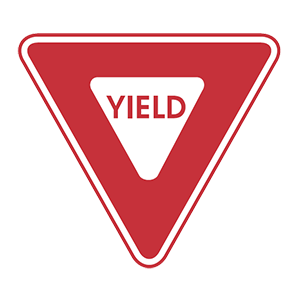
17. This sign is a:
nebraska-yield
A. Yield sign.
B. School crossing sign.
C. Stop sign.
18. It is legal to drive with an alcoholic beverage container that has been opened only if the container is:
A. Under the front seat.
B. In the glove department.
C. In the trunk.
19. To see objects in their blind spot when changing lanes, drivers should check:
A. Only the left outside mirror.
B. Over their left or right shoulder.
C. Only the inside rearview mirror.
20. At an intersection with stop signs on all corners, yield the right-of-way to any driver:
A. On your left.
B. Who arrived before you.
C. Across from your vehicle.
21. This sign indicates that the road ahead:
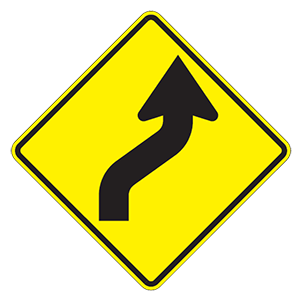
nebraska-reverse curve
A. Turns sharply right, then left.
B. Curves right, then left.
C. Curves right.
22. What is an important step in turning?
A. Check traffic in all directions.
B. Increase your speed.
C. Always move to the left lane.
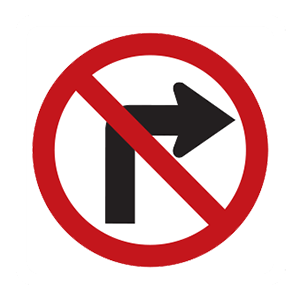
23. This road sign means:
maryland-no right turn
A. No right turn.
B. No U-turns.
C. No left turn.
24. If you find that the roadway ahead of you is flooded, you should:
A. Slam on the brakes.
B. Not drive through the flooded area. Turn around and find another route.
C. Drive only in the center of the roadway.
25. Extra space in front of a large truck is needed for:
A. Other drivers to merge onto the freeway.
B. The truck driver to stop the vehicle.
C. Other drivers when they want to slow down.
26. When backing up:
A. Look through the rear window.
B. Press hard on the gas pedal.
C. Rely only on your rearview mirror.
27. Continuous hard braking on ice and snow often:
A. Helps you stop faster.
B. Locks the front wheels of a vehicle, causing a loss of steering.
C. Keeps the brakes from freezing.
28. California's Move Over law requires:
A. All vehicles to stay in the right lane at all times.
B. Trucks to use the left lane.
C. All vehicles to vacate the lane closest to an emergency vehicle that is stopped with its lights flashing.
29. If a motorist sees pedestrians in an upcoming crosswalk, what should the motorist do?
A. Continue ahead. The motorist has the right-of-way.
B. Wait for the pedestrians to cross the street.
C. Pull to the right and go around the pedestrians.
30. A flashing red traffic light at an intersection means:
A. Slow down before entering.
B. Stop before entering.
C. Stop and wait for the green light.
31. The speed limit at an uncontrolled railroad crossing is:
A. 25 mph.
B. 15 mph.
C. 20 mph.
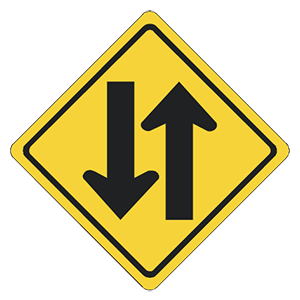
32. This sign means:
illinois-two way roadway
A. Two-way traffic.
B. Change in direction ahead.
C. School zone and crossing.
33. When you are merging onto the freeway, you should be driving:
A. At or near the speed of traffic on the freeway.
B. Five to 10 mph slower than the speed of traffic on the freeway.
C. The posted speed limit for freeway traffic.
34. You are approaching a railroad crossing with no warning devices and are unable to see 400 feet down the tracks in one direction. The speed limit is:
A. 15 mph.
B. 20 mph.
C. 25 mph.
35. You are driving on a freeway with a posted speed limit of 65 mph. Traffic is heavy and moving at 35 mph. The best speed for your vehicle is most likely:
A. 25 mph.
B. 35 mph.
C. 30 mph.
36. Temporary signs used in construction and maintenance work areas:
A. Have a red background with green writing.
B. Have an orange background with black writing.
C. Have a yellow background with blue writing.