Dmv Permit Test 105

By Teacher David Global  •  Free

1. When you tailgate other drivers (drive closely to their rear bumper):
A. You can frustrate the other drivers and make them angry.
B. Your actions cannot result in a traffic citation.
C. You help reduce traffic congestion.
2. If a traffic signal light is green and a police officer signals for you to stop, you should:
A. Obey the officer.
B. Obey the traffic signal.
C. Do what the vehicle in front of you does.
3. If you are involved in a traffic collision, you are required to complete and submit a written report to the DMV:
A. Only if you or the other driver is injured.
B. If there is property damage in excess of $1,000 or if there are any injuries.
C. Only if you are at fault.
4. Hydroplaning occurs when tires ride on a thin film of water instead of on the surface of the road. To prevent hydroplaning in rainy weather, you should:
A. Put on your cruise control to maintain a constant speed.
B. Decrease your speed.
C. Move to the shoulder of the road as soon as it starts to rain.
5. You want to turn left at an upcoming corner. Yield the right-of-way to:
A. Oncoming vehicles also turning left.
B. All approaching vehicles.
C. Pedestrians on the sidewalk waiting for a "Walk" signal.
6. The proper way to make a right turn is to:
A. Signal, slow down, and get into the lane closest to the centerline before turning.
B. Signal, slow down, and get into the lane closest to the right curb before turning.
C. Approach the corner in the lane nearest the right curb, but move over toward the middle of the street before turning.
7. A broken yellow centerline indicates that:
A. Passing is not permitted.
B. Passing on the right is permitted when the way ahead is clear.
C. Passing on the left is permitted when the way ahead is clear.
8. At a red traffic light with a green arrow, you may proceed in the direction of the arrow if:
A. You first come to a complete stop.
B. You wait until the light changes.
C. You are in the proper lane and the roadway is clear.
9. You should yield to a pedestrian:
A. Only if they are in a crosswalk.
B. At all times, even if the pedestrian is not obeying traffic laws.
C. Only if the traffic lights are in the pedestrian's favor.
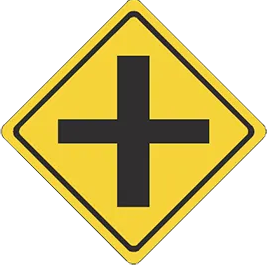
10. This sign means:
A. Crossroad ahead.
B. Merge.
C. Stop.
11. On a multilane road, a dashed yellow line next to a solid yellow line means:
A. Passing is prohibited from both directions.
B. Passing is permitted from both directions.
C. Passing is permitted only from the direction next to the dashed line.
12. Blocking an intersection during "rush hour" traffic is not permitted:
A. Unless you entered the intersection on a green light.
B. Under any circumstances, even if your light is green.
C. Unless you have the right-of-way or a green light.
13. If you approach a stopped school bus that has its lights flashing and signal arm extended, you should:
A. Stop.
B. Proceed at 15 mph if no children are present.
C. Proceed at normal speed, but watch for children.
14. When parking uphill on a two-way street with no curb, your front wheels should be:
A. Turned to the left (toward the street).
B. Turned to the right (away from the street).
C. Parallel with the pavement.
15. If you drive 55 mph in a 55 mph zone, you can be given a speeding ticket:
A. Under no circumstances because it is always legal.
B. If the road or weather conditions require a slower speed.
C. Only if you are approaching a sharp curve in the road.
16. To make a right turn at a corner, you:
A. May not enter the bicycle lane.
B. Should only merge into the bicycle lane if you stop before turning.
C. Must merge into the bicycle lane before turning.
17. Which child would require a child passenger restraint system?
A. A 9-year-old who is 4 feet 10 inches tall
B. A 10-year-old who is 5 feet 3 inches tall
C. A 7-year-old who is 4 feet 8 inches tall
18. What is the purpose of rumble strips?
A. They alert drivers to potential tire problems.
B. They test a vehicle's shock absorbers.
C. Through vibration and sound, they alert inattentive drivers to the fact that their vehicles have left the travel lane.
19. Adjust your rearview and side mirrors:
A. Before you start driving.
B. Whenever you need to use them.
C. Before you get into the car.
20. While driving on a roadway with a single broken white centerline:
A. You must stay within your lane.
B. You may cross the centerline to change lanes.
C. You may change lanes only from the left lane.
21. A driver should:
A. Stare directly in front of their car.
B. Only focus on the middle of the road.
C. Watch beside, ahead, and to the rear of their car.
22. Which of these statements is true about roadwork zones?
A. Fines are the same for violations committed in work zones as they are under normal traffic conditions.
B. You must "Slow for the Cone Zone."
C. Slow down only if you think workers are present.
23. Before switching on the ignition, you should:
A. Buckle your safety belt.
B. Be sure all passengers have buckled their safety belts.
C. Both of the above.
24. To prevent tailgating, drivers should follow the:
A. One-second rule.
B. Two-second rule.
C. Three-second rule.
25. When a pedestrian guided by a dog or carrying a white cane is crossing the street:
A. You must always yield the right-of-way.
B. You must tell them where to cross the street.
C. You only have to yield the right-of-way if you are at a corner.
26. Which of the following factors affect an individual's absorption of alcohol?
A. Weight
B. Height
C. Intelligence
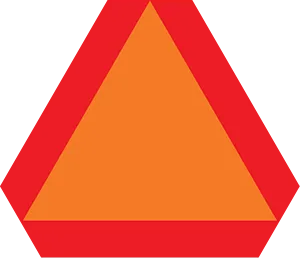
27. This sign means:
A. Slow-moving vehicle.
B. Road construction/maintenance area.
C. Traffic signal ahead.
28. If there is a deep puddle on the road ahead, you should:
A. Maintain the posted speed to make it through the water.
B. Avoid the puddle if possible.
C. Shift into neutral as you drive through the water.
29. It is legal to drive with an alcoholic beverage container that has been opened only if the container is:
A. Under the front seat.
B. In the glove department.
C. In the trunk.
30. When merging onto the freeway, you should be driving:
A. At or near the speed of the freeway traffic.
B. At the legal speed limit.
C. More slowly than the freeway traffic.
31. When changing lanes, you should never:
A. Look over your shoulder to check your blind spot.
B. Change lanes abruptly or spontaneously.
C. Check for other vehicles moving into the same lane.
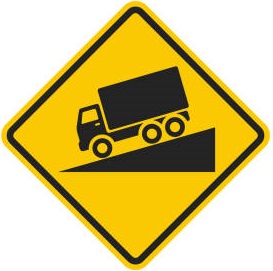
32. This road sign means:
A. Intersection ahead.
B. Merging traffic.
C. Steep hill ahead.
33. This white sign means you should not pass other vehicles:
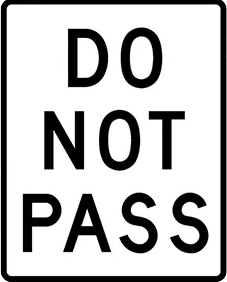
A. Until after you pass the sign.
B. Unless it seems safe to do so.
C. For any reason.
34. If you must park your vehicle in an area not usually used for parking:
A. Park with your reverse lights on.
B. Make sure your vehicle is visible to drivers approaching from any direction.
C. Park five feet from the curb.
35. Which of the following is true about vehicles displaying a diamond-shaped sign that indicates a hazardous load?
A. They are not allowed to drive on freeways.
B. They must stop before crossing railroad tracks.
C. They are not allowed to exceed 35 mph.
36. You have stopped for a train at a railroad crossing. After the train passes, you should:
A. Wait for signal lights to stop flashing.
B. Look for a second train.
C. Both of the above.