Dmv Permit Test 103

By Teacher David Global  •  Free

1. You are driving in the far right lane of a four-lane freeway and notice thick broken white lines on the left side of your lane. You are driving in:
A. The carpool lane and must merge into the next lane.
B. A special lane for slow-moving vehicles.
C. An exit lane.
2. When passing another vehicle, you should return to your original lane when:
A. You can see both headlights of the passed vehicle in your rearview mirror.
B. You have cleared the front bumper of the passed vehicle.
C. You are 50 feet in front of the passed vehicle.
3. You must show proof of insurance to law enforcement:
A. Only if you are involved in a collision.
B. If you are involved in a collision or stopped for a citation.
C. Only if you are stopped and cited.
4. A sign with this shape means:
A. No passing zone.
B. Right turn permitted on red.
C. Yield right-of-way.
5. You are approaching a green traffic light and traffic is blocking the intersection. What is the best thing to do?
A. Partially enter the intersection to establish your right-of-way.
B. Don't enter the intersection until you can get completely across.
C. Continue into the intersection and wait for traffic to clear.
6. When you see this sign, you should:
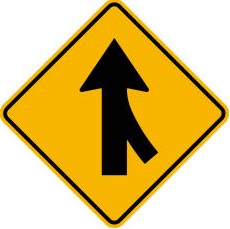
A. Watch for traffic merging from the right.
B. Merge right.
C. Turn left.
7. While driving, you should look 10 to 15 seconds ahead of you:
A. And focus on the middle of the road.
B. Because it is a legal requirement.
C. To see potential hazards early.
8. When should drivers yield the right-of-way to pedestrians in a crosswalk?
A. Only if the pedestrians first wave to the driver.
B. Only if the pedestrians are not texting while walking.
C. At all times.
9. To pass on a two-lane road, you should:
A. Sound your horn as you pass.
B. Flash your headlights as you pass.
C. Judge the distance to any oncoming vehicles.
10. When driving behind another vehicle at night, you should:
A. Keep your headlights on the low beam setting.
B. Use your high beam headlights until you are within 10 feet of the vehicle ahead.
C. Use your high beam headlights.
11. When driving in fog, you should:
A. Use your high beam headlights.
B. Use your parking lights.
C. Use your low beam headlights.
12. If you pass a school bus that is stopped with its red lights flashing, you will:
A. Be fined up to $1,000.
B. Be fined up to $100.
C. Face no legal consequences.
13. What message will be found on a red octagon-shaped sign?
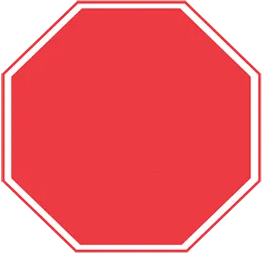
A. Do not enter.
B. One-way.
C. Stop.
14. When stopped at a red traffic light with a green arrow, you may proceed in the direction of the arrow if you:
A. First come to a complete stop.
B. Wait until the light changes.
C. Are in the proper lane and the intersection is clear.
15. You enter a designated turn lane to make a left turn at an upcoming intersection. There is oncoming traffic. You should:
A. Move to the left of the center lane.
B. Signal before you arrive at the intersection.
C. Turn your front wheels to the left to be prepared to turn.
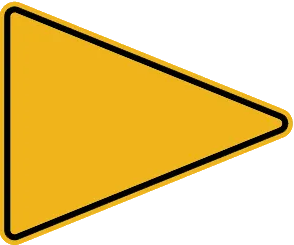
16. When you see this black and yellow sign, it means:
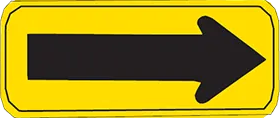
A. The road to the right is for one-way traffic only.
B. There is a detour to the right due to road construction.
C. The road ahead changes direction at an extreme angle.
17. You hit a parked vehicle and can't find the owner. What must you do?
A. Call your insurance company when you get home.
B. Wait for the owner to return.
C. Leave a note with your name and address on the parked vehicle.
18. Roads with double solid yellow line markings down the center indicate that passing is:
A. Allowed from both directions.
B. Allowed only from your direction of travel.
C. Not allowed from either direction.
19. If pedestrians are illegally crossing in the middle of the street instead of in a crosswalk, you:
A. Must stop for them.
B. Do not have to stop for them.
C. Should honk your horn at them.
20. You were parked and have been waiting a long time with your turn signal on to re-enter traffic. However, traffic is heavy. You should:
A. Continue waiting and yielding to traffic in the lane.
B. Slowly inch your vehicle into the traffic lane.
C. Drive on the shoulder until a gap in traffic appears.
21. Trucks' blind spots are:
A. Directly behind the body.
B. On the immediate left of the cab.
C. Both on the immediate left of the cab and directly behind the body.
22. It is very foggy. You should slow down and:
A. Turn on your emergency flashers.
B. Turn your lights to their high beam setting.
C. Turn your lights to their low beam setting.
23. Extra space in front of a large truck is needed for:
A. Other drivers to merge onto the freeway.
B. The truck driver to stop the vehicle.
C. Other drivers when they want to slow down.
24. If you plan to pass another vehicle, you should:
A. Not assume the other driver will make space for you to return to your lane.
B. Assume the other driver will let you pass if you use your turn signal.
C. Assume the other driver will maintain a constant speed.
25. With a Class C driver license, a person may drive:
A. A three-axle vehicle if the Gross Vehicle Weight is less than 6,000 pounds.
B. Any three-axle vehicle, regardless of the weight.
C. A vehicle pulling two trailers.
26. Temporary signs used in construction and maintenance work areas:
A. Have a red background with green writing.
B. Have an orange background with black writing.
C. Have a yellow background with blue writing.
27. As your speed increases, it is important to:
A. Turn on your headlights.
B. Look well ahead of your vehicle.
C. Change lanes frequently.
28. It is illegal to park your vehicle:
A. In an unmarked crosswalk.
B. Within three feet of a private driveway.
C. In a bicycle lane.
29. A solid yellow arrow on a traffic signal means:
A. You should speed up so you can make the turn before the light changes.
B. You do not need to signal to turn from the indicated lane.
C. You should prepare to stop and yield the right-of-way to oncoming traffic.
30. Which of the following statements about driving speed is true?
A. As your speed increases, the chance of a fatality increases.
B. As your speed increases, so should your following distance.
C. Both of the above.
31. If you see orange construction signs and cones on a freeway, you must:
A. Slow down because the lane ends ahead.
B. Be prepared for workers and equipment ahead.
C. Change lanes and maintain your current speed.
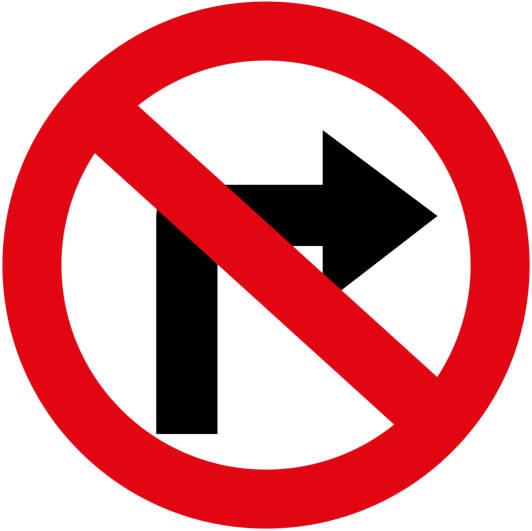
32. This sign means:
A. No U-turn.
B. No left turn.
C. No right turn.
33. On freezing, wet days, which of the following roadways is most likely to hide spots of ice?
A. Roadways near the tops of hills
B. Roadways on bridges and overpasses
C. Roadways paved with asphalt
34. When parking your vehicle parallel to the curb on a level street:
A. Your front wheels must be turned toward the street.
B. Your wheels must be within 18 inches of the curb.
C. One of your rear wheels must touch the curb.
35. How many alcoholic drinks does it take to affect your driving ability?
A. Three
B. Two
C. One
36. Hydroplaning occurs when tires ride on a thin film of water instead of on the road. To prevent hydroplaning in wet weather, you should:
A. Put on your cruise control to maintain a constant speed.
B. Slow down.
C. Move to the shoulder of the road as soon as it starts to rain.