Dmv Permit Test 102

By Teacher David Global  •  Free

1. On a freeway, you should look farther ahead than you would on a city street:
A. In order to see potential hazards early.
B. Because it takes a quarter of a mile to stop your vehicle completely.
C. Because it helps you keep up with traffic.
2. Which of these statements is true about drugs and driving?
A. Any prescription drug is safe to use if you don't feel drowsy.
B. Even over-the-counter drugs can impair your driving.
C. Only illegal drugs can impair your driving.
3. Allow extra space in front of your vehicle when following a:
A. Station wagon.
B. Passenger vehicle.
C. Motorcycle.
4. When passing another car, you have enough space to return to the driving lane:
A. If the other driver signals for you to re-enter the lane.
B. If you look over your shoulder and see the passed car behind you.
C. If you can see both of the passed vehicle's headlights in your rearview mirror.
5. You are driving on the freeway behind a large truck. You should drive:
A. Closer behind the truck than you would if following a passenger vehicle.
B. Farther behind the truck than you would if following a passenger vehicle.
C. To the right side of the truck and wait to pass.
6. You consent to take a chemical test for the alcohol content of your blood, breath, or urine:
A. Only if you have been drinking alcohol.
B. Whenever you drive in California.
C. Only if you have a collision.
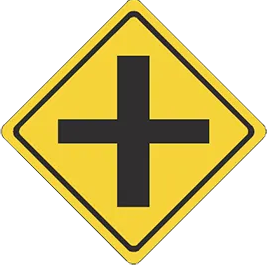
7. This road sign means:
A. Hospital.
B. Upcoming intersection.
C. Railroad crossing.
8. On a green arrow, you must:
A. Yield to any vehicle, bicycle, or pedestrian in the intersection.
B. Yield to pedestrians only in the intersection.
C. Wait four seconds before proceeding.
9. To avoid traction loss on wet roads, you should:
A. Make abrupt turns.
B. Apply the brakes firmly.
C. Slow down.
10. If you see a pedestrian using a guide dog or carrying a white cane:
A. The pedestrian must yield the right-of-way.
B. You must yield the right-of-way.
C. Honk your horn to let them know you are there.
11. You see a flashing yellow traffic signal at an upcoming intersection. The flashing yellow light means:
A. Stop before entering the intersection, as long as you can do so safely.
B. Stop. Yield to all cross traffic before crossing the intersection.
C. Slow down and cross the intersection carefully.
12. Safely backing your vehicle requires all of the following, except:
A. Looking over your right shoulder as you back up.
B. Checking your vehicle's surroundings.
C. Tapping your horn before you back up.
13. Animals may be transported in the back of a pickup truck only if:
A. The sides of the truck bed are at least 18 inches high.
B. They are properly secured.
C. The tailgate of the truck is closed.
14. "No passing zone" signs tell drivers:
A. To speed up slightly.
B. That it is not safe to pass.
C. To maintain a steady speed.
15. When you approach an octagonal sign, you must:
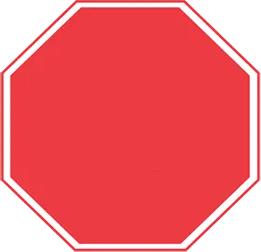
A. Slow.
B. Stop.
C. Turn.
16. When you are merging onto the freeway, you should be driving:
A. At or near the speed of traffic on the freeway.
B. Five to 10 mph slower than the speed of traffic on the freeway.
C. The posted speed limit for freeway traffic.
17. You are approaching a railroad crossing with no warning devices and are unable to see 400 feet down the tracks in one direction. The speed limit is:
A. 15 mph.
B. 20 mph.
C. 25 mph.
18. When making a right turn from a highway with two lanes traveling in your direction, you may turn from:
A. The lane closest to the center of the road.
B. The lane nearest the curb or edge of the roadway.
C. Either lane, depending on oncoming traffic.
19. When driving under low-visibility conditions due to fog, you should:
A. Turn on your high beam headlights.
B. Slow down and use your low beam headlights.
C. Increase your speed so you do not cause an accident.
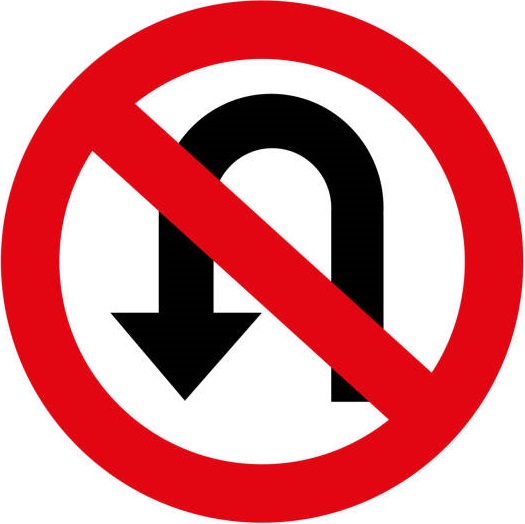
20. This sign means:
A. No turns.
B. No outlet.
C. No U-turns.
21. The speed limit at an uncontrolled railroad crossing is:
A. 25 mph.
B. 15 mph.
C. 20 mph.
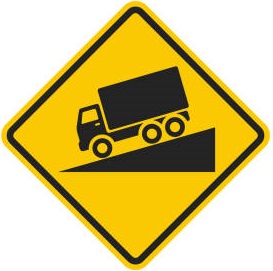
22. This sign means:
A. Upcoming downgrade or hill.
B. Road construction area.
C. Upcoming narrowing of roadway.
23. A broken yellow line between two lanes of traffic means:
A. Both lanes of traffic are going in the same direction.
B. Passing is permitted when it's safe.
C. Passing is not permitted.
24. If you have trouble seeing other vehicles because of dust or smoke blowing across the roadway, you should drive more slowly and turn on your:
A. Emergency flashers.
B. Parking lights.
C. Headlights.
25. When parking next to a curb, you should use your turn signals:
A. Only when pulling away from the curb.
B. When pulling next to, but not away from, the curb.
C. When pulling next to or away from the curb.
26. You should not start across an intersection if you know you will block the intersection when the light turns red:
A. Under any circumstances.
B. Unless you entered the intersection on a yellow light.
C. Unless you entered the intersection on a green light.
27. To help others see you when daylight begins to fade, you should use your:
A. Parking lights.
B. Low beam headlights.
C. Emergency flashers.
28. It is illegal to leave a child age six or younger unattended in a vehicle on a hot day:
A. Even if they are secured in a child passenger restraint system.
B. If they are supervised by a person twelve years of age or older.
C. Only if the key is in the ignition.
29. You reach an intersection with stop signs on all four corners at the same time as the driver on your left. Who has the right-of-way?
A. The driver on your left has the right-of-way.
B. You have the right-of-way.
C. Whoever is signaling to make a turn has the right-of-way.
30. To turn left from a multilane one-way street onto a one-way street, you should start your turn from:
A. Any lane (as long as it is safe).
B. The lane closest to the left curb.
C. The lane in the center of the road.
31. Various traffic control devices in construction and maintenance work areas are the color:
A. Red.
B. Orange.
C. Yellow.
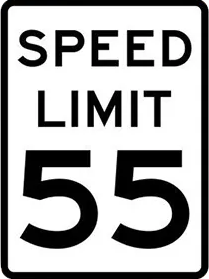
32. This road sign means:
A. You must travel through the intersection at the posted speed limit.
B. The maximum speed limit under ideal conditions is 55 mph.
C. You must not travel below the speed indicated.
33. You may legally block an intersection:
A. If you entered the intersection on the green light.
B. During rush hour traffic.
C. Under no circumstances.
34. When planning to pass another vehicle, you should:
A. Not count on other drivers to make room for you.
B. Assume the driver will let you pass if you use your turn signal.
C. Assume the driver will maintain a constant speed.
35. Always stop before crossing railroad tracks when:
A. There isn't room on the other side for you to completely cross the tracks.
B. The railroad crossing is located in a city or town that has frequent train traffic.
C. You are transporting two or more young children in a passenger vehicle.
36. If your vehicle starts to lose traction because of water on the road, you should:
A. Drive at a constant speed to gain better traction.
B. Apply the brakes firmly to prevent your vehicle from sliding.
C. Slow down gradually and not apply the brakes.