Dmv Permit Test 110

By Teacher David Global  •  Free

1. This road sign means:
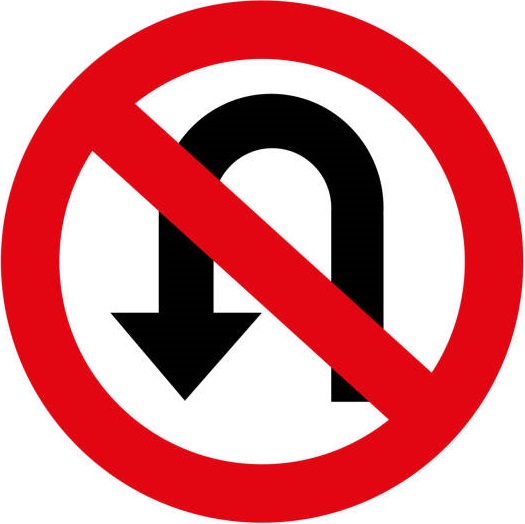
A. Do not enter.
B. Roundabout ahead.
C. No U-turns.
2. A large truck is ahead of you and is turning right onto a street with two lanes in each direction. The truck:
A. May complete its turn in either of the two lanes.
B. May have to swing wide to complete the right turn.
C. Must stay in the right lane at all times while turning.
3. When changing lanes, you should never:
A. Look over your shoulder to check your blind spot.
B. Change lanes abruptly or spontaneously.
C. Check for other vehicles moving into the same lane.
4. You may cross a double yellow line to pass another vehicle if the yellow line next to:
A. The other side of the road is a solid line.
B. Your side of the road is a broken line.
C. The other side of the road is a broken line.
5. When changing lanes, you can check your blind spot by:
A. Using the inside rearview mirror.
B. Turning your head and looking over your shoulder.
C. Using your side mirror.
6. Which of the following is true about vehicles displaying a diamond-shaped sign that indicates a hazardous load?
A. They are not allowed to drive on freeways.
B. They must stop before crossing railroad tracks.
C. They are not allowed to exceed 35 mph.
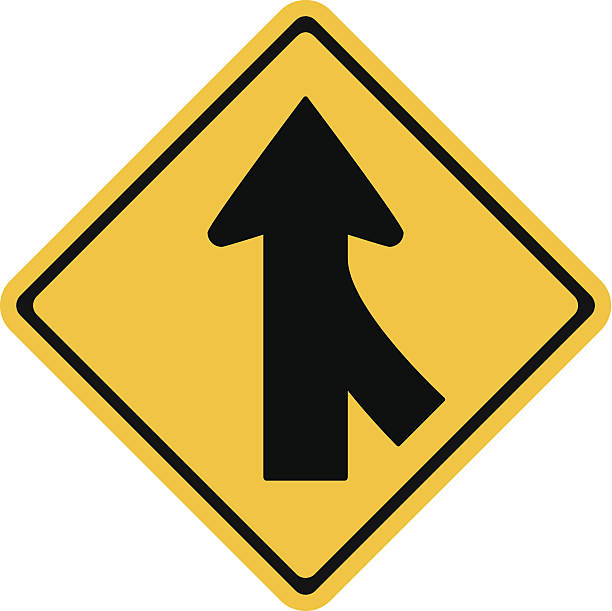
7. This yellow sign means:
A. One lane ahead.
B. Merging traffic ahead.
C. Lane ends ahead.
8. If the rear of your vehicle is skidding to the left, you should:
A. Not turn your steering wheel.
B. Turn your steering wheel to the left to correct the skid.
C. Turn your steering wheel to the right to correct the skid.
9. It is illegal for a person 21 years of age or older to drive with a blood alcohol concentration (BAC) that is ____ or higher.
A. 0.08% -- Eight-hundredths of one percent
B. 0.10% -- One-tenth of one percent
C. 0.05% -- Five-hundredths of one percent
10. When using a roundabout, drivers should:
A. Stop in the middle of the roundabout.
B. Yield to traffic already in the roundabout.
C. Yield to entering traffic.
11. If you become drowsy while driving, you should:
A. Try to fight it.
B. Take a break.
C. Take some caffeine pills.
12. Reaction time is slower after:
A. Drinking alcohol.
B. Sleeping.
C. Working hard.
13. When you see an emergency vehicle approaching while using its flashing lights, you must:
A. Maintain your speed and stay in your lane until the vehicle has passed.
B. Move into the right lane and drive slowly until the vehicle has passed.
C. Pull over to the curb or edge of the road and stop until the vehicle has passed.
14. You want to park uphill on a two-way road and there is no curb. Which direction do you turn your front wheels?
A. Straight ahead
B. Right, toward the side of the road
C. Left, toward the center of the road
15. If bad weather makes it difficult for you to see clearly, you should:
A. Speed up to get off the road quickly.
B. Drive in the lane closest to oncoming traffic.
C. Increase your following distance.
16. Which of the following is true about roadways on bridges and overpasses in cold, wet weather?
A. They tend to freeze before the rest of the road does.
B. They do not freeze because they are made of concrete.
C. They tend to freeze after the rest of the road does.
17. When passing on the left of a vehicle, it is safe to move back into the right lane:
A. After about three seconds.
B. When you can no longer see the vehicle over your right shoulder.
C. When you can see the front of the vehicle in your rearview mirror.
18. Never make a U-turn:
A. in residential districts.
B. at or on a railroad crossing.
C. where there isn't a "No U-turn" sign posted.
19. When should drivers yield the right-of-way to pedestrians in a crosswalk?
A. Only if the pedestrians first wave to the driver.
B. Only if the pedestrians are not texting while walking.
C. At all times.
20. It is illegal to park your vehicle:
A. In an unmarked crosswalk.
B. Within three feet of a private driveway.
C. In a bicycle lane.
21. Work zone barriers, drums, cones, and signs are used to:
A. Make drivers angry about slow traffic.
B. Inconvenience drivers.
C. Keep traffic out of hazardous work zones.
22. It is illegal to leave a child age six or younger unattended in a vehicle on a hot day:
A. Even if they are secured in a child passenger restraint system.
B. If they are supervised by a person twelve years of age or older.
C. Only if the key is in the ignition.
23. To avoid hydroplaning while driving in rainy conditions, you should:
A. Drive at a speed appropriate for ideal conditions.
B. Apply your brakes as soon as your car starts to skid.
C. Slow down.
24. What is the benefit of a space cushion around your vehicle?
A. Other drivers can cut in front of you, improving the flow of traffic.
B. If another driver makes a mistake, you have time to react.
C. It inflates to protect you from injury in the case of a collision.
25. A white painted curb indicates a:
A. Loading zone for freight or passengers.
B. Loading zone for passengers or mail only.
C. Loading zone for freight only.
26. To help avoid skidding on slippery surfaces, you should:
A. Shift to a lower gear after starting down a steep hill.
B. Speed up to enter curves and slow down to exit them.
C. Slow down before entering curves and intersections.
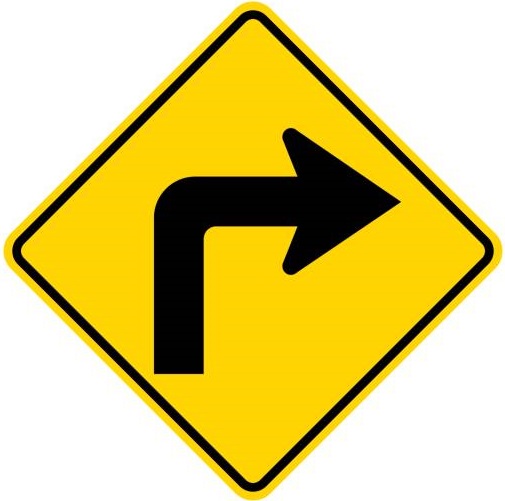
27. This yellow sign means:
A. There is a sharp turn to the right.
B. The lane must turn right.
C. A right turn is permitted on a green arrow only.
28. A blood alcohol concentration of 0.02 percent:
A. Won't have any effect on your driving.
B. Won't put other drivers at risk.
C. Will double your chances of having an accident.
29. Motorcycles, scooters, and mopeds are not easy to see; therefore, you should:
A. Slow down when driving.
B. Make constant visual checks.
C. Share a lane with a motorcycle.
30. You hit a parked vehicle and can't find the owner. What must you do?
A. Call your insurance company when you get home.
B. Wait for the owner to return.
C. Leave a note with your name and address on the parked vehicle.
31. A broken yellow centerline indicates that:
A. Passing is not permitted.
B. Passing on the right is permitted when the way ahead is clear.
C. Passing on the left is permitted when the way ahead is clear.
32. A broken yellow line beside a solid yellow line indicates that:
A. Passing is permitted from the lane next to the solid yellow line.
B. Passing is not permitted from either direction.
C. Passing is permitted from the lane next to the broken yellow line.
33. When entering an interstate highway, you should:
A. Stop, check for cars, and enter when safe.
B. Check for cars and reduce your speed to 25 mph before entering the traffic lane.
C. Check for cars, increase your speed to match the flow of traffic, and merge when the way is clear.
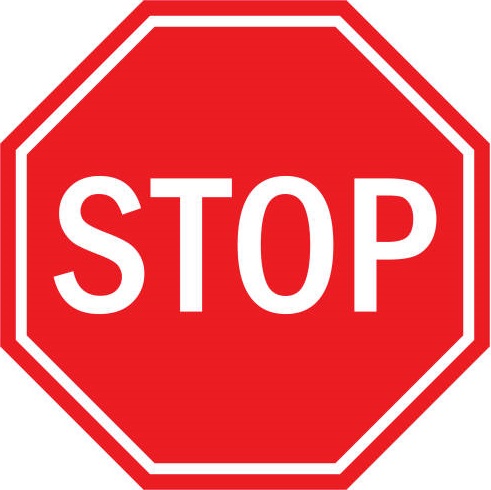
34. This road sign means:
A. Drive with caution and be ready to stop.
B. You must come to a complete stop.
C. Stop, if necessary.
35. When a car with bright headlights drives toward you at night, you should:
A. Stop until the other driver passes.
B. Look below their headlights.
C. Glance toward the right edge of your lane.
36. Roadways are the most slippery:
A. During a heavy downpour.
B. After it has been raining for awhile.
C. During the first rain after a dry spell.