Dmv Permit Test 77

By Teacher David Global  •  Free

1. You may cross double yellow lines to pass another vehicle if the:
A. Vehicle in front of you moves to the right to let you pass.
B. Yellow line next to your side of the road is broken.
C. Yellow line next to the opposite side of the road is broken.
2. To see vehicles in your blind spots, you should check:
A. The inside rearview mirror.
B. The outside rearview mirror.
C. Over your shoulders.
3. If you are driving near a large commercial vehicle, you should:
A. Follow the large vehicle closely to reduce wind drag on your vehicle.
B. Avoid driving beside it for long stretches of time.
C. Drive on its right side when on curves and hills.
4. Distracted driving is:
A. Anything that causes evasive action while driving.
B. Anything that takes your attention away from driving.
C. Anything that causes you to pay more attention to driving.
5. When driving under low-visibility conditions due to fog, you should:
A. Turn on your high beam headlights.
B. Slow down and use your low beam headlights.
C. Increase your speed so you do not cause an accident.
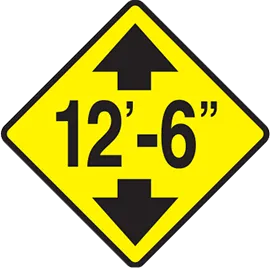
6. This sign indicates:
A. The distance from road surface to a bridge or overpass.
B. The maximum legal height of a vehicle allowed in this state.
C. The maximum width of a vehicle allowed on the highway.
7. When used on roadways, bicycles are considered:
A. Hazards.
B. Vehicles.
C. Dangerous.
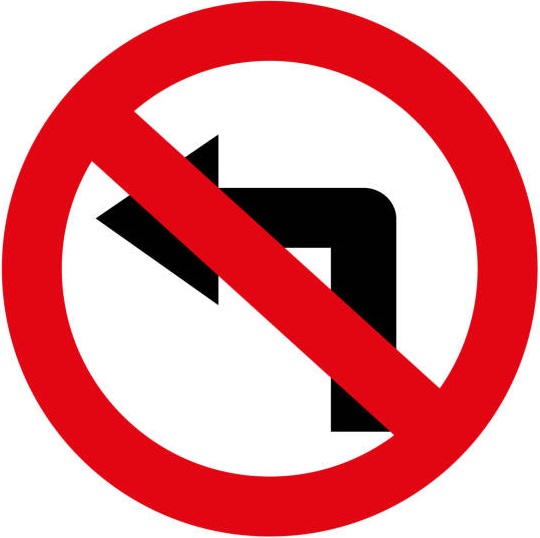
8. This sign means:
A. All traffic must turn left.
B. No left turn.
C. No U-turn.
9. If no signs or markings are present to control turning at an intersection, drivers should turn:
A. Into the first available lane.
B. Into the last available lane.
C. Into any lane.
10. A solid yellow line next to a broken yellow line means that vehicles:
A. Driving in both directions may pass.
B. Next to the broken line may pass.
C. Next to the solid line may pass.
11. After passing a vehicle, it is safe to return to your driving lane when:
A. The driver you passed signals for you to return to your lane.
B. You signal your intention for three seconds.
C. You see the headlights of the passed vehicle in your rearview mirror.
12. A solid yellow line on your side of the centerline means:
A. Reduce your speed.
B. Traffic light ahead.
C. Do not pass.
13. When driving in fog, you should:
A. Use your high beam headlights.
B. Use your parking lights.
C. Use your low beam headlights.
14. You are on the freeway and traffic is merging into your lane. You should:
A. Make room for the merging traffic, if possible.
B. Assert your right-of-way by driving faster.
C. Always maintain your position.
15. When driving on the highway, consistently looking far ahead of your vehicle:
A. Helps you keep up with traffic.
B. Reduces the need for last-minute braking or turning.
C. Allows you to spot upcoming police officers.
16. When driving in fog, rain, or snow, use:
A. Low beams.
B. High beams.
C. Fog lights only.
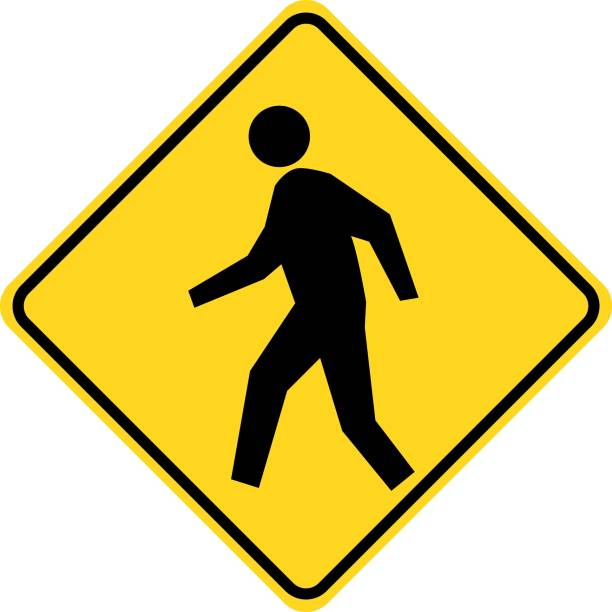
17. This sign means:
A. School crossing.
B. School zone.
C. Pedestrian crossing.
18. In which of the following scenarios should your wheels not be pointed straight ahead?
A. When waiting to make a left turn at a traffic light.
B. When parked on a hill or sloping driveway.
C. When parked on the side of a level roadway where there is no curb.
19. After you have passed a vehicle moving in the same direction, it is safe to move back into the right lane:
A. After about three seconds.
B. When you can no longer see the passed vehicle over your right shoulder.
C. When you can see the entire front of the passed vehicle in your rearview mirror.
20. You are approaching an intersection at the posted speed limit when the signal turns yellow. You should:
A. Slow down and proceed through the intersection without caution.
B. Speed up to cross the intersection before the light turns red.
C. Stop before entering the intersection, if you can do so safely.
21. The amount of alcohol in the blood is referred to as:
A. Implied consent (IC).
B. Blood alcohol concentration (BAC).
C. Rate of alcohol consumption (RAC).
22. A steady yellow traffic signal light is a warning that the light is about to change to red. If you are already within the intersection when a green light changes to yellow, you should:
A. Stop.
B. Continue moving and clear the intersection safely.
C. Increase your speed so as not to cause an accident.
23. Which of the following statements is correct?
A. Use your left foot to brake.
B. Use your right foot for both braking and accelerating your vehicle.
C. You should always brake abruptly to ensure stopping.
24. You exit the freeway on a ramp that curves downhill. You should:
A. Slow to a safe speed before the curve.
B. Slow to the posted speed limit for the freeway.
C. Wait until you have entered the curve to begin braking.
25. When stopped at a red traffic light with a green arrow, you may proceed in the direction of the arrow if you:
A. First come to a complete stop.
B. Wait until the light changes.
C. Are in the proper lane and the intersection is clear.