Dmv Permit Test 96

By Teacher David Global  •  Free

1. Streets and highways are most slippery:
A. When it has been raining hard for several hours.
B. When they are clean and dry.
C. Just after it starts to rain.
2. When driving on an interstate, to avoid traffic merging from on-ramps to your right, the best thing to do is to:
A. Change lanes to the left.
B. Slow down.
C. Maintain your speed and position.
3. A large truck is ahead of you and is turning right onto a street with two lanes in each direction. The truck:
A. May complete its turn in either of the two lanes.
B. May have to swing wide to complete the right turn.
C. Must stay in the right lane at all times while turning.
4. Having a driver license is a:
A. Requirement.
B. Privilege.
C. Right.
5. If it feels like your tires have lost contact with the surface of the road, you should:
A. Slow down by shifting into a lower gear.
B. Ease your foot off the gas pedal.
C. Slow down by pumping the brakes quickly and firmly.
6. If you want to enter the freeway but you don't see a gap in traffic, you should:
A. Maintain your speed and force the other drivers to create a gap.
B. Slow down on the ramp to wait for a gap.
C. Stop at the end of the ramp to wait for a gap.
7. To avoid hydroplaning while driving in rainy conditions, you should:
A. Drive at a speed appropriate for ideal conditions.
B. Apply your brakes as soon as your car starts to skid.
C. Slow down.
8. On a green arrow, you must:
A. Yield to any vehicle, bicycle, or pedestrian in the intersection.
B. Yield to pedestrians only in the intersection.
C. Wait four seconds before proceeding.
9. Which of the following is most likely to be slippery in cold weather after snow or rain?
A. A hilly, open road
B. A residential road
C. A road in a shaded area
10. Alcohol is:
A. A stimulant.
B. An antihistamine.
C. A depressant.
11. When parking your vehicle on any hill:
A. One of your rear wheels should touch the curb.
B. Use your parking brake and leave the vehicle in "park."
C. Your front wheels should be parallel to the road, if there is no curb.
12. You are entering a freeway. Check traffic on the freeway by:
A. Using your rearview and side mirrors.
B. Using your rearview mirror.
C. Using your side mirror and looking over your shoulder.
13. When approaching an intersection with a flashing red light, you must:
A. Come to a complete stop, yield to oncoming traffic and pedestrians, then proceed.
B. Reduce your speed and proceed with caution.
C. Come to a complete stop and remain stopped as long as the light is red.
14. When driving in fog or mist, never put your headlights on the high beam setting because:
A. The light will reflect back into your eyes.
B. Approaching vehicles might not see you.
C. Vehicles behind you may follow too closely.
15. This sign means:
A. Railroad ahead.
B. No passing zone.
C. School zone.
16. When you want to change lanes, you should never:
A. Move into another lane while within an intersection.
B. Check your blind spot by looking over your shoulder.
C. Check for other drivers moving into the same lane.
17. If you have a sudden tire blowout:
A. Use the brakes lightly.
B. Pump the brakes.
C. Apply the brakes firmly.
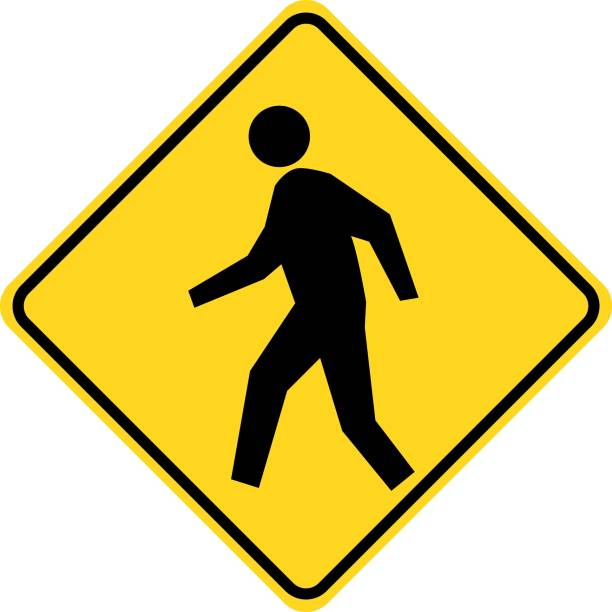
18. This sign means:
A. Pedestrians walking along the road ahead.
B. Pedestrian crossing ahead.
C. Pedestrians must not cross here.
19. When driving at night, you should:
A. Always use your high beams.
B. Look directly at the headlights of an oncoming vehicle.
C. Increase your following distance.
20. Increase your following distance when driving behind a large vehicle:
A. To better see around the sides of the vehicle.
B. Because other drivers tend to pull behind large vehicles before trying to pass them.
C. Because following too closely will get you caught in the vehicle's slipstream.
21. Arkansas law requires drivers to turn on their headlights when:
A. They are driving closely behind another vehicle.
B. Windshield wipers are in use.
C. They want to get somebody's attention.
22. If you approach a flashing red traffic light, you:

A. Are traveling in the wrong direction.
B. Must treat the intersection as if it is controlled by a stop sign.
C. May not proceed until it changes to green.
23. This sign indicates that the road ahead:
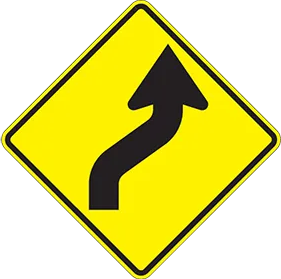
A. Turns sharply right, then left.
B. Curves right, then left.
C. Curves right.
24. Your license can be suspended if you are under 21 and drive with a blood alcohol level of:
A. 0.15 percent or more.
B. 0.08 percent or more.
C. Any amount.
25. When changing lanes, you should never:
A. Cross the centerline in an intersection.
B. Check your blind spots by looking over your left or right shoulder.
C. Check for other drivers moving into the same lane.