Dmv Permit Test 95

By Teacher David Global  •  Free

1. If the driver of an oncoming vehicle fails to dim their headlights:
A. Look toward the center of the roadway.
B. Look toward the right side of the road.
C. Look straight ahead.
2. If you are being followed too closely on a two-lane road:
A. Reduce your speed slowly to encourage the tailgater to drive around you.
B. Speed up to increase the distance between you and the other car.
C. Apply your brakes to slow down, then resume your original speed.
3. If you are continually being passed on the right and the left while driving in the center lane of an expressway, you should:
A. Stay in the center lane.
B. Move to the lane on your right.
C. Move to the lane on your left.
4. When a bicyclist is making a left turn:
A. They may use the left lane.
B. They may cut through all lanes.
C. They may wait on the side of the road.
5. The best way to avoid a dangerous situation while driving is to:
A. Know what is happening around your vehicle.
B. Turn off the radio.
C. Always keep your eyes focused ahead of your car.
6. If your wheels drop off the roadway or pavement edge, you should:
A. Wait until it is safe to do so, then gradually re-enter the roadway.
B. Turn back onto the roadway immediately.
C. Stop.
7. You want to turn left at an upcoming corner. Yield the right-of-way to:
A. Oncoming vehicles also turning left.
B. All approaching vehicles.
C. Pedestrians on the sidewalk waiting for a "Walk" signal.
8. When entering the interstate, check for a gap in traffic in the nearest lane, adjust your speed to match traffic, signal, and:
A. Expect traffic to allow you to proceed into the lane, since you have the right-of-way.
B. Merge carefully into the gap.
C. Wait for the lane to clear before merging.
9. A solid white line down the center of a road indicates that:
A. Lanes travel in opposite directions and drivers are permitted to pass.
B. Lanes travel in the same direction and drivers are permitted to pass.
C. Lanes travel in the same direction and drivers are not permitted to pass.
10. To avoid the need for last-minute braking or turning, consistently look down the road ____ ahead of your vehicle.
A. Three seconds
B. 10 seconds
C. 15 seconds
11. If the rear of your vehicle is skidding to the left, you should:
A. Not turn your steering wheel.
B. Turn your steering wheel to the left to correct the skid.
C. Turn your steering wheel to the right to correct the skid.
12. To avoid glare from the headlights of an approaching car:
A. Look briefly toward the right side of the road.
B. Stay focused on the centerline on the road.
C. Flash your high beams.
13. You should increase the distance between your vehicle and the vehicle ahead when you:
A. Are following a small passenger vehicle.
B. Are being tailgated by another driver.
C. Are driving more slowly than the posted speed limit.
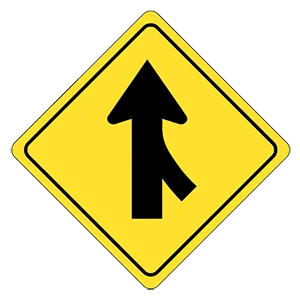
14. This sign means:
A. One-way traffic.
B. Intersection ahead.
C. Merging traffic from the right.
15. You are crossing an intersection and an emergency vehicle is approaching while using its siren and flashing lights. You should:
A. Stop immediately in the intersection until it passes.
B. Pull to the right of the intersection and stop.
C. Continue through the intersection, pull to the right, and stop.
16. When turning left from a two-way street onto a one-way street, you should:
A. Turn into any lane.
B. Turn into first lane.
C. Turn into second lane.
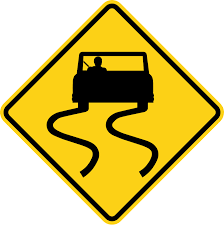
17. This road sign means:
A. Steep grade ahead.
B. The road ahead winds with a series of turns or curves.
C. Slippery when wet.
18. It is legal to make a left turn at a red traffic light after stopping only if:
A. You are traveling on a two-way street and turning onto a two-way street.
B. You are traveling on a one-way street and turning onto another one-way street.
C. You yield to all other traffic at the intersection.
19. If your car begins to skid out of control, you should:
A. Pump the brakes.
B. Apply the brakes lightly.
C. Stay off the brakes.
20. As you approach the top of a hill, you should:
A. Speed up slightly.
B. Prepare to stop, if needed.
C. Maintain a steady speed.
21. When stopping on snow or ice, drivers who are operating vehicles equipped with an Anti-Lock Braking System (ABS) should:
A. Pump the brakes.
B. Press and hold the brake pedal firmly.
C. Stay off the brakes and wait for the car to drift to a stop.
22. In traffic moving at 50 to 55 mph, you are least likely to have an accident if you:
A. Drive a few miles per hour faster than most other vehicles.
B. Stay within that speed range.
C. Drive a few miles per hour slower than most other vehicles.
23. A broken yellow centerline means that:
A. Passing is not permitted.
B. Passing on the right is permitted when the way ahead is clear.
C. Passing on the left is permitted when the way ahead is clear.
24. In inclement weather, you should:
A. Steer off the road.
B. Drive in a low gear.
C. Steer and brake smoothly.
25. Roads are slippery after it first starts to rain. When the road is slippery, you should:
A. Avoid making turns and stops while driving at high speeds.
B. Test your tires' traction while going uphill.
C. Decrease the distance you look ahead of your vehicle.