Dmv Permit Test 94

By Teacher David Global  •  Free

1. When you see a flashing yellow light at an intersection, you should:
A. Yield to all traffic before crossing the intersection.
B. Stop, then enter the intersection when it is safe to do so.
C. Slow down and cross the intersection carefully.
2. If you can see that the roadway up ahead is covered by heavy smoke, you should:
A. Turn on your four-way flashers and continue.
B. Reduce your speed, move as far to the right as possible, and stop off the roadway.
C. Turn on your high beam headlights and continue.
3. When passing, you should move back into the right lane when:
A. You are one vehicle length ahead of the passed vehicle.
B. You can see both headlights of the passed vehicle in your rearview mirror.
C. You are 50 feet ahead of the passed vehicle.
4. If you are about to be hit from the rear, you should not:
A. Release your seat belt.
B. Brace yourself.
C. Press your head against the head restraint.
5. If a child is about to run into the street, you should:
A. Start to prepare to slow down.
B. Flash your headlights.
C. Sound a sharp blast of your horn.
6. If you park facing uphill on a street with a curb, set the parking brake and:
A. Turn the front wheels toward the curb.
B. Turn the front wheels away from the curb.
C. Leave the front wheels straight.
7. If you find yourself in a skid:
A. Brake lightly.
B. Stay off the brakes.
C. Brake abruptly.
8. You are approaching an intersection where a traffic signal is displaying a steady yellow light. If you have not already entered the intersection, you should:
A. Speed up to beat the red light.
B. Reduce you speed and proceed carefully through the intersection.
C. Come to a safe stop.
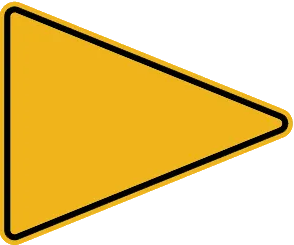
9. A sign with this shape means:
A. No passing zone.
B. Right turn permitted on red.
C. Yield right-of-way.
10. If you miss your exit on the freeway, you should not:
A. Continue on the freeway and find an alternate route to your destination.
B. Proceed to the next exit, leave the freeway, and return to your proper exit.
C. Back up on the road or shoulder.
11. When a school bus is picking up or dropping off children, you must:
A. Stop, regardless of your direction of travel.
B. Stop if you are driving in the same direction.
C. Slow down and be prepared to stop.
12. A dashed white line down the center of a two-lane road indicates that:
A. Lanes travel in opposite directions and drivers are permitted to pass.
B. Lanes travel in the same direction and drivers are permitted to pass.
C. Lanes travel in opposite directions and drivers are not permitted to pass.
13. When driving at night on a dimly lit street, you should:
A. Drive slowly enough that you can stop within the area illuminated by your headlights.
B. Turn on your high beam headlights to better see the vehicles ahead of you.
C. Keep the instrument panel lights bright to be more visible to other drivers.
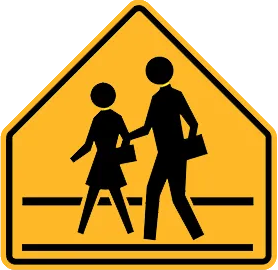
14. This yellow warning sign means:
A. You are approaching a school or school crosswalk.
B. Slow down, drive with caution, and watch for children.
C. Both of the above.
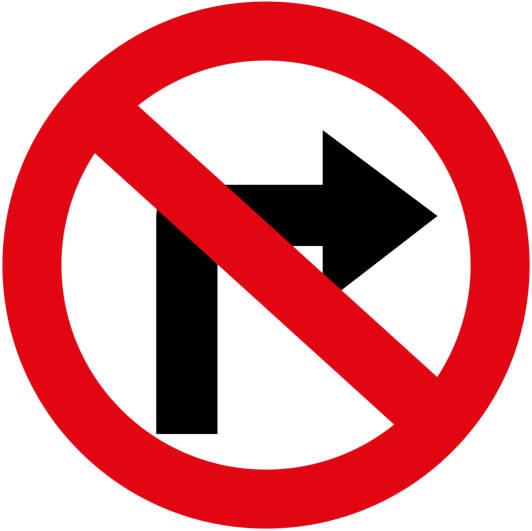
15. This sign means:
A. No right turn.
B. Stop sign ahead.
C. Divided highway.
16. When crossing a sidewalk to enter traffic from an alley or driveway, drivers should:
A. Stop only if pedestrians are on the sidewalk.
B. Stop before driving onto the sidewalk or sidewalk area.
C. Expect pedestrians on the sidewalk to yield the right-of-way.
17. Highway pavement will be particularly treacherous and most slippery:
A. If it has been raining several hours.
B. If it has just begun to rain.
C. If it has been raining for one to two hours.
18. When arriving to an uncontrolled intersection at the same time as vehicles to your right and left, you should:
A. Yield the right-of-way to the vehicle on your left.
B. Yield the right-of-way to the vehicle on your right.
C. Wait until there are no vehicles at the intersection before proceeding.
19. If you park facing uphill where there is no curb, set the parking brake and:
A. Turn your wheels toward the edge of the road.
B. Turn your wheels away from the edge of the road.
C. Keep your wheels facing straight.
20. To avoid injury from an airbag, a driver should sit ____ inches away from the steering wheel.
A. 20
B. 15
C. 10
21. There are two traffic lanes moving in your direction. You are driving in the left lane and many vehicles are passing you on the right. If the driver behind you wishes to drive faster, you should:
A. Stay in your lane so you don't impede the flow of traffic.
B. Drive onto the left shoulder to let the other vehicles pass.
C. Move into the right lane when it is safe.
22. You reach an intersection with stop signs on all four corners at the same time as the driver on your left. Who has the right-of-way?
A. The driver on your left has the right-of-way.
B. You have the right-of-way.
C. Whoever is signaling to make a turn has the right-of-way.
23. If you plan to pass another vehicle, you should:
A. Not assume the other driver will make space for you to return to your lane.
B. Assume the other driver will let you pass if you use your turn signal.
C. Assume the other driver will maintain a constant speed.
24. A broken yellow centerline indicates that:
A. Passing is not permitted.
B. Passing on the right is permitted when the way ahead is clear.
C. Passing on the left is permitted when the way ahead is clear.
25. If you are facing a green traffic light but the intersection ahead is blocked by traffic, you should:
A. Turn left and find another route.
B. Stay out of the intersection until traffic clears.
C. Follow the other vehicles and enter the intersection.