Dmv Permit Test 93

By Teacher David Global  •  Free

1. You should always travel:
A. At the speed of vehicles surrounding you.
B. At the speed limit.
C. At a speed appropriate for road and weather conditions.
2. It is illegal for a person 21 years of age or older to drive with a minimum blood alcohol concentration (BAC) of:
A. 0.05 percent.
B. 0.08 percent.
C. 0.02 percent.
3. You drive defensively when you:
A. Put one car length between you and the car ahead.
B. Look only at the car in front of you while driving.
C. Keep your eyes moving to look for possible hazards.
4. Which of these statements is true about roadwork zones?
A. Fines are the same for violations committed in work zones as they are under normal traffic conditions.
B. You must "Slow for the Cone Zone."
C. Slow down only if you think workers are present.
5. Give the right-of-way to any pedestrian who is:
A. In a marked crosswalk.
B. In any crosswalk or intersection.
C. Crossing any street.
6. If you approach a traffic light with a red signal and a police officer directs you to go through the intersection without stopping, you should:
A. Stop until the light turns green.
B. Go through the intersection without stopping.
C. Come to a complete stop before proceeding.
7. When parallel parking, you should park within ____ inches of the curb.
A. Six
B. 12
C. 18
8. If you parallel park facing downward on a hill:
A. Turn your wheels sharply toward the side of the road.
B. Turn your wheels away from the side of the road.
C. Keep your wheels straight.
9. Regulatory signs are:
A. Green.
B. Yellow.
C. White.
10. When preparing to make a left turn from a two-way street, you should drive:
A. Near the right-hand side of the road.
B. Near the centerline.
C. On the left of the centerline.
11. To be able to turn quickly, your hands must be:
A. On opposite sides of the steering wheel.
B. Next to each other on the top of the steering wheel.
C. On the top and bottom of the steering wheel.
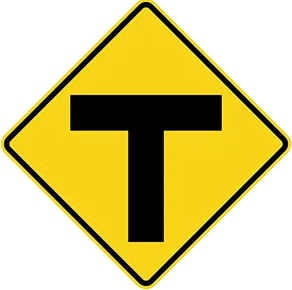
12. This sign shows one type of:
A. Right turn.
B. Intersection.
C. Lane change.
13. At intersections, crosswalks, and railroad crossings, you should always:
A. Stop, listen, and proceed cautiously.
B. Look to the sides of your vehicle to see what is coming.
C. Slowly pass vehicles that seem to be stopped for no reason.
14. Make room for cars that are entering the freeway by:
A. Slowing down.
B. Merging into a different lane.
C. Maintaining your speed and position.
15. If you have trouble seeing other vehicles because of dust or smoke blowing across the roadway, you should drive more slowly and turn on your:
A. Emergency flashers.
B. Parking lights.
C. Headlights.
16. This red and white sign means you should:
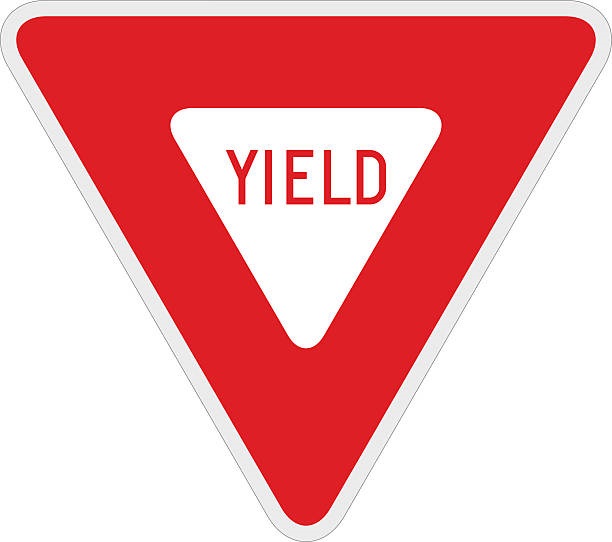
A. Stop and check for traffic coming from both directions before proceeding.
B. Give the right-of-way to traffic on the road you wish to enter or cross.
C. Maintain a steady speed and check for traffic coming from all directions.
17. At intersections with a "Yield" sign, you must:
A. Yield the right-of-way to cross traffic that is near enough to cause conflict.
B. Yield the right-of-way only to vehicles on your right.
C. Always slow down and proceed without stopping.
18. When should you yield your legal right-of-way?
A. Often, even at controlled intersections.
B. Whenever it helps prevent collisions.
C. Never. It confuses other drivers.
19. When you are merging onto the freeway, you should be driving:
A. At or near the speed of traffic on the freeway.
B. Five to 10 mph slower than the speed of traffic on the freeway.
C. The posted speed limit for freeway traffic.
20. You want to park uphill on a two-way road and there is no curb. Which direction do you turn your front wheels?
A. Straight ahead
B. Right, toward the side of the road
C. Left, toward the center of the road
21. When passing another vehicle, you should return to your original lane when:
A. You can see both headlights of the passed vehicle in your rearview mirror.
B. You have cleared the front bumper of the passed vehicle.
C. You are 50 feet in front of the passed vehicle.
22. Having a driver license is a:
A. Right, not a privilege.
B. Privilege, not a right.
C. Requirement.
23. A vehicle suddenly cuts in front of you, creating a hazard. What should you do first?
A. Honk and step on the brake firmly.
B. Take your foot off the gas pedal.
C. Swerve into the lane next to you.
24. Broken yellow lines are used on streets and highways to:
A. Indicate no passing zones.
B. Separate lanes of traffic moving in the same direction.
C. Separate lanes of traffic moving in opposite directions.
25. If you are about to be hit from the rear, you should consider each of the following, except for:
A. Applying your brakes.
B. Letting go of the steering wheel.
C. Pressing your head firmly against the head restraint.