Dmv Permit Test 92

By Teacher David Global  •  Free

1. You hit a parked vehicle and can't find the owner. What must you do?
A. Call your insurance company when you get home.
B. Wait for the owner to return.
C. Leave a note with your name and address on the parked vehicle.
2. When approaching a flashing yellow traffic light, drivers should:
A. Treat the light like a stop sign.
B. Wait until the light turns green to proceed.
C. Slow down and proceed with caution through the intersection.
3. When adjusting your rearview mirror, you should be able to clearly see:
A. The entire rear window.
B. The passengers in the backseat.
C. Your own reflection.
4. You are driving behind a motorcycle and want to pass. You must:
A. Stay in the right lane as much as possible because the motorcycle is small and doesn't use all of the lane.
B. Blow your horn to make the motorcycle move onto the shoulder so that you can pass.
C. Have your vehicle entirely in the left lane before and during the pass.
5. When changing lanes, you should never:
A. Look over your shoulder to check your blind spot.
B. Change lanes abruptly or spontaneously.
C. Check for other vehicles moving into the same lane.
6. Which of the following describes the thinking of defensive drivers?
A. They know other drivers will do the right thing.
B. They consider what other drivers might do and are prepared to react.
C. They expect no breaks and give none.
7. What is a potential effect of taking a prescription drug while drinking alcohol?
A. There will likely be no effect.
B. It will make you more alert.
C. It can make you unfit to drive.
8. You may cross double yellow lines to pass another vehicle if the:
A. Vehicle in front of you moves to the right to let you pass.
B. Yellow line next to your side of the road is broken.
C. Yellow line next to the opposite side of the road is broken.
9. Always stop before crossing railroad tracks when:
A. There isn't room on the other side for you to completely cross the tracks.
B. The railroad crossing is located in a city or town that has frequent train traffic.
C. You are transporting two or more young children in a passenger vehicle.
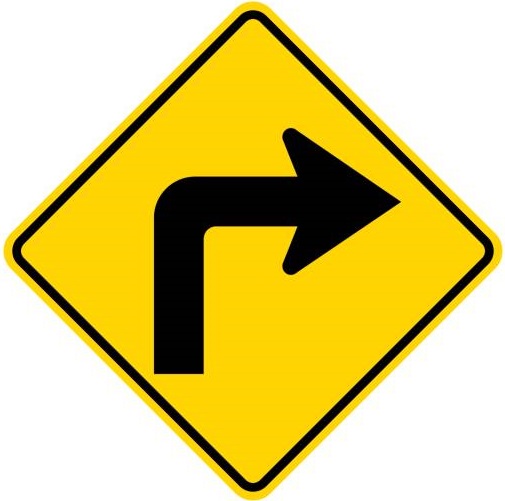
10. This yellow sign means:
A. There is a sharp turn to the right.
B. The lane must turn right.
C. A right turn is permitted on a green arrow only.
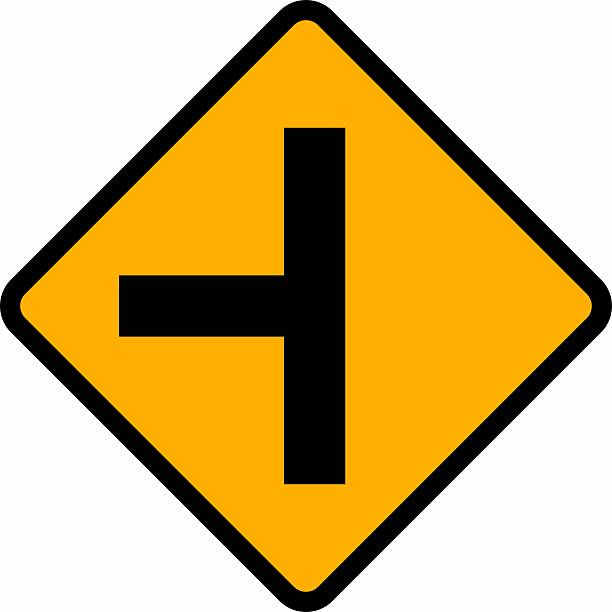
11. This sign means:
A. Side road.
B. Merge.
C. Yield the right-of-way.
12. To see objects in their blind spot when changing lanes, drivers should check:
A. Only the left outside mirror.
B. Over their left or right shoulder.
C. Only the inside rearview mirror.
13. You are approaching an intersection at the posted speed limit when the signal turns yellow. You should:
A. Slow down and proceed through the intersection without caution.
B. Speed up to cross the intersection before the light turns red.
C. Stop before entering the intersection, if you can do so safely.
14. When you are facing a green light and there are pedestrians in the intersection:
A. You must yield the right-of-way to pedestrians.
B. You have the right-of-way over pedestrians.
C. Pedestrians must wait for you to cross.
15. If a truck or bus is making a right turn where you also need to make a right turn, you should:
A. Quickly turn before the truck or bus is able to.
B. Wait until the truck or bus turns before you turn.
C. Squeeze between the truck or bus and the curb.
16. A broken yellow line beside a solid yellow line indicates that:
A. Passing is permitted from the lane next to the solid yellow line.
B. Passing is not permitted from either direction.
C. Passing is permitted from the lane next to the broken yellow line.
17. Drivers turning left must yield to:
A. Oncoming vehicles traveling straight or turning right.
B. Passing cars.
C. No one in particular.
18. If you are driving near a large commercial vehicle, you should:
A. Follow the large vehicle closely to reduce wind drag on your vehicle.
B. Avoid driving beside it for long stretches of time.
C. Drive on its right side when on curves and hills.
19. While driving at night, a vehicle coming toward you has its high beams on, making it hard for you to see the road ahead. You should:
A. Look ahead toward the left edge of your lane.
B. Look ahead toward the right edge of your lane.
C. Look straight ahead in your lane.
20. If your car's suspension is bad, it can cause:
A. Vehicle control problems.
B. Squealing brakes.
C. Slack in the steering.
21. If you are feeling fatigued while driving, you should:
A. Increase your speed to reach your destination more quickly.
B. Increase the volume of your radio.
C. Find a safe parking area to take a short nap.
22. If you want to pass a pedestrian who is walking along the roadway and an oncoming vehicle is approaching, you should:
A. Slow down and let the oncoming vehicle pass before you pass the pedestrian.
B. Keep driving at a steady speed. The oncoming vehicle must stop for you.
C. Honk your horn to get the pedestrian to move over.
23. You have stopped for a train at a railroad crossing. After the train passes, you should:
A. Wait for signal lights to stop flashing.
B. Look for a second train.
C. Both of the above.
24. Drivers may pass another vehicle by using the shoulder of a road:
A. When the shoulder is paved.
B. When the other vehicle is waiting to turn left.
C. Under no circumstances.
25. You are involved in a minor collision at an intersection. There are no injuries and there is very little vehicle damage. You should:
A. Leave your vehicle in the traffic lane until law enforcement arrives.
B. Move your vehicle out of the traffic lane, if possible.
C. Not move your vehicle for any reason.