Dmv Permit Test 91

By Teacher David Global  •  Free

1. When taking any medicine, you should:
A. Consult your doctor about the effects before driving.
B. Have someone follow you home.
C. Keep your window open and drive more slowly.
2. This sign is used to warn drivers that:
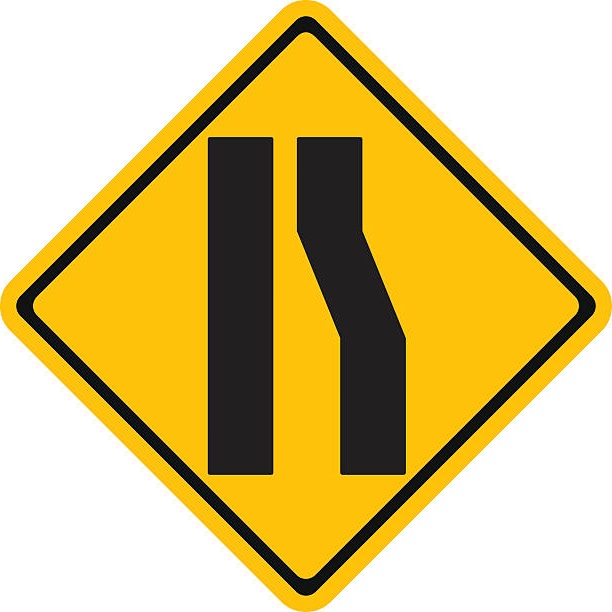
A. The right lane is ending and traffic should merge left.
B. The road curves ahead.
C. There are upcoming intersections.
3. Which of these statements is true about changing lanes?
A. You only need to turn and look over your right shoulder for lane changes to the right or left.
B. Look over your right shoulder for a right lane change and your left shoulder for a left lane change.
C. Vehicles with two outside mirrors do not have blind spots.
4. When driving in work zones, you should:
A. Increase your speed to get through the zone as quickly as possible.
B. Reduce your speed and be prepared to stop suddenly.
C. Maintain your normal speed the whole way through the zone.
5. When driving on a slippery surface, such as snow or ice:
A. Shift to a low gear before going down steep hills.
B. Maintain traction by following other vehicles closely.
C. Pump your brakes to keep them from freezing.
6. Before you change lanes, you should check your mirrors and:
A. Never look over your right shoulder.
B. Always slow down in your traffic lane.
C. Glance over your shoulder.
7. Double solid yellow lane markings mean that:
A. Neither lane may pass.
B. Both lanes may pass.
C. The lane to the right may pass.
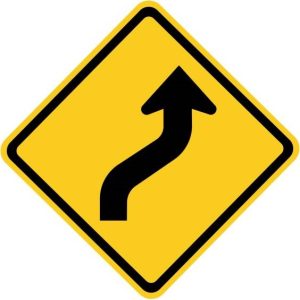
8. This road sign means:
A. Road construction ahead.
B. The road ahead curves left then right.
C. The road ahead curves right then left.
9. You are driving on the freeway. The vehicle in front of you is a large truck. You should drive:
A. Closely behind the truck in bad weather because the driver can see farther ahead than you can.
B. Farther behind the truck than you would when following a passenger vehicle.
C. No more than one car length behind the truck so the driver can see you.
10. Remove all snow, frost, and ice from:
A. Just the windshield.
B. All windows.
C. Just the windshield and passenger window.
11. A solid yellow line on your side of the centerline means:
A. Reduce your speed.
B. Traffic light ahead.
C. Do not pass.
12. It is more dangerous to drive at night than during the day because:
A. You cannot see as far ahead at night.
B. The road is always more slippery at night.
C. Your reaction time is slower at night.
13. Any amount of alcohol in the blood may affect a driver's:
A. Right-of-way privileges.
B. Judgment and physical coordination.
C. Knowledge.
14. Trucks' blind spots are:
A. Directly behind the body.
B. On the immediate left of the cab.
C. Both on the immediate left of the cab and directly behind the body.
15. As you approach an intersection with a flashing yellow light:
A. Stop before crossing the intersection.
B. Slow down and proceed with caution.
C. Wait for a green light before proceeding.
16. When parking next to a curb, you should use your turn signals:
A. Only when pulling away from the curb.
B. When pulling next to, but not away from, the curb.
C. When pulling next to or away from the curb.
17. When driving at night, you should:
A. Always use your high beams.
B. Look directly at the headlights of an oncoming vehicle.
C. Increase your following distance.
18. The center of the roadway is marked with one solid yellow line and one broken yellow line. If the broken yellow line is directly next to your traffic lane, it means:
A. You are not allowed to pass in this area.
B. You are in a passing zone and it is safe for you to pass other vehicles on the left if no oncoming traffic is present.
C. You are only allowed to make right turns in this area.
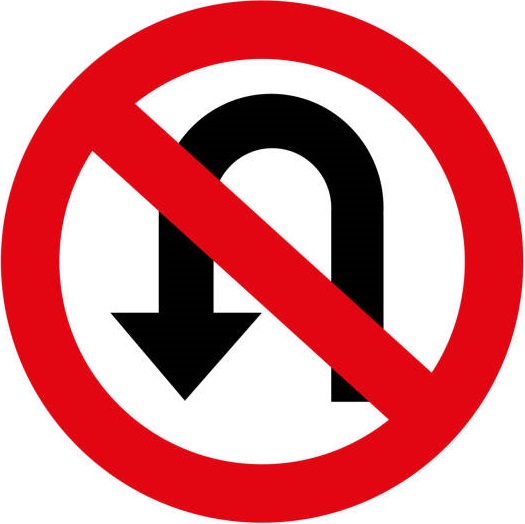
19. This road sign means:
A. Do not enter.
B. No parking.
C. No U-turn.
20. Vehicles stopped behind a school bus with its red lights flashing must remain stopped until:
A. All students are off the bus.
B. The stop arm is retracted.
C. The stop arm is retracted and the bus resumes motion.
21. Before stopping your vehicle at a traffic signal or sign, you should:
A. Press down hard on the accelerator.
B. Check your mirrors for surrounding traffic.
C. Set the parking brake.
22. To enter a gap in highway traffic:
A. Watch only the vehicles behind the gap.
B. Check behind you, then watch the vehicle ahead.
C. Speed up and let the other vehicles make way.
23. A curb painted red means:
A. Loading zone.
B. The area is reserved for picking up or dropping off passengers.
C. No parking, standing, or stopping.
24. Which of the following statements is correct?
A. Use your left foot to brake.
B. Use your right foot for both braking and accelerating your vehicle.
C. You should always brake abruptly to ensure stopping.
25. When double solid yellow lines separate lanes of traffic:
A. Passing is permitted from the left.
B. Passing is permitted from the right.
C. Passing is not permitted from either direction.