Dmv Permit Test 74

By Teacher David Global  •  Free

1. Temporary signs used in construction and maintenance work areas:
A. Have a red background with green writing.
B. Have an orange background with black writing.
C. Have a yellow background with blue writing.
2. When driving in fog, it is best to drive with:
A. High beam headlights.
B. Low beam headlights.
C. Four-way flashers.
3. When crossing a sidewalk while entering or exiting a driveway, drivers:
A. Have the right-of-way.
B. Should yield to pedestrians.
C. Should honk at pedestrians to get them to clear a path.
4. Handicap parking spaces are available:
A. To anyone, but only if all other spaces are occupied.
B. Only to drivers with the appropriate license plate or hanging tag.
C. To people who are not feeling well.
5. To improve visibility lowered by rain or fog, drivers should use their:
A. Low beam headlights.
B. High beam headlights.
C. Parking lights.
6. A driver should:
A. Stare directly in front of their car.
B. Only focus on the middle of the road.
C. Watch beside, ahead, and to the rear of their car.
7. If you have had several beers, the effects of alcohol will be reduced only by:
A. Taking a cold shower.
B. Waiting several hours.
C. Drinking several cups of coffee.
8. A school bus is stopped ahead of you in your lane with its red lights flashing. You should:
A. Stop and proceed when you think all of the children have exited the bus.
B. Slow to 25 mph and pass cautiously.
C. Stop for as long as the red lights are flashing.
9. Changing from one lane to another is best done:
A. Quickly and often.
B. When a car is in your blind spot.
C. Gradually and carefully.
10. What should you do when an emergency vehicle is approaching you while displaying flashing red or blue lights?
A. Pull to the right side of the road and come to a complete stop.
B. Continue driving, but stay out of its way.
C. Try to reach your destination before the emergency vehicle catches up to you.
11. As the percentage of alcohol (BAC) in your blood increases, you become:
A. More intoxicated.
B. More sober.
C. More coordinated.
12. If a vehicle is equipped with airbags:
A. Seat belts should still be worn.
B. Seat belts do not need to be worn.
C. Seat belts should be worn behind the back.
13. If you become drowsy while driving, you should:
A. Try to fight it.
B. Take a break.
C. Take some caffeine pills.
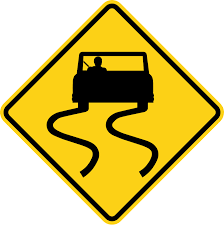
14. This yellow signs means:
A. The road ahead has many curves.
B. There is a sharp curve in the road ahead.
C. The road ahead may be slippery.
15. If a traffic signal light is green and a police officer signals for you to stop, you should:
A. Obey the officer.
B. Obey the traffic signal.
C. Do what the vehicle in front of you does.
16. This sign means:
A. There is a 35 mph speed zone after the curve ahead.
B. Drive no slower than 35 mph around the upcoming curve.
C. Approach the upcoming curve at a speed of 35 mph or slower.
17. You are driving on the freeway behind a large truck. You should drive:
A. Closer behind the truck than you would if following a passenger vehicle.
B. Farther behind the truck than you would if following a passenger vehicle.
C. To the right side of the truck and wait to pass.
18. A steady green traffic light at an intersection means:
A. Increase your speed.
B. Adjust your mirrors.
C. You may continue through the intersection at a safe and reasonable speed, if it is clear to do so.
19. If it is necessary to make an emergency stop while driving on an interstate, you should:
A. Sound your horn at passing cars to get their attention.
B. Get out of your vehicle and flag down the first vehicle that passes.
C. Pull off the road, turn on your emergency flashers, and stay in your vehicle, if you can
20. What is a crosswalk?
A. Another name for a four-way intersection.
B. An area designated for road construction workers.
C. The area where pedestrians may cross the roadway.
21. A solid yellow arrow on a traffic signal means:
A. You should speed up so you can make the turn before the light changes.
B. You do not need to signal to turn from the indicated lane.
C. You should prepare to stop and yield the right-of-way to oncoming traffic.
22. You should not make sudden stops in front of large trucks and buses because:
A. Small vehicle drivers cannot adequately see large trucks and buses in their rearview mirrors.
B. Large trucks and buses, due to their size and weight, require longer distances to stop than smaller passenger vehicles.
C. Large trucks and buses travel at a higher speeds than small vehicles.
23. Which of the following are factors commonly contributing to traffic crashes?
A. Exceeding the posted speed limit and driving too fast for conditions or circumstances.
B. Getting adequate rest and staying alert.
C. Scanning the environment and staying focused on the driving task.
24. What can you do to reduce road rage?
A. Always signal your intention when changing lanes.
B. Talk on your cell phone while driving.
C. Use your horn frequently.
25. Reaction time is slower after:
A. Drinking alcohol.
B. Sleeping.
C. Working hard.