Dmv Permit Test 90

By Teacher David Global  •  Free

1. You are approaching a green traffic light and traffic is blocking the intersection. What is the best thing to do?
A. Partially enter the intersection to establish your right-of-way.
B. Don't enter the intersection until you can get completely across.
C. Continue into the intersection and wait for traffic to clear.
2. Should you always drive more slowly than other traffic?
A. No, you can block traffic when you drive too slowly.
B. Yes, it is a good defensive driving technique.
C. Yes, it is always safer than driving faster than other traffic.
3. To help others see you when daylight begins to fade, you should use your:
A. Parking lights.
B. Low beam headlights.
C. Emergency flashers.
4. A broken yellow line beside a solid yellow line indicates that passing is:
A. Permitted from the side next to the solid yellow line.
B. Not permitted from either direction.
C. Permitted from the side next to the broken yellow line.
5. At a red traffic light with a green arrow, you may proceed in the direction of the arrow if:
A. You first come to a complete stop.
B. You wait until the light changes.
C. You are in the proper lane and the roadway is clear.
6. When you drive through a construction zone, you should:
A. Stop to watch the workers.
B. Decrease your following distance.
C. Pass the construction zone carefully and not “rubberneck."
7. When changing lanes:
A. Rely on the rearview mirror.
B. Look over your shoulder in the direction you plan to move.
C. Rely on the left side mirror.
8. You have allowed the wheels of your vehicle to run off the edge of the pavement. What should you do first?
A. Turn the front wheels slightly to the left to edge the car back onto the pavement.
B. Hold the steering wheel firmly, release the gas pedal, and gently apply the brakes.
C. Apply the brakes and turn the front wheels sharply to the left.
9. When driving in fog, rain, or snow, use:
A. Low beams.
B. High beams.
C. Fog lights only.
10. The amount of alcohol in the blood is referred to as:
A. Implied consent (IC).
B. Blood alcohol concentration (BAC).
C. Rate of alcohol consumption (RAC).
11. Continuous hard braking on ice and snow often:
A. Helps you stop faster.
B. Locks the front wheels of a vehicle, causing a loss of steering.
C. Keeps the brakes from freezing.
12. Which of these statements is true about large trucks?
A. They take longer to stop than passenger vehicles.
B. They all have air brakes that allow them to stop quickly.
C. They are more maneuverable than passenger vehicles.
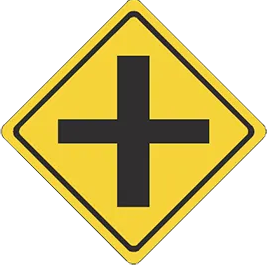
13. This sign means:
A. Crossroad ahead.
B. Merge.
C. Stop.
14. "No zones" are areas around trucks where cars:
A. Disappear into blind spots or are so close that they restrict the truck driver's ability to stop and maneuver safely.
B. Have sufficient space to travel behind the truck.
C. Have several car lengths between their vehicle and the truck.
15. When driving on gravel or dirt roads:
A. Your tires grip the road better than when you are driving on pavement.
B. Your tires do not have as much traction as they do on pavement, so you must slow down.
C. Visibility is better than on pavement.
16. You are on the freeway and traffic is merging into your lane. You should:
A. Make room for the merging traffic, if possible.
B. Assert your right-of-way by driving faster.
C. Always maintain your position.
17. Stopping distances and severity of crashes:
A. Decrease as vehicle speed increases.
B. Are not affected by vehicle speed.
C. Increase as vehicle speed increases.
18. Stopping distances and the severity of collisions:
A. Decrease as a vehicle's speed increases.
B. Are not affected by a vehicle's speed.
C. Increase as a vehicle's speed increases.
19. Which of the following statements about blind spots is true?
A. Blind spots are eliminated if you have one outside mirror.
B. Large trucks have bigger blind spots than most passenger vehicles.
C. Blind spots can be checked by looking in your rearview mirror.
20. The driver ahead of you stops at a crosswalk. What should you do?
A. Cautiously pass the vehicle at 10 mph or slower.
B. Stop, proceeding only when all the pedestrians have crossed.
C. Change lanes, look carefully, and pass the stopped vehicle.
21. This sign shows one type of:
A. Intersection.
B. Road curve.
C. Right turn.
22. If you find that the roadway ahead of you is flooded, you should:
A. Slam on the brakes.
B. Not drive through the flooded area. Turn around and find another route.
C. Drive only in the center of the roadway.
23. Which of these is a safe driving technique?
A. Using your high beam lights in the fog.
B. Staring at the road ahead of your vehicle.
C. Checking your rearview mirrors frequently.
24. What should a driver do when approaching a traffic control signal that is not in operation?
A. Come to a full stop and yield the right-of-way before entering the intersection.
B. If the intersection is clear, the driver does not need to stop.
C. Drive quickly through the intersection to get out of the way of other vehicles.
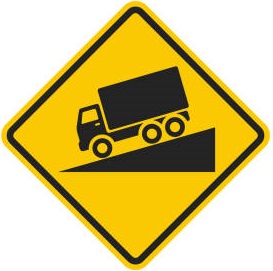
25. This sign means:
A. Upcoming downgrade or hill.
B. Road construction area.
C. Upcoming narrowing of roadway.