Dmv Permit Test 89

By Teacher David Global  •  Free

1. If you experience a tire blowout:
A. Tap or pump the brakes.
B. Slow down gradually and use your brakes lightly.
C. Apply the brakes firmly and quickly.
2. Blue traffic signs offer information on:
A. Motorist services.
B. Construction and maintenance.
C. Mileage information, such as distances to specific locations.
3. Roads with double solid yellow line markings down the center indicate that passing is:
A. Allowed from both directions.
B. Allowed only from your direction of travel.
C. Not allowed from either direction.
4. To improve visibility lowered by rain or fog, drivers should use their:
A. Low beam headlights.
B. High beam headlights.
C. Parking lights.
5. A broken yellow line between two lanes of traffic means:
A. Both lanes of traffic are going in the same direction.
B. Passing is permitted when it's safe.
C. Passing is not permitted.
6. When driving on the highway, consistently looking far ahead of your vehicle:
A. Helps you keep up with traffic.
B. Reduces the need for last-minute braking or turning.
C. Allows you to spot upcoming police officers.
7. Slowing down just to look at collisions or anything else out-of-the-ordinary:
A. Causes traffic congestion.
B. Prevents rear-end collisions.
C. Improves traffic flow by preventing collisions.
8. If your car becomes disabled while on the highway, you should:
A. Stop in the right lane.
B. Park with all four wheels off the traveled highway, if possible.
C. Stop where you are.
9. Check your rearview mirrors:
A. Often to see how traffic is moving behind you.
B. To see if a vehicle is in your blind spot.
C. Only when you are slowing down.
10. You enter a designated turn lane to make a left turn at an upcoming intersection. There is oncoming traffic. You should:
A. Move to the left of the center lane.
B. Signal before you arrive at the intersection.
C. Turn your front wheels to the left to be prepared to turn.
11. It is dangerous to follow a motorcycle too closely because:
A. They do not follow the same rules as motor vehicles.
B. A motorcycle can stop much faster than a standard vehicle.
C. They brake more slowly than motor vehicles.
12. If you are being followed too closely on a multilane highway, you should:
A. Speed up to match the speed of the car behind you.
B. Move into the lane to your right and let the other car pass.
C. Slow down to antagonize the driver.
13. At dawn or dusk and in rain or snow, it can be hard to see and be seen. A good way to let other drivers know you are there is to turn:
A. Up the instrumental panel lights.
B. On your parking lights.
C. On your headlights.
14. When backing up:
A. Look through the rear window.
B. Press hard on the gas pedal.
C. Rely only on your rearview mirror.
15. When you are behind a motorcycle, you should:
A. Be ready to use your horn.
B. Drive more slowly.
C. Allow a larger following distance.
16. A broken yellow line down the center of a road indicates that:
A. A construction zone is ahead.
B. Passing is not permitted from either direction.
C. Passing is permitted from either direction.
17. When changing lanes, you can check your blind spot by:
A. Using the inside rearview mirror.
B. Turning your head and looking over your shoulder.
C. Using your side mirror.
18. You are driving on a one-way street. You may only turn left onto another one-way street if:
A. You increase your speed before the turn.
B. Traffic on the street moves to the right.
C. Traffic on the street moves to the left.
19. In rainy weather, you should be most careful when turning or stopping:
A. After it has been raining all day.
B. One half hour after it stops raining.
C. During the first half hour of rain.
20. To see vehicles in your blind spots, you should check:
A. The inside rearview mirror.
B. The outside rearview mirror.
C. Over your shoulders.
21. Motorcycles, scooters, and mopeds are not easy to see; therefore, you should:
A. Slow down when driving.
B. Make constant visual checks.
C. Share a lane with a motorcycle.
22. You should allow an extra cushion of space:
A. When following a station wagon.
B. When following a driver who cannot see the rear of their vehicle.
C. When following a small passenger car.
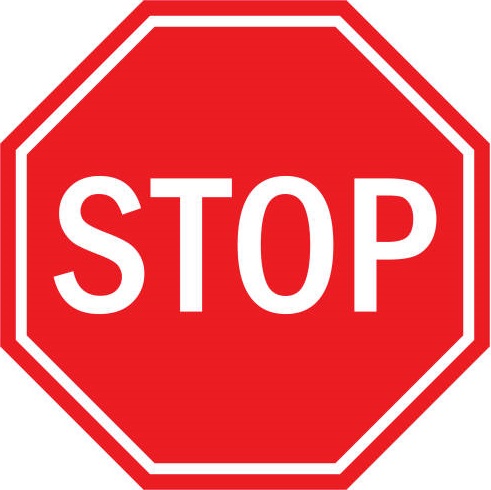
23. This road sign means:
A. Slow down or stop.
B. Stop if necessary.
C. You must come to a complete stop.
24. To pass on a two-lane road, you should:
A. Sound your horn as you pass.
B. Flash your headlights as you pass.
C. Judge the distance to any oncoming vehicles.
25. If a tire blows out, you should:
A. Apply the brake and hold it.
B. Hold the steering wheel tightly and use the brakes lightly.
C. Pull over quickly.