Dmv Permit Test 85

By Teacher David Global  •  Free

1. Remove all snow, frost, and ice from:
A. Just the windshield.
B. All windows.
C. Just the windshield and passenger window.
2. To avoid traction loss on wet roads, you should:
A. Make abrupt turns.
B. Apply the brakes firmly.
C. Slow down.
3. To know where traffic is behind you:
A. Frequently check your rearview mirror.
B. Turn and look out your back window.
C. Keep other vehicles out of your blind spots.
4. Allow extra space in front of your vehicle when following a:
A. Station wagon.
B. Passenger vehicle.
C. Motorcycle.
5. If weather or light conditions require you to have your lights on while driving:
A. Use your parking lights.
B. Use your high beams.
C. Use your low beams.
6. If a child is riding a bicycle near your vehicle:
A. Beep your horn.
B. Expect the child to be in total control of the bicycle.
C. Expect the unexpected.
7. You must show proof of insurance to law enforcement:
A. Only if you are involved in a collision.
B. If you are involved in a collision or stopped for a citation.
C. Only if you are stopped and cited.
8. You are involved in a minor collision at an intersection. There are no injuries and there is very little vehicle damage. You should:
A. Leave your vehicle in the traffic lane until law enforcement arrives.
B. Move your vehicle out of the traffic lane, if possible.
C. Not move your vehicle for any reason.
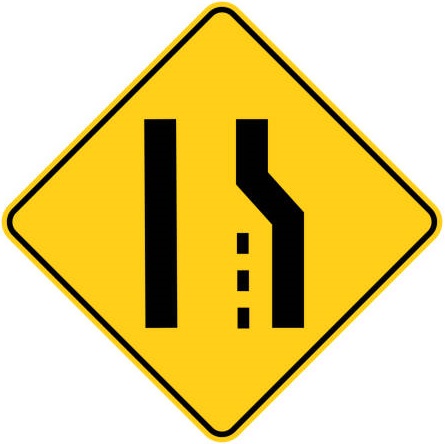
9. This road sign means:
A. Highway entrance ramp.
B. Road widens.
C. Right lane ends.
10. When approaching an intersection controlled by a flashing yellow light, you must:
A. Come to a complete stop at the intersection.
B. Maintain your normal speed.
C. Slow down and proceed with caution.
11. A curb painted red means:
A. Loading zone.
B. The area is reserved for picking up or dropping off passengers.
C. No parking, standing, or stopping.
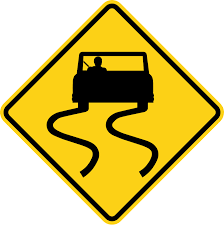
12. This road sign means:
A. When pavement is wet, reduce your speed.
B. The road ahead winds in a series of turns or curves.
C. Traffic increases ahead.
13. Which of these is a safe driving technique?
A. Using your high beam lights in the fog.
B. Staring at the road ahead of your vehicle.
C. Checking your rearview mirrors frequently.
14. A red arrow pointing to the right on a traffic light means you may:
A. Turn in that direction after slowing and checking for traffic.
B. Not turn in that direction until the light turns green.
C. Turn in that direction after you come to a complete stop.
15. When driving on a slippery surface, such as snow or ice:
A. Shift to a low gear before going down steep hills.
B. Maintain traction by following other vehicles closely.
C. Pump your brakes to keep them from freezing.
16. You are driving on a city street and see an emergency vehicle with flashing lights behind you. What should you do?
A. Drive to the right edge of the road and slow down.
B. Drive to the right edge of the road and stop.
C. Stay in your lane, slow down, and let it pass.
17. Stopping distances and the severity of collisions:
A. Decrease as a vehicle's speed increases.
B. Are not affected by a vehicle's speed.
C. Increase as a vehicle's speed increases.
18. You can drive off the road to pass another vehicle:
A. If the vehicle ahead is turning left.
B. If there are two or more lanes traveling in your direction.
C. Under no circumstances.
19. As your speed increases, it is important to:
A. Turn on your headlights.
B. Look well ahead of your vehicle.
C. Change lanes frequently.
20. Which of the following statements about driving speed is true?
A. As your speed increases, the chance of a fatality increases.
B. As your speed increases, so should your following distance.
C. Both of the above.
21. When passing another car, you have enough space to return to the driving lane:
A. If the other driver signals for you to re-enter the lane.
B. If you look over your shoulder and see the passed car behind you.
C. If you can see both of the passed vehicle's headlights in your rearview mirror.
22. When parking next to a curb, you should use your turn signals:
A. Only when pulling away from the curb.
B. When pulling next to, but not away from, the curb.
C. When pulling next to or away from the curb.
23. If your vehicle starts to lose traction because of water on the road, you should:
A. Drive at a constant speed to gain better traction.
B. Apply the brakes firmly to prevent your vehicle from sliding.
C. Slow down gradually and not apply the brakes.
24. What is a potential effect of taking a prescription drug while drinking alcohol?
A. There will likely be no effect.
B. It will make you more alert.
C. It can make you unfit to drive.
25. A broken yellow line beside a solid yellow line indicates that passing is:
A. Permitted from the side next to the solid yellow line.
B. Not permitted from either direction.
C. Permitted from the side next to the broken yellow line.