Dmv Permit Test 84

By Teacher David Global  •  Free

1. You have stopped for a train at a railroad crossing. After the train passes, you should:
A. Wait for signal lights to stop flashing.
B. Look for a second train.
C. Both of the above.
2. You are driving on the freeway. The vehicle in front of you is a large truck. You should drive:
A. Closely behind the truck in bad weather because the driver can see farther ahead than you can.
B. Farther behind the truck than you would when following a passenger vehicle.
C. No more than one car length behind the truck so the driver can see you.
3. Check your rearview mirrors:
A. Often to see how traffic is moving behind you.
B. To see if a vehicle is in your blind spot.
C. Only when you are slowing down.
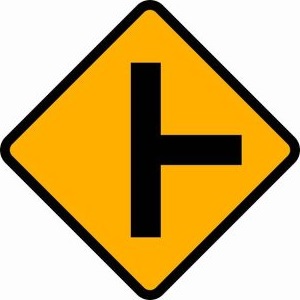
4. This road sign means:
A. All traffic must turn right.
B. All traffic must go straight.
C. A side road intersects ahead.
5. There are oncoming vehicles to your left and a row of parked vehicles to your right. You should steer:
A. Closer to the oncoming vehicles than the parked vehicles.
B. Closer to the parked vehicles than the oncoming vehicles.
C. A middle course between the oncoming and parked vehicles.
6. At an intersection with stop signs on all corners, yield the right-of-way to any driver:
A. On your left.
B. Who arrived before you.
C. Across from your vehicle.
7. Which of the following statements is true?
A. Driving too slowly is not an unsafe practice.
B. Driving too slowly on certain highways can be dangerous.
C. The speed at which you drive a vehicle does not affect safety.
8. An orange and red triangular sign on a vehicle always means:
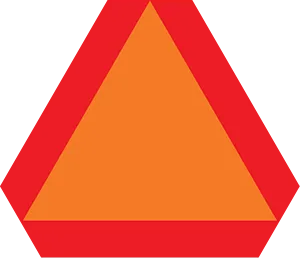
A. The vehicle has the right-of-way.
B. Slow-moving vehicle.
C. Shoulder work ahead.
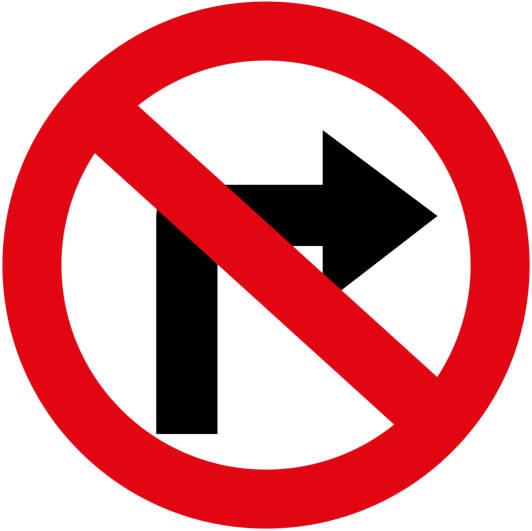
9. This sign means:
A. No right turn.
B. You must turn right.
C. Watch for traffic on your right.
10. You should allow an extra cushion of space:
A. When following a station wagon.
B. When following a driver who cannot see the rear of their vehicle.
C. When following a small passenger car.
11. "No zones" are areas around trucks where cars:
A. Disappear into blind spots or are so close that they restrict the truck driver's ability to stop and maneuver safely.
B. Have sufficient space to travel behind the truck.
C. Have several car lengths between their vehicle and the truck.
12. Backing your vehicle is:
A. Always dangerous.
B. Dangerous if you have a helper.
C. Only dangerous in large vehicles.
13. A broken yellow line down the center of a road indicates that:
A. A construction zone is ahead.
B. Passing is not permitted from either direction.
C. Passing is permitted from either direction.
14. When you drive through a construction zone, you should:
A. Stop to watch the workers.
B. Decrease your following distance.
C. Pass the construction zone carefully and not “rubberneck."
15. To pass on a two-lane road, you should:
A. Sound your horn as you pass.
B. Flash your headlights as you pass.
C. Judge the distance to any oncoming vehicles.
16. What is the only effective way to remove alcohol from the body?
A. Drink strong coffee.
B. Wait.
C. Take a cold shower.
17. When adjusting your rearview mirror, you should be able to clearly see:
A. The entire rear window.
B. The passengers in the backseat.
C. Your own reflection.
18. You have allowed the wheels of your vehicle to run off the edge of the pavement. What should you do first?
A. Turn the front wheels slightly to the left to edge the car back onto the pavement.
B. Hold the steering wheel firmly, release the gas pedal, and gently apply the brakes.
C. Apply the brakes and turn the front wheels sharply to the left.
19. If you drive more slowly than the flow of traffic, you will most likely:
A. Interfere with traffic and receive a ticket.
B. Improve traffic flow.
C. Demonstrate defensive driving techniques.
20. As you enter into a roundabout, you should slow down and:
A. Yield to any crossing pedestrians and bicyclists.
B. Yield to any car already within the roundabout.
C. Both of the above.
21. Just like alcohol and other drugs, drowsiness can:
A. Help you to be a better driver.
B. Make you feel better.
C. Impair your judgment.
22. A blood alcohol concentration of 0.02 percent:
A. Won't have any effect on your driving.
B. Won't put other drivers at risk.
C. Will double your chances of having an accident.
23. To turn left from a multilane one-way street onto a one-way street, you should start your turn from:
A. Any lane (as long as it is safe).
B. The lane closest to the left curb.
C. The lane in the center of the road.
24. You should drive on the shoulder to pass a car:
A. If the vehicle ahead of you is turning left.
B. Under no circumstances.
C. If the shoulder is wide enough.
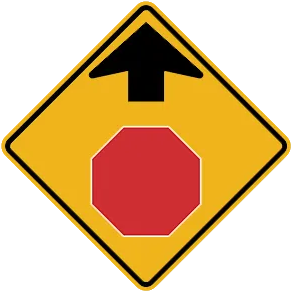
25. This sign means:
A. Stop Sign Ahead.
B. Side Road.
C. Railroad Warning.