Dmv Permit Test 72

By Teacher David Global  •  Free

1. To be able to turn quickly, your hands must be:
A. On opposite sides of the steering wheel.
B. Next to each other on the top of the steering wheel.
C. On the top and bottom of the steering wheel.
2. It is legal to make a left turn at a red traffic light after stopping only if:
A. You are traveling on a two-way street and turning onto a two-way street.
B. You are traveling on a one-way street and turning onto another one-way street.
C. You yield to all other traffic at the intersection.
3. When approaching an intersection with a flashing red light, you must:
A. Come to a complete stop, yield to oncoming traffic and pedestrians, then proceed.
B. Reduce your speed and proceed with caution.
C. Come to a complete stop and remain stopped as long as the light is red.
4. If your wheels drop off the roadway or pavement edge, you should:
A. Wait until it is safe to do so, then gradually re-enter the roadway.
B. Turn back onto the roadway immediately.
C. Stop.
5. You have allowed the wheels of your vehicle to run off the edge of the pavement. What should you do first?
A. Turn the front wheels slightly to the left to edge the car back onto the pavement.
B. Hold the steering wheel firmly, release the gas pedal, and gently apply the brakes.
C. Apply the brakes and turn the front wheels sharply to the left.
6. If you are being followed too closely on a two-lane road:
A. Reduce your speed slowly to encourage the tailgater to drive around you.
B. Speed up to increase the distance between you and the other car.
C. Apply your brakes to slow down, then resume your original speed.
7. When changing lanes, you should never:
A. Cross the centerline in an intersection.
B. Check your blind spots by looking over your left or right shoulder.
C. Check for other drivers moving into the same lane.
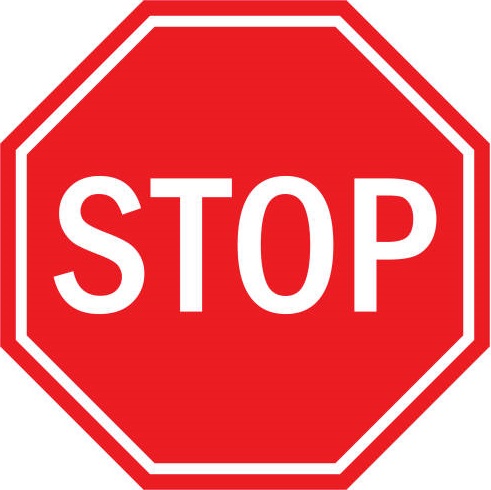
8. What does this road sign mean?
A. Slow down and prepare to stop if cars are approaching you.
B. Come to a full stop then proceed when it is safe to do so.
C. Proceed carefully through the intersection, not always stopping.
9. Unless prohibited by a sign, you may left turn on red:
A. From a two-way road to a one-way road.
B. From a one-way road to a one-way road.
C. Except in school zones.
10. You are preparing to exit the interstate. When should you start reducing your speed?
A. About halfway through the deceleration lane.
B. As you approach the deceleration lane.
C. Immediately upon entering the deceleration lane.
11. In rainy weather, you should be most careful when turning or stopping:
A. After it has been raining all day.
B. One half hour after it stops raining.
C. During the first half hour of rain.
12. If a firetruck is responding to an emergency, you must stay:
A. At least 200 feet behind the emergency vehicle.
B. At least 500 feet behind the emergency vehicle.
C. Three to six seconds behind the emergency vehicle.
13. Highway pavement will be particularly treacherous and most slippery:
A. If it has been raining several hours.
B. If it has just begun to rain.
C. If it has been raining for one to two hours.
14. When passing another vehicle, you should return to your original lane when:
A. You can see both headlights of the passed vehicle in your rearview mirror.
B. You have cleared the front bumper of the passed vehicle.
C. You are 50 feet in front of the passed vehicle.
15. If you find yourself in a skid:
A. Brake lightly.
B. Stay off the brakes.
C. Brake abruptly.
16. When entering the interstate on a short entrance ramp where there is no acceleration lane, you should:
A. Immediately enter the far-right traffic lane on the interstate and speed up to match the flow of traffic.
B. Use the shoulder of the main road to get up to the speed of traffic.
C. Speed up and enter the interstate only after you have identified a gap in traffic.
17. To avoid glare from the headlights of an approaching car:
A. Look briefly toward the right side of the road.
B. Stay focused on the centerline on the road.
C. Flash your high beams.
18. If you are about to be hit from the rear, you should consider each of the following, except for:
A. Applying your brakes.
B. Letting go of the steering wheel.
C. Pressing your head firmly against the head restraint.
19. Having a driver license is a:
A. Right, not a privilege.
B. Privilege, not a right.
C. Requirement.
20. A large truck is ahead of you and is turning right onto a street with two lanes in each direction. The truck:
A. May complete its turn in either of the two lanes.
B. May have to swing wide to complete the right turn.
C. Must stay in the right lane at all times while turning.
21. When turning left from a two-way street onto a one-way street, you should:
A. Turn into any lane.
B. Turn into first lane.
C. Turn into second lane.
22. You enter a designated turn lane to make a left turn at an upcoming intersection. There is oncoming traffic. You should:
A. Move to the left of the center lane.
B. Signal before you arrive at the intersection.
C. Turn your front wheels to the left to be prepared to turn.
23. You may not park within ____ of a railroad crossing.
A. 100 feet
B. 75 feet
C. 50 feet
24. You should increase the distance between your vehicle and the vehicle ahead when you:
A. Are following a small passenger vehicle.
B. Are being tailgated by another driver.
C. Are driving more slowly than the posted speed limit.
25. When should you yield your legal right-of-way?
A. Often, even at controlled intersections.
B. Whenever it helps prevent collisions.
C. Never. It confuses other drivers.
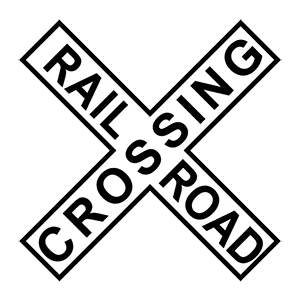
26. This white sign means:
A. The railroad crossing is controlled. Continue at your regular speed.
B. Look, listen, and prepare to stop at the crossing if necessary.
C. Stop at the railroad tracks and wait for a signal before crossing.
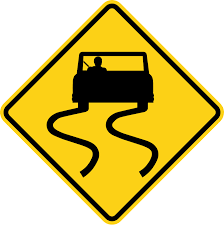
27. This sign means:
A. Slow down; curving road ahead.
B. Slow down and do not use your brakes.
C. Slow down; slippery when wet.
28. Which of these statements is true about roadwork zones?
A. Fines are the same for violations committed in work zones as they are under normal traffic conditions.
B. You must "Slow for the Cone Zone."
C. Slow down only if you think workers are present.
29. In traffic moving at 50 to 55 mph, you are least likely to have an accident if you:
A. Drive a few miles per hour faster than most other vehicles.
B. Stay within that speed range.
C. Drive a few miles per hour slower than most other vehicles.
30. You are driving behind a motorcycle and want to pass. You must:
A. Stay in the right lane as much as possible because the motorcycle is small and doesn't use all of the lane.
B. Blow your horn to make the motorcycle move onto the shoulder so that you can pass.
C. Have your vehicle entirely in the left lane before and during the pass.