Dmv Permit Test 67

By Teacher David Global  •  Free

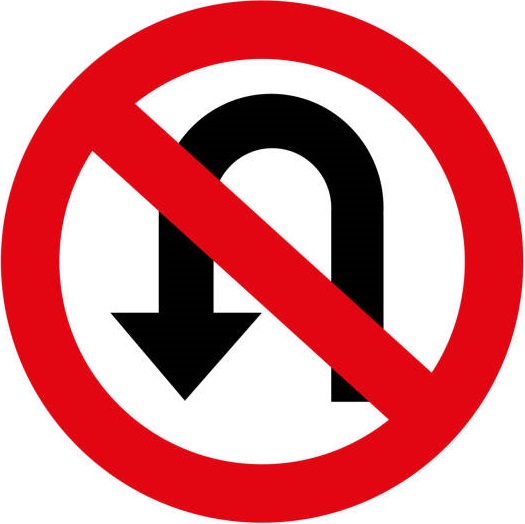
1. This sign means:
A. No turns.
B. No outlet.
C. No U-turns.
2. A broken yellow line beside a solid yellow line indicates that passing is:
A. Permitted from the side next to the solid yellow line.
B. Not permitted from either direction.
C. Permitted from the side next to the broken yellow line.
3. When approaching a roundabout, you should always:
A. Increase your speed.
B. Maintain your speed.
C. Decrease your speed.
4. When driving in fog, rain, or snow, use:
A. Low beams.
B. High beams.
C. Fog lights only.
5. When merging onto the freeway, you should be driving:
A. At or near the speed of the freeway traffic.
B. At the legal speed limit.
C. More slowly than the freeway traffic.
6. If a tire blows out, you should:
A. Apply the brake and hold it.
B. Hold the steering wheel tightly and use the brakes lightly.
C. Pull over quickly.
7. When double solid yellow lines separate lanes of traffic:
A. Passing is permitted from the left.
B. Passing is permitted from the right.
C. Passing is not permitted from either direction.
8. At a railroad crossing, you must:
A. Watch for vehicles that must stop at all railroad crossings (school buses, trucks carrying hazardous materials, etc.).
B. Watch for multiple trains.
C. Both of the above.
9. You should use your horn when:
A. Another vehicle is in your way.
B. It may help prevent a collision.
C. Another driver makes a mistake.
10. You are approaching an intersection at the posted speed limit when the signal turns yellow. You should:
A. Slow down and proceed through the intersection without caution.
B. Speed up to cross the intersection before the light turns red.
C. Stop before entering the intersection, if you can do so safely.
11. You can help keep the driver behind you a safe distance away from your vehicle by:
A. Driving 10 mph faster than the car behind you.
B. Driving 10 mph slower than the car behind you.
C. Maintaining a steady speed.
12. When changing lanes, you should never:
A. Look over your shoulder to check your blind spot.
B. Change lanes abruptly or spontaneously.
C. Check for other vehicles moving into the same lane.
13. Vehicles in Arizona must be covered by liability insurance:
A. Only when driven on an interstate.
B. At all times.
C. Only when driven by a minor.
14. If oncoming headlights are blinding you while you are driving at night, you should:
A. Look toward the right edge of the road.
B. Switch your lights to high beams.
C. Turn your lights on and off.
15. A steady red arrow displayed on a traffic light means:
A. Drivers cannot turn in the indicated direction.
B. Drivers may turn in the indicated direction after coming to a complete stop.
C. Drivers may turn in the indicated direction.
16. When backing up:
A. Look through the rear window.
B. Press hard on the gas pedal.
C. Rely only on your rearview mirror.
17. When changing lanes:
A. Check your side mirror and look over your shoulder to make sure the lane is clear.
B. Check the inside rearview mirror.
C. Slow down.
18. You want to park downhill on a two-way road and there is no curb. Which way do you turn your front wheels?
A. Straight ahead
B. Right, toward the side of the road
C. Left, toward the center of the road
19. Water on the road can cause a vehicle to hydroplane. Your car may hydroplane at speeds as low as:
A. 45 miles per hour.
B. 35 miles per hour.
C. 40 miles per hour.
20. When driving in fog, you should:
A. Use your high beam headlights.
B. Use your parking lights.
C. Use your low beam headlights.
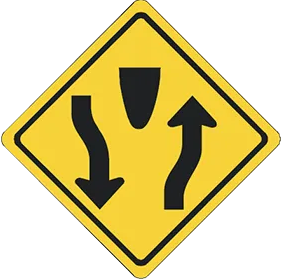
21. This sign means:
A. Divided highway.
B. Railroad warning.
C. No passing zone.
22. When passing on the left of a vehicle, it is safe to move back into the right lane:
A. After about three seconds.
B. When you can no longer see the vehicle over your right shoulder.
C. When you can see the front of the vehicle in your rearview mirror.
23. Excessive speed:
A. Saves time so you can get to your destination more quickly.
B. Helps you maneuver around obstacles.
C. Increases the likelihood of serious bodily injury and death.
24. Roads with double solid yellow line markings down the center indicate that passing is:
A. Allowed from both directions.
B. Allowed only from your direction of travel.
C. Not allowed from either direction.
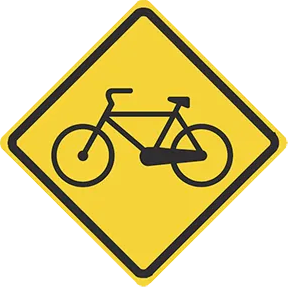
25. This road sign means:
A. Bicycle crossing.
B. Stop only if other cars are approaching.
C. Yield the right-of-way to pedestrians.
26. If you are approaching an intersection where the traffic light has changed from green to yellow:
A. You should proceed with caution.
B. You must clear the intersection before the light turns red.
C. You should come to a safe stop and wait for the light to turn green to proceed.
27. Which of these is a safe driving technique?
A. Using your high beam lights in the fog.
B. Staring at the road ahead of your vehicle.
C. Checking your rearview mirrors frequently.
28. You should not make sudden stops in front of large trucks and buses because:
A. Small vehicle drivers cannot adequately see large trucks and buses in their rearview mirrors.
B. Large trucks and buses, due to their size and weight, require longer distances to stop than smaller passenger vehicles.
C. Large trucks and buses travel at a higher speeds than small vehicles.
29. A flashing red traffic light at an intersection means:
A. The same thing as a yield sign.
B. The light is about to turn green.
C. The same thing as a stop sign.
30. Motorcycles, scooters, and mopeds are not easy to see; therefore, you should:
A. Slow down when driving.
B. Make constant visual checks.
C. Share a lane with a motorcycle.