Dmv Permit Test 66

By Teacher David Global  •  Free

1. At a school crossing sign, you should:
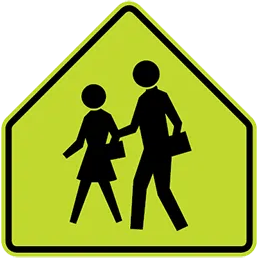
A. Always stop, whether there is a stop sign or not.
B. Watch for children and be ready to stop.
C. Always sound your horn when you see children.
2. When passing another vehicle:
A. Pass the vehicle as slowly as possible.
B. Drive at the same speed as the vehicle you are passing.
C. Pass the vehicle as safely and as quickly as possible.
3. On a freeway, you should look farther ahead than you would on a city street:
A. In order to see potential hazards early.
B. Because it takes a quarter of a mile to stop your vehicle completely.
C. Because it helps you keep up with traffic.
4. If your car's suspension is bad, it can cause:
A. Vehicle control problems.
B. Squealing brakes.
C. Slack in the steering.
5. How do you check your blind spots?
A. By looking in your side mirrors.
B. By turning your head and looking over your shoulders.
C. By looking in your rearview mirror.
6. You should drive on the shoulder to pass a car:
A. If the vehicle ahead of you is turning left.
B. Under no circumstances.
C. If the shoulder is wide enough.
7. Which of the following factors affect an individual's absorption of alcohol?
A. Weight
B. Height
C. Intelligence
8. To turn left from a multilane one-way street onto a one-way street, you should start your turn from:
A. Any lane (as long as it is safe).
B. The lane closest to the left curb.
C. The lane in the center of the road.
9. You are merging onto an interstate highway. You should:
A. Select a safe gap and merge into the lane of traffic.
B. Merge across two lanes at once.
C. Always stop before entering the highway.
10. It is dangerous to follow a motorcycle too closely because:
A. They do not follow the same rules as motor vehicles.
B. A motorcycle can stop much faster than a standard vehicle.
C. They brake more slowly than motor vehicles.
11. A driver should:
A. Assume all drivers automatically obey the right-of-way rules.
B. Assume most drivers obey the right-of-way rules.
C. Always be prepared to yield the right-of-way.
12. Which of these statements is true about changing lanes?
A. You only need to turn and look over your right shoulder for lane changes to the right or left.
B. Look over your right shoulder for a right lane change and your left shoulder for a left lane change.
C. Vehicles with two outside mirrors do not have blind spots.
13. Which of the following statements about blind spots is true?
A. Blind spots are eliminated if you have one outside mirror.
B. Large trucks have bigger blind spots than most passenger vehicles.
C. Blind spots can be checked by looking in your rearview mirror.
14. When you see an emergency vehicle approaching while using its flashing lights, you must:
A. Maintain your speed and stay in your lane until the vehicle has passed.
B. Move into the right lane and drive slowly until the vehicle has passed.
C. Pull over to the curb or edge of the road and stop until the vehicle has passed.
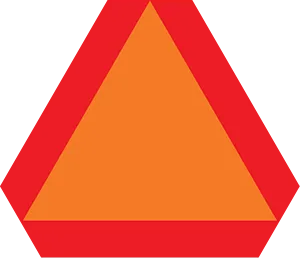
15. This symbol is used for:
A. Dangerous intersections.
B. Slow-moving vehicles.
C. Yield signs.
16. When driving on a slippery surface, such as snow or ice:
A. Shift to a low gear before going down steep hills.
B. Maintain traction by following other vehicles closely.
C. Pump your brakes to keep them from freezing.
17. Which of the following statements is correct?
A. Use your left foot to brake.
B. Use your right foot for both braking and accelerating your vehicle.
C. You should always brake abruptly to ensure stopping.
18. After passing a vehicle, it is safe to return to your driving lane when:
A. The driver you passed signals for you to return to your lane.
B. You signal your intention for three seconds.
C. You see the headlights of the passed vehicle in your rearview mirror.
19. To avoid traction loss on wet roads, you should:
A. Make abrupt turns.
B. Apply the brakes firmly.
C. Slow down.
20. While driving at night, a vehicle coming toward you has its high beams on, making it hard for you to see the road ahead. You should:
A. Look ahead toward the left edge of your lane.
B. Look ahead toward the right edge of your lane.
C. Look straight ahead in your lane.
21. You are approaching a green traffic light and traffic is blocking the intersection. What is the best thing to do?
A. Partially enter the intersection to establish your right-of-way.
B. Don't enter the intersection until you can get completely across.
C. Continue into the intersection and wait for traffic to clear.
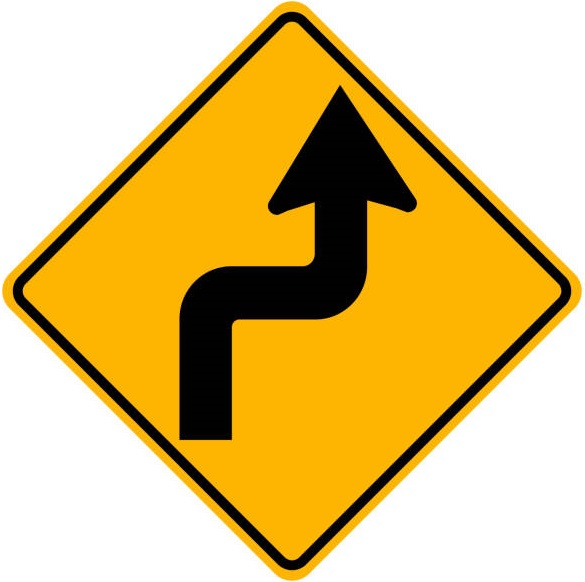
22. This road sign means:
A. Sharp right turn ahead.
B. A road joins from the right.
C. The road ahead turns sharply right then sharply left.
23. When a school bus is stopped on the road ahead to load or unload children, you must:
A. Come to a complete stop until all the children have left the bus.
B. Come to a complete stop until the red lights stop flashing and the stop arm is withdrawn.
C. Change lanes, drive slowly, and pass the bus cautiously.
24. You are on the freeway and traffic is merging into your lane. You should:
A. Make room for the merging traffic, if possible.
B. Assert your right-of-way by driving faster.
C. Always maintain your position.
25. Excessive speed:
A. Does not increase the chance of a crash.
B. Increases your ability to react to a hazard.
C. Often leads to high-risk decision-making.
26. If you have an argument with another person and you are angry, you should:
A. Loudly play the radio while driving so you won’t think about your argument.
B. Take a few minutes to cool off before driving.
C. Drive on the interstate to let off steam.
27. Use your headlights on rainy, snowy, or foggy days:
A. To keep your engine warm.
B. So others can see your vehicle.
C. To warn others of bad weather conditions.
28. To see objects in their blind spot when changing lanes, drivers should check:
A. Only the left outside mirror.
B. Over their left or right shoulder.
C. Only the inside rearview mirror.
29. When driving under snowy or icy conditions:
A. It is safe to use your cruise control.
B. Make speed and directional changes more gradually than you would otherwise.
C. Drive as you would under normal conditions.
30. When using a roundabout, drivers should:
A. Yield to traffic already in the roundabout.
B. Yield to entering traffic.
C. Drive in a clockwise direction.