Dmv Permit Test 65

By Teacher David Global  •  Free

1. Increase your following distance when driving behind a large vehicle:
A. To better see around the sides of the vehicle.
B. Because other drivers tend to pull behind large vehicles before trying to pass them.
C. Because following too closely will get you caught in the vehicle's slipstream.
2. When turning left at an intersection:
A. You should always yield to oncoming traffic and pedestrians.
B. Oncoming traffic and pedestrians should yield to you.
C. You should never yield to oncoming traffic and pedestrians.
3. If a child is riding a bicycle near your vehicle:
A. Beep your horn.
B. Expect the child to be in total control of the bicycle.
C. Expect the unexpected.
4. Should you always drive more slowly than other traffic?
A. No, you can block traffic when you drive too slowly.
B. Yes, it is a good defensive driving technique.
C. Yes, it is always safer than driving faster than other traffic.
5. You should signal continuously while turning because it:
A. Is illegal to turn off your signal before completing a turn.
B. Lets other drivers know what your intentions are.
C. Is always unsafe to turn off a signal before completing a turn.
6. When driving in fog, you should:
A. Slow down and use your low beam headlights.
B. Slow down and use your high beam headlights.
C. Turn your lights on and off to warn other drivers.
7. You may drive in an HOV lane if:
A. You are driving more quickly than the flow of traffic.
B. You are driving more slowly than the flow of traffic.
C. Your vehicle has multiple occupants.
8. If you must park your vehicle in an area not usually used for parking:
A. Park with your reverse lights on.
B. Make sure your vehicle is visible to drivers approaching from any direction.
C. Park five feet from the curb.
9. Interstate driving requires drivers to:
A. Have the ability to safely drive at increased speeds.
B. Be constantly alert.
C. Both of the above.
10. If you are driving near a large commercial vehicle, you should:
A. Follow the large vehicle closely to reduce wind drag on your vehicle.
B. Avoid driving beside it for long stretches of time.
C. Drive on its right side when on curves and hills.
11. The first thing that alcohol effects is:
A. Vision.
B. Judgment.
C. Balance.
12. If a motorist sees pedestrians in an upcoming crosswalk, what should the motorist do?
A. Continue ahead. The motorist has the right-of-way.
B. Wait for the pedestrians to cross the street.
C. Pull to the right and go around the pedestrians.
13. To know where traffic is behind you:
A. Frequently check your rearview mirror.
B. Turn and look out your back window.
C. Keep other vehicles out of your blind spots.
14. If you can see that the roadway up ahead is covered by heavy smoke, you should:
A. Turn on your four-way flashers and continue.
B. Reduce your speed, move as far to the right as possible, and stop off the roadway.
C. Turn on your high beam headlights and continue.
15. When may you pass on the right shoulder of the road?
A. When the car in front of you is turning.
B. When the car in front of you is driving too slowly.
C. Never.
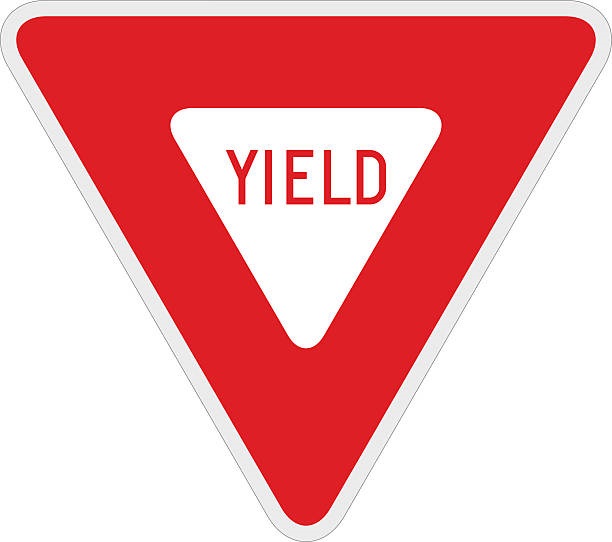
16. This sign means:
A. Cars on the right move first.
B. You have the right-of-way.
C. Let cross traffic pass before proceeding.
17. Continuous hard braking on ice and snow often:
A. Helps you stop faster.
B. Locks the front wheels of a vehicle, causing a loss of steering.
C. Keeps the brakes from freezing.
18. You have stopped for a train at a railroad crossing. After the train passes, you should:
A. Wait for signal lights to stop flashing.
B. Look for a second train.
C. Both of the above.
19. Which of these statements is true about driving and taking medications?
A. Most cold medications can make a person drowsy.
B. Over-the-counter medications cannot impair driving ability if taken in the recommended dosages.
C. Medications are safe to take at any time, if prescribed by a doctor.
20. If weather or light conditions require you to have your lights on while driving:
A. Use your parking lights.
B. Use your high beams.
C. Use your low beams.
21. A broken yellow line down the center of a road indicates that:
A. A construction zone is ahead.
B. Passing is not permitted from either direction.
C. Passing is permitted from either direction.
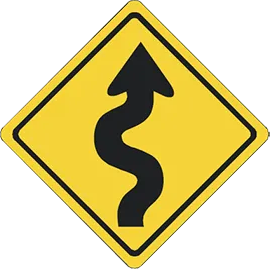
22. This sign means:
A. Winding road ahead.
B. Do not enter.
C. Pedestrian crossing.
23. Drivers turning left must yield to:
A. Oncoming vehicles traveling straight or turning right.
B. Passing cars.
C. No one in particular.
24. Stopping distances and the severity of collisions:
A. Decrease as a vehicle's speed increases.
B. Are not affected by a vehicle's speed.
C. Increase as a vehicle's speed increases.
25. When changing lanes, you can check your blind spot by:
A. Using the inside rearview mirror.
B. Turning your head and looking over your shoulder.
C. Using your side mirror.
26. You must show proof of insurance to law enforcement:
A. Only if you are involved in a collision.
B. If you are involved in a collision or stopped for a citation.
C. Only if you are stopped and cited.
27. You should not start across an intersection if you know you will block the intersection when the light turns red:
A. Under any circumstances.
B. Unless you entered the intersection on a yellow light.
C. Unless you entered the intersection on a green light.
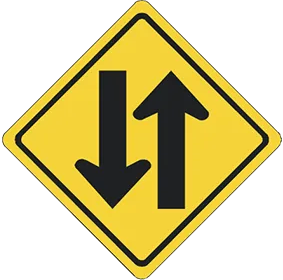
28. This sign means:
A. You can travel in either direction in this lane.
B. There is two-way traffic.
C. You are approaching a divided highway.
29. If you are driving in another driver's blind spot, you should:
A. Move forward or drop back so the other driver can see you.
B. Keep a steady pace.
C. Stay in the driver's blind spot.
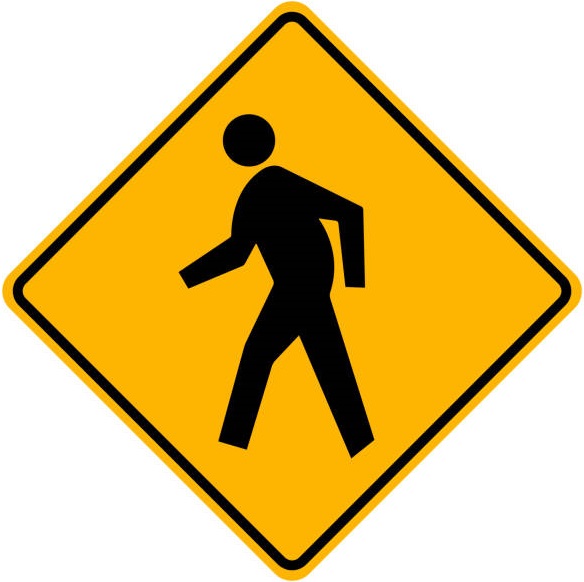
30. This sign means:
A. Pedestrian crossing.
B. Side road.
C. Railroad ahead.