Dmv Permit Test 64

By Teacher David Global  •  Free

1. Which of the following statements about blind spots is true?
A. They are eliminated if you have one outside mirror on each side of the vehicle.
B. Large trucks have bigger blind spots than most passenger vehicles.
C. Blind spots can be checked by looking in your rearview mirrors.
2. At a red traffic light with a green arrow, you may proceed in the direction of the arrow if:
A. You first come to a complete stop.
B. You wait until the light changes.
C. You are in the proper lane and the roadway is clear.
3. As your speed increases, it is important to:
A. Turn on your headlights.
B. Look well ahead of your vehicle.
C. Change lanes frequently.
4. When driving on the highway, consistently looking far ahead of your vehicle:
A. Helps you keep up with traffic.
B. Reduces the need for last-minute braking or turning.
C. Allows you to spot upcoming police officers.
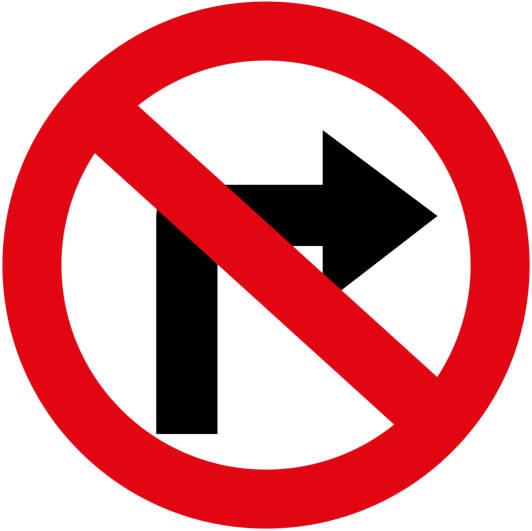
5. This sign means:
A. No U-turn.
B. No left turn.
C. No right turn.
6. Sudden wind gusts on highways:
A. Generally affect only the movement of large vehicles.
B. Only cause visibility problems.
C. Can cause problems for all vehicles.
7. If there is a deep puddle on the road ahead, you should:
A. Maintain the posted speed to make it through the water.
B. Avoid the puddle if possible.
C. Shift into neutral as you drive through the water.
8. To improve visibility lowered by rain or fog, drivers should use their:
A. Low beam headlights.
B. High beam headlights.
C. Parking lights.
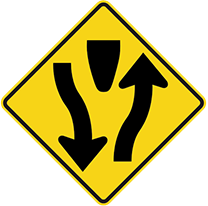
9. This sign means:
A. Curves ahead.
B. Divided highway starts.
C. Divided highway ends.
10. If you are being passed in a no passing zone, you should:
A. Pull off the road.
B. Maintain your speed and position.
C. Slow down and let the other driver safely return to the drive lane.
11. "No zones" are areas around trucks where cars:
A. Disappear into blind spots or are so close that they restrict the truck driver's ability to stop and maneuver safely.
B. Have sufficient space to travel behind the truck.
C. Have several car lengths between their vehicle and the truck.
12. When you see a flashing yellow light at an intersection, you should:
A. Yield to all traffic before crossing the intersection.
B. Stop, then enter the intersection when it is safe to do so.
C. Slow down and cross the intersection carefully.
13. A red arrow pointing to the right on a traffic light means you may:
A. Turn in that direction after slowing and checking for traffic.
B. Not turn in that direction until the light turns green.
C. Turn in that direction after you come to a complete stop.
14. If the rear of your vehicle is skidding to the left, you should:
A. Not turn your steering wheel.
B. Turn your steering wheel to the left to correct the skid.
C. Turn your steering wheel to the right to correct the skid.
15. Which of the following statements about driving speed is true?
A. As your speed increases, the chance of a fatality increases.
B. As your speed increases, so should your following distance.
C. Both of the above.
16. When may you legally drive around or under a railroad crossing gate?
A. Never.
B. When you can see clearly in both directions.
C. When the warning lights are not flashing.
17. If you come to an intersection and your view to the side is blocked, you should:
A. Slow down and look both ways.
B. Maintain your speed and look both ways.
C. Stop, then inch forward until you can see clearly in both directions.
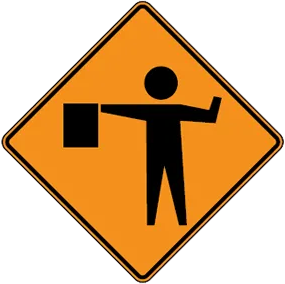
18. This road sign means:
A. Flagger ahead.
B. Turn left at the intersection.
C. Last turn before a toll road.
19. If you are about to be hit from the rear, you should not:
A. Release your seat belt.
B. Brace yourself.
C. Press your head against the head restraint.
20. Which of the following statements is true?
A. Driving too slowly is not an unsafe practice.
B. Driving too slowly on certain highways can be dangerous.
C. The speed at which you drive a vehicle does not affect safety.
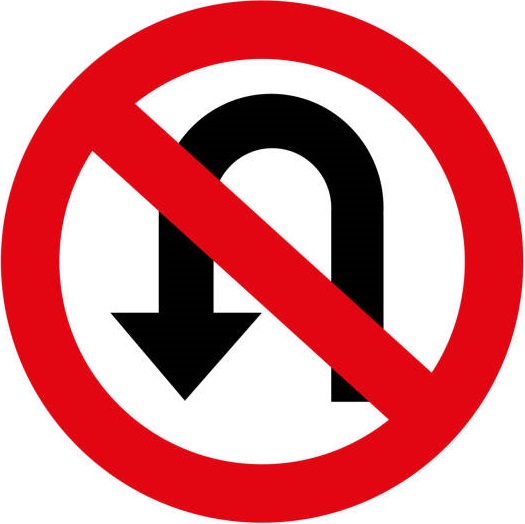
21. This sign means:
A. No U-turn.
B. No turning.
C. No left turn.
22. It is very foggy. You should slow down and:
A. Turn on your emergency flashers.
B. Turn your lights to their high beam setting.
C. Turn your lights to their low beam setting.
23. Double solid yellow line markings down the center of a road indicate that passing is:
A. Allowed from both directions.
B. Allowed only from your direction of travel.
C. Not allowed from either direction.
24. You are driving on the freeway. The vehicle in front of you is a large truck. You should drive:
A. Closely behind the truck in bad weather because the driver can see farther ahead than you can.
B. Farther behind the truck than you would when following a passenger vehicle.
C. No more than one car length behind the truck so the driver can see you.
25. When driving at night, you should:
A. Always use your high beams.
B. Look directly at the headlights of an oncoming vehicle.
C. Increase your following distance.
26. You exit the freeway on a ramp that curves downhill. You should:
A. Slow to a safe speed before the curve.
B. Slow to the posted speed limit for the freeway.
C. Wait until you have entered the curve to begin braking.
27. When driving on gravel or dirt roads:
A. Your tires grip the road better than when you are driving on pavement.
B. Your tires do not have as much traction as they do on pavement, so you must slow down.
C. Visibility is better than on pavement.
28. You may cross double yellow lines to pass another vehicle if the:
A. Vehicle in front of you moves to the right to let you pass.
B. Yellow line next to your side of the road is broken.
C. Yellow line next to the opposite side of the road is broken.
29. If your vehicle starts to lose traction because of water on the road, you should:
A. Drive at a constant speed to gain better traction.
B. Apply the brakes firmly to prevent your vehicle from sliding.
C. Slow down gradually and not apply the brakes.
30. When should drivers yield the right-of-way to pedestrians in a crosswalk?
A. Only if the pedestrians first wave to the driver.
B. Only if the pedestrians are not texting while walking.
C. At all times.