Dmv Permit Test 62

By Teacher David Global  •  Free

1. A driver entering freeway traffic from an entrance or acceleration ramp:
A. Has the right-of-way.
B. Should yield to drivers already on the interstate.
C. May force their way into traffic.
2. To pass on a two-lane road, you should:
A. Sound your horn as you pass.
B. Flash your headlights as you pass.
C. Judge the distance to any oncoming vehicles.
3. It is more dangerous to drive at night than during the day because:
A. You cannot see as far ahead at night.
B. The road is always more slippery at night.
C. Your reaction time is slower at night.
4. Trucks' blind spots are:
A. Directly behind the body.
B. On the immediate left of the cab.
C. Both on the immediate left of the cab and directly behind the body.
5. If you are driving on a highway next to a single broken white line marking:
A. You cannot cross the line to pass.
B. You may cross the line to pass and change lanes.
C. You may only cross the line to change lanes if you are in the left lane.
6. When entering traffic after being parked at a curb, you:
A. Should drive more slowly than other traffic for 200 feet.
B. Should wait for a large enough gap to get up to the speed of traffic.
C. Should wait for the first two vehicles to pass, then drive into the lane.
7. Which of the following road surfaces freezes first?
A. A tunnel
B. An intersection
C. A bridge
8. Prior to entering a curve:
A. Activate your turn signal.
B. Reduce your speed.
C. Brake hard.
9. Extra space in front of a large truck is needed for:
A. Other drivers to merge onto the freeway.
B. The truck driver to stop the vehicle.
C. Other drivers when they want to slow down.
10. Hydroplaning occurs when tires ride on a thin film of water instead of on the road. To prevent hydroplaning in wet weather, you should:
A. Put on your cruise control to maintain a constant speed.
B. Slow down.
C. Move to the shoulder of the road as soon as it starts to rain.
11. To see vehicles in your blind spots, you should check:
A. The inside rearview mirror.
B. The outside rearview mirror.
C. Over your shoulders.
12. When you see this sign, you should stop and:
A. Check for vehicles only in the direction that you plan on going, then proceed.
B. Let all vehicles that arrive before or after you go first.
C. Check for traffic in all directions before proceeding.
13. Drivers turning left must yield to:
A. Overtaking cars.
B. Oncoming cars.
C. No one.
14. Drivers are required to obey instructions from:
A. Security guards patrolling parking lots.
B. Other drivers whose vehicles are broken down on the roadway.
C. Flaggers (signal persons) at construction sites.
15. When passing another vehicle, it is safe to return to your lane if you:
A. Cannot see the vehicle directly to your right.
B. See the vehicle’s headlights in your rearview mirror.
C. Have passed the other vehicle’s front bumper.
16. Hydroplaning occurs when tires ride on a thin film of water instead of on the surface of the road. To prevent hydroplaning in rainy weather, you should:
A. Put on your cruise control to maintain a constant speed.
B. Decrease your speed.
C. Move to the shoulder of the road as soon as it starts to rain.
17. When turning left at an intersection:
A. You should always yield to oncoming traffic and pedestrians.
B. Oncoming traffic and pedestrians should yield to you.
C. You should never yield to oncoming traffic and pedestrians.
18. The center of the roadway is marked with one solid yellow line and one broken yellow line. If the broken yellow line is directly next to your traffic lane, it means:
A. You are not allowed to pass in this area.
B. You are in a passing zone and it is safe for you to pass other vehicles on the left if no oncoming traffic is present.
C. You are only allowed to make right turns in this area.
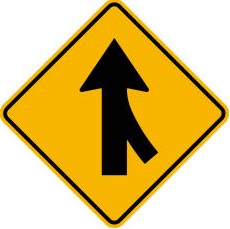
19. This yellow sign means:
A. One lane ahead.
B. Merging traffic ahead.
C. Lane ends ahead.
20. The proper way to make a right turn is to:
A. Signal, slow down, and get into the lane closest to the centerline before turning.
B. Signal, slow down, and get into the lane closest to the right curb before turning.
C. Approach the corner in the lane nearest the right curb, but move over toward the middle of the street before turning.
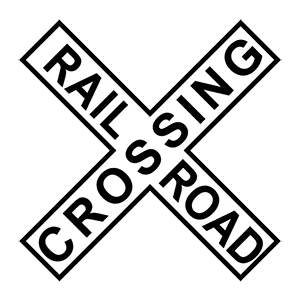
21. This white sign means:
A. The railroad crossing is controlled. Continue at your regular speed.
B. Look, listen, and prepare to stop at the crossing if necessary.
C. Stop at the railroad tracks and wait for a signal before crossing.
22. How many alcoholic drinks does it take to affect your driving ability?
A. Three
B. Two
C. One
23. If you come to an intersection controlled by a flashing yellow light, you must:
A. Wait for the green light before proceeding.
B. Slow down and cross the intersection carefully.
C. Stop before crossing the intersection.
24. The speed limit when approaching a school crossing is:
A. 10 mph.
B. 15 mph.
C. 25 mph.
25. You hit a parked vehicle and can't find the owner. What must you do?
A. Call your insurance company when you get home.
B. Wait for the owner to return.
C. Leave a note with your name and address on the parked vehicle.
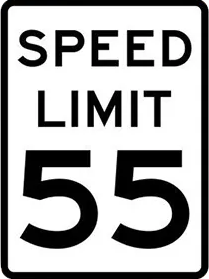
26. This road sign means:
A. You must travel through the intersection at the posted speed limit.
B. The maximum speed limit under ideal conditions is 55 mph.
C. You must not travel below the speed indicated.
27. You are driving on a city street and see an emergency vehicle with flashing lights behind you. What should you do?
A. Drive to the right edge of the road and slow down.
B. Drive to the right edge of the road and stop.
C. Stay in your lane, slow down, and let it pass.
28. When driving behind another vehicle at night, you should:
A. Keep your headlights on the low beam setting.
B. Use your high beam headlights until you are within 10 feet of the vehicle ahead.
C. Use your high beam headlights.
29. At dawn or dusk and in rain or snow, it can be hard to see and be seen. A good way to let other drivers know you are there is to turn:
A. Up the instrumental panel lights.
B. On your parking lights.
C. On your headlights.
30. A blood alcohol concentration of 0.02 percent:
A. Won't have any effect on your driving.
B. Won't put other drivers at risk.
C. Will double your chances of having an accident.