Dmv Permit Test 60

By Teacher David Global  •  Free

1. To see objects in their blind spot when changing lanes, drivers should check:
A. Only the left outside mirror.
B. Over their left or right shoulder.
C. Only the inside rearview mirror.
2. When using a roundabout, drivers should:
A. Yield to traffic already in the roundabout.
B. Yield to entering traffic.
C. Drive in a clockwise direction.
3. A broken yellow line between two lanes of traffic means:
A. Both lanes of traffic are going in the same direction.
B. Passing is permitted when it's safe.
C. Passing is not permitted.
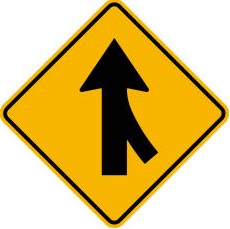
4. This road sign means:
A. Cars in the right lane must slow down.
B. No left turn.
C. Merge.
5. Which of the following statements about blind spots is true?
A. Blind spots are eliminated if you have one outside mirror.
B. Large trucks have bigger blind spots than most passenger vehicles.
C. Blind spots can be checked by looking in your rearview mirror.
6. When approaching a roundabout, you should always:
A. Increase your speed.
B. Maintain your speed.
C. Decrease your speed.
7. You are approaching a green traffic light and traffic is blocking the intersection. What is the best thing to do?
A. Partially enter the intersection to establish your right-of-way.
B. Don't enter the intersection until you can get completely across.
C. Continue into the intersection and wait for traffic to clear.
8. Stopping distances and severity of crashes:
A. Decrease as vehicle speed increases.
B. Are not affected by vehicle speed.
C. Increase as vehicle speed increases.
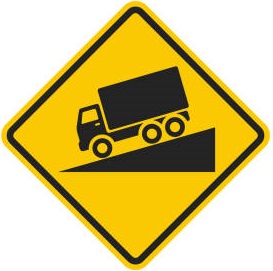
9. This sign indicates that:
A. There is a steep hill ahead.
B. No trucks are allowed on the upcoming hill.
C. A logging road is ahead.
10. Use your headlights on rainy, snowy, or foggy days:
A. To keep your engine warm.
B. So others can see your vehicle.
C. To warn others of bad weather conditions.
11. To help avoid skidding on slippery surfaces, you should:
A. Shift to a lower gear after starting down a steep hill.
B. Speed up to enter curves and slow down to exit them.
C. Slow down before entering curves and intersections.
12. If you are driving and a tire suddenly goes flat, you should:
A. Rapidly pump the brake pedal several times.
B. Slow down gradually and not brake.
C. Press down on the brake pedal as hard as you can.
13. When approaching an intersection controlled by a flashing yellow light, you must:
A. Come to a complete stop at the intersection.
B. Maintain your normal speed.
C. Slow down and proceed with caution.
14. You should not use your horn:
A. When visibility ahead is limited.
B. If you might hit another vehicle.
C. Near blind pedestrians.
15. If you find that the roadway ahead of you is flooded, you should:
A. Slam on the brakes.
B. Not drive through the flooded area. Turn around and find another route.
C. Drive only in the center of the roadway.
16. At an intersection with stop signs on all corners, yield the right-of-way to any driver:
A. On your left.
B. Who arrived before you.
C. Across from your vehicle.
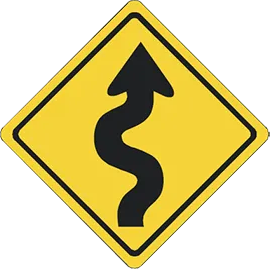
17. This sign tells you that:
A. No turns are allowed on the road.
B. The road narrows ahead.
C. There is a series of curves ahead.
18. Before you change lanes, you should check your mirrors and:
A. Never look over your right shoulder.
B. Always slow down in your traffic lane.
C. Glance over your shoulder.
19. When parking next to a curb, you should use your turn signals:
A. Only when pulling away from the curb.
B. When pulling next to, but not away from, the curb.
C. When pulling next to or away from the curb.
20. On a freeway, you should look farther ahead than you would on a city street:
A. In order to see potential hazards early.
B. Because it takes a quarter of a mile to stop your vehicle completely.
C. Because it helps you keep up with traffic.
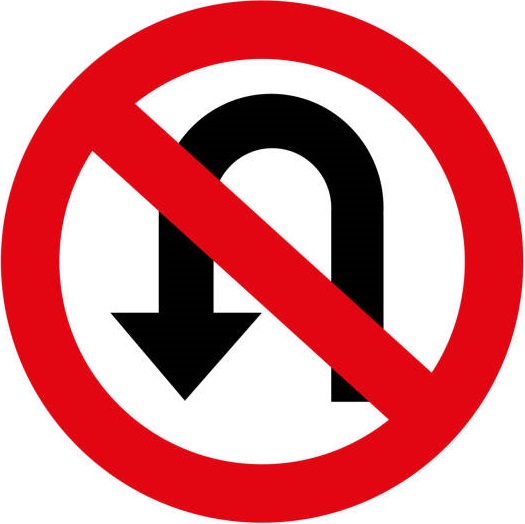
21. This road sign means:
A. Do not enter.
B. Roundabout ahead.
C. No U-turns.
22. Construction zone signs are generally:
A. Square or rectangular with white and red coloring.
B. Round or octagonal with black and yellow coloring.
C. Diamond-shaped or rectangular with orange and black coloring.
23. A curb painted red means:
A. Loading zone.
B. The area is reserved for picking up or dropping off passengers.
C. No parking, standing, or stopping.
24. If you come to an intersection controlled by a flashing yellow light, you must:
A. Wait for the green light before proceeding.
B. Slow down and cross the intersection carefully.
C. Stop before crossing the intersection.
25. Which of these statements is true about drugs and driving?
A. Any prescription drug is safe to use if you don't feel drowsy.
B. Even over-the-counter drugs can impair your driving.
C. Only illegal drugs can impair your driving.
26. If it is necessary to make an emergency stop while driving on an interstate, you should:
A. Sound your horn at passing cars to get their attention.
B. Get out of your vehicle and flag down the first vehicle that passes.
C. Pull off the road, turn on your emergency flashers, and stay in your vehicle, if you can.
27. A steady red arrow displayed on a traffic light means:
A. Drivers cannot turn in the indicated direction.
B. Drivers may turn in the indicated direction after coming to a complete stop.
C. Drivers may turn in the indicated direction.
28. When you are facing a green light and there are pedestrians in the intersection:
A. You must yield the right-of-way to pedestrians.
B. You have the right-of-way over pedestrians.
C. Pedestrians must wait for you to cross.
29. Collisions are more likely to happen when:
A. All vehicles are traveling at about the same speed.
B. One lane of traffic is traveling faster than the other lanes.
C. One vehicle is traveling faster or slower than the flow of traffic.
30. Which of these statements is true about large trucks?
A. They take longer to stop than passenger vehicles.
B. They all have air brakes that allow them to stop quickly.
C. They are more maneuverable than passenger vehicles.