Dmv Permit Test 59

By Teacher David Global  •  Free

1. What does this road sign indicate?
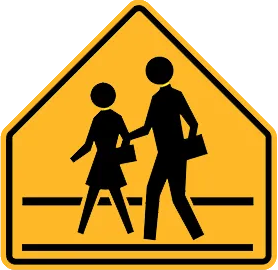
A. Directions for children
B. School zone ahead
C. Playground area ahead
2. Roads with double solid yellow line markings down the center indicate that passing is:
A. Allowed from both directions.
B. Allowed only from your direction of travel.
C. Not allowed from either direction.
3. When passing on the left of a vehicle, it is safe to move back into the right lane:
A. After about three seconds.
B. When you can no longer see the vehicle over your right shoulder.
C. When you can see the front of the vehicle in your rearview mirror.
4. Which of these statements is true about driving and taking medications?
A. Most cold medications can make a person drowsy.
B. Over-the-counter medications cannot impair driving ability if taken in the recommended dosages.
C. Medications are safe to take at any time, if prescribed by a doctor.
5. In which of the following scenarios should your wheels not be pointed straight ahead?
A. When waiting to make a left turn at a traffic light.
B. When parked on a hill or sloping driveway.
C. When parked on the side of a level roadway where there is no curb.
6. When driving under snowy or icy conditions:
A. It is safe to use your cruise control.
B. Make speed and directional changes more gradually than you would otherwise.
C. Drive as you would under normal conditions.
7. When passing a row of parked vehicles, you should:
A. Be prepared for a person or vehicle to unexpectedly enter your lane.
B. Expect all other drivers and pedestrians to respect your right-of-way.
C. Drive closely to the parked vehicles to allow more room for moving traffic.
8. Vehicles stopped behind a school bus with its red lights flashing must remain stopped until:
A. All students are off the bus.
B. The stop arm is retracted.
C. The stop arm is retracted and the bus resumes motion.
9. If you want to pass a pedestrian who is walking along the roadway and an oncoming vehicle is approaching, you should:
A. Slow down and let the oncoming vehicle pass before you pass the pedestrian.
B. Keep driving at a steady speed. The oncoming vehicle must stop for you.
C. Honk your horn to get the pedestrian to move over.
10. When changing lanes:
A. Rely on the rearview mirror.
B. Look over your shoulder in the direction you plan to move.
C. Rely on the left side mirror.
11. This sign means:
A. Railroad ahead.
B. No passing zone.
C. School zone.
12. If your vehicle starts to lose traction because of water on the road, you should:
A. Drive at a constant speed to gain better traction.
B. Apply the brakes firmly to prevent your vehicle from sliding.
C. Slow down gradually and not apply the brakes.
13. Which of these is a safe driving technique?
A. Using your high beam lights in the fog.
B. Staring at the road ahead of your vehicle.
C. Checking your rearview mirrors frequently.
14. Collisions are more likely to happen when:
A. All vehicles are traveling at about the same speed.
B. One lane of traffic is traveling faster than the other lanes.
C. One vehicle is traveling faster or slower than the flow of traffic.
15. If you are being passed in a no passing zone, you should:
A. Pull off the road.
B. Maintain your speed and position.
C. Slow down and let the other driver safely return to the drive lane.
16. You are driving on a city street and see an emergency vehicle with flashing lights behind you. What should you do?
A. Drive to the right edge of the road and slow down.
B. Drive to the right edge of the road and stop.
C. Stay in your lane, slow down, and let it pass.
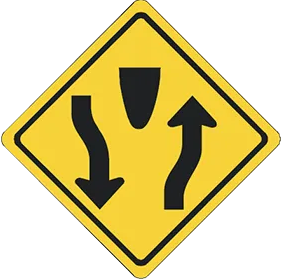
17. This sign means:
A. You are approaching the end of a divided highway.
B. You are approaching the beginning of a divided highway.
C. The road will be slippery ahead.
18. Motorcycles, scooters, and mopeds are not easy to see; therefore, you should:
A. Slow down when driving.
B. Make constant visual checks.
C. Share a lane with a motorcycle.
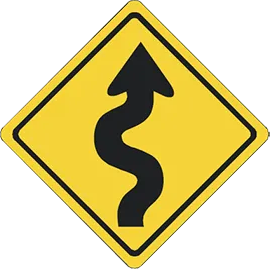
19. This road sign means:
A. Sharp turn to the right ahead.
B. Upcoming sharp left and right turns.
C. Winding road ahead.
20. Extra space in front of a large truck is needed for:
A. Other drivers to merge onto the freeway.
B. The truck driver to stop the vehicle.
C. Other drivers when they want to slow down.
21. You are merging onto an interstate highway. You should:
A. Select a safe gap and merge into the lane of traffic.
B. Merge across two lanes at once.
C. Always stop before entering the highway.
22. Stopping distances and the severity of collisions:
A. Decrease as a vehicle's speed increases.
B. Are not affected by a vehicle's speed.
C. Increase as a vehicle's speed increases.
23. Drivers turning left must yield to:
A. Overtaking cars.
B. Oncoming cars.
C. No one.
24. You are approaching an intersection at the posted speed limit when the signal turns yellow. You should:
A. Slow down and proceed through the intersection without caution.
B. Speed up to cross the intersection before the light turns red.
C. Stop before entering the intersection, if you can do so safely.
25. It is dangerous to follow a motorcycle too closely because:
A. They do not follow the same rules as motor vehicles.
B. A motorcycle can stop much faster than a standard vehicle.
C. They brake more slowly than motor vehicles.
26. To pass on a two-lane road, you should:
A. Sound your horn as you pass.
B. Flash your headlights as you pass.
C. Judge the distance to any oncoming vehicles.
27. At a railroad crossing, you must:
A. Watch for vehicles that must stop at all railroad crossings (school buses, trucks carrying hazardous materials, etc.).
B. Watch for multiple trains.
C. Both of the above.
28. To know where traffic is behind you:
A. Frequently check your rearview mirror.
B. Turn and look out your back window.
C. Keep other vehicles out of your blind spots.
29. Interstate driving requires drivers to:
A. Have the ability to safely drive at increased speeds.
B. Be constantly alert.
C. Both of the above.
30. When entering an interstate highway, you should:
A. Stop, check for cars, and enter when safe.
B. Check for cars and reduce your speed to 25 mph before entering the traffic lane.
C. Check for cars, increase your speed to match the flow of traffic, and merge when the way is clear.