Dmv Permit Test 48

By Teacher David Global  •  Free

1. Coming to a complete stop at an intersection, yielding to cross traffic/pedestrians, and then proceeding through the intersection when the way is clear corresponds with:
A. A solid red light.
B. A flashing yellow light.
C. A solid green light.
D. A flashing red light.
2. When driving to an unfamiliar area, you:
A. Should depend on road signs to find your way.
B. Should plan your trip in advance.
C. Only have to know generally where your destination is.
D. Should always choose the most direct route.
3. You are making a left turn from a two-way street onto a one-way street. When you have completed the turn, your car should be:
A. In the right lane of the street.
B. In the center of the street.
C. In the left lane of the street.
D. In the lane with the least traffic.
4. A fully loaded tractor-trailer traveling at 55 mph could take up to ____ to come to a complete stop.
A. 50 feet
B. 125 feet
C. 400 feet
D. 750 feet
5. The required amount of liability insurance coverage for property damage is a minimum of:
A. $15,000.
B. $5,000.
C. $50,000.
D. $25,000.
6. Your body gets rid of approximately:
A. Three alcoholic drinks an hour.
B. One alcoholic drink an hour.
C. Two alcoholic drinks an hour.
D. None of the above.
7. When changing lanes, you can check your blind spots by:
A. Using the inside rearview mirror.
B. Using the outside rearview mirror.
C. Using both inside and outside rearview mirrors.
D. Turning your head and looking over your shoulder.
8. Upon the approach of a vehicle displaying a flashing blue or red light, the law requires that you must:
A. Slow down and drive with caution.
B. Pull over to the side of the road and stop.
C. Drive to the nearest intersection and stop.
D. Stop where you are.
9. If your car starts to skid, turn your steering wheel:
A. To keep the front wheels straight.
B. In the direction you want the vehicle to go.
C. In the opposite direction of the skid.
D. In any direction. It doesn't matter.
10. You may cross double solid yellow lines:
A. To pass a slow-moving truck.
B. To turn into a driveway.
C. To pass another car.
D. Under no conditions.
11. What are the colors of warning signs indicating upcoming hazards?
A. Black letters or symbols on a white background
B. Black letters or symbols on a yellow background
C. White letters or symbols on a blue background
D. White letters or symbols on a green background
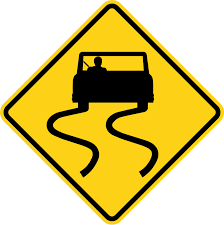
12. This sign means:
A. Slippery when wet.
B. Tow-away zone.
C. Steep downgrade.
D. Roadwork ahead.
13. A single broken white line down the center of a two-lane road indicates:
A. Lanes are moving in opposite directions and drivers are not permitted to pass.
B. Lanes are moving in opposite directions and drivers are permitted to pass when it is safe to do so.
C. Lanes are moving in the same direction and drivers are not permitted to pass.
D. Lanes are moving in the same direction and drivers are permitted to pass when it is safe to do so.
14. When changing lanes, you should:
A. Rely on your mirrors.
B. Begin signaling as you move into the next lane.
C. Signal at least 500 feet before your lane change when driving on residential streets.
D. Always check your blind spot.
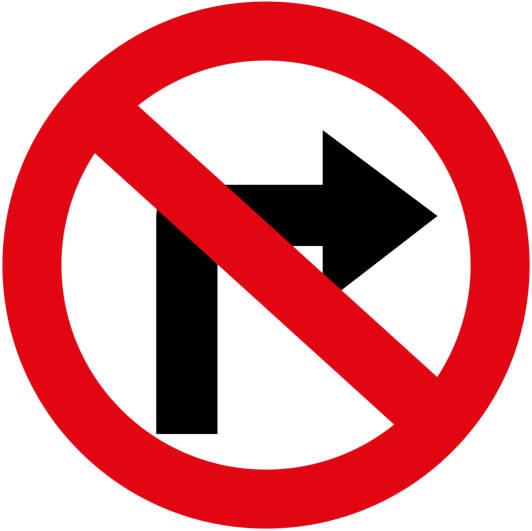
15. This sign means:
A. No U-turn.
B. No left turn.
C. No right turn.
D. No turning.
16. An approaching driver fails to dim their high beam headlights. Where should you look?
A. At the wheels of the approaching vehicle.
B. Toward the right side of the road.
C. Toward the left side of the road.
D. Straight down the middle of the road.
17. You must pull over to the edge of the road and allow an emergency vehicle to pass:
A. Regardless of your direction.
B. Only if it is following you.
C. Only if it is approaching you from the opposite direction.
D. None of the above.
18. When driving on roads that may be slippery:
A. Always drive at the maximum speed limit.
B. Use cruise control to maintain a steady speed.
C. Reduce your following distance.
D. Do not make any sudden changes in speed or direction.
19. You must yield to other drivers:
A. When entering a street from a garage or alley.
B. When they are on a road to your left and you have reached an unmarked intersection at the same time.
C. When your traffic signal is a green arrow.
D. All of the above.
20. When parking in an uphill direction on a roadway with a curb, your front wheels:
A. Should point straight ahead.
B. Should turn away from the curb.
C. Should turn toward the curb.
D. May face in any direction, as long as you set the parking brake.