Dmv Permit Test 47

By Teacher David Global  •  Free

1. In a vehicle not equipped with an Anti-Lock Braking System (ABS), you should pump your brakes to slow down because:
A. It keeps air out of the brake line.
B. It prevents skids.
C. It prevents tires from going bald.
D. It stops you faster.
2. If a vehicle using high beams comes toward you, you should look toward ____ of the road.
A. Either side
B. The center
C. The right side
D. The left side
3. When entering a highway from an entrance ramp, you should generally:
A. Enter above the speed of traffic to get ahead.
B. Enter slowly to avoid other vehicles.
C. Stop first, then slowly enter traffic.
D. Accelerate to the speed of traffic.
4. When approaching a traffic signal displaying a flashing yellow arrow, drivers:
A. Should merge into a lane in the direction of the arrow.
B. Should come to a complete stop.
C. May turn left after yielding to oncoming traffic and pedestrians.
D. Have the right-of-way and may expect oncoming traffic to stop for them.
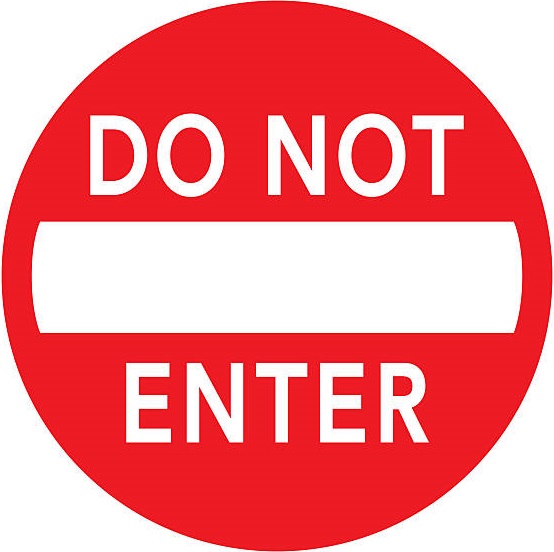
5. This sign means:
A. Stop.
B. No U-turn.
C. Yield.
D. Do not enter.
6. You are involved in an accident and your vehicle is blocking traffic. You should:
A. Move your vehicle off the traveled portion of the roadway, if possible.
B. Not move your vehicle under any circumstances.
C. Wait until the police arrive before moving your vehicle.
D. None of the above.
7. From top to bottom, the following is the proper order for traffic lights:
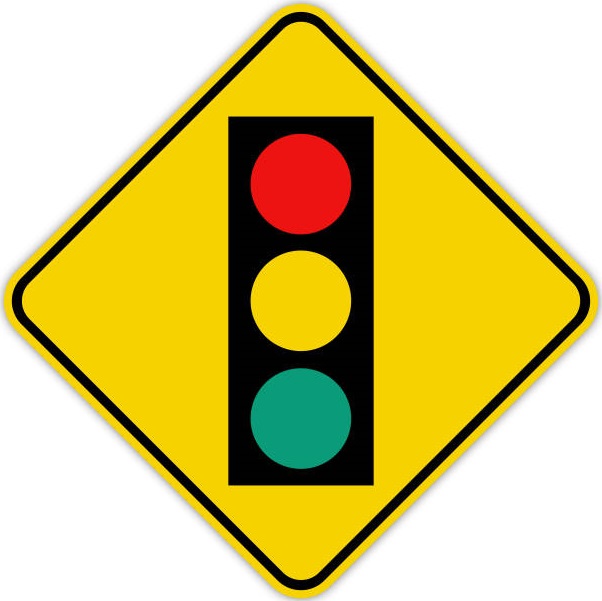
A. Red, yellow, green.
B. Red, green, yellow.
C. Green, red, yellow.
D. Green, yellow, red.
8. The school zone speed limit is:
A. 10 mph.
B. 25 mph.
C. 20 mph.
D. 35 mph.
9. The driver's left arm and hand are extended downward. This hand signal means that the driver plans to:
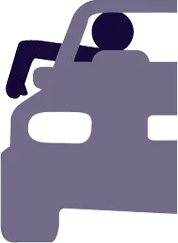
A. Turn left.
B. Turn right.
C. Stop.
D. Start up.
10. A slow-moving vehicle emblem is:
A. A rectangular red sign.
B. A circular green sign.
C. A diamond-shaped yellow sign.
D. A triangular orange sign.
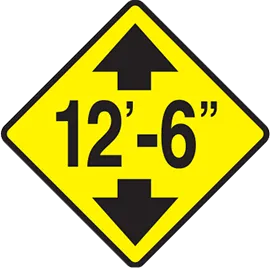
11. This road sign means:
A. Steep grade ahead.
B. Pedestrian crossing ahead.
C. Low ground railroad crossing.
D. Low clearance.
12. The penalty for driving a vehicle without valid liability insurance is license suspension for a minimum of:
A. 60 days.
B. 90 days.
C. Two years.
D. 30 days.
13. If an oncoming driver is heading toward you in your lane, you should:
A. Blow your horn, steer right, and accelerate.
B. Blow your horn, steer left, and brake.
C. Blow your horn, steer right, and brake.
D. Stay in the center of your lane, blow your horn, and brake.
14. What is a "No zone?"
A. A designated no passing zone
B. A one-way traffic area
C. The blind spot of a large vehicle
D. An area designated for motor vehicles
15. A work zone:
A. May be moving or stationary.
B. Is marked with black and white signs.
C. Does not require a driver to slow down and pay extra attention.
D. All of the above.
16. Traffic signals sometimes display arrows to control turns from specific lanes. A solid yellow arrow:
A. Is never used as a traffic signal.
B. Has the same meaning as a circular yellow traffic light.
C. Means that drivers may turn in the direction indicated by the arrow.
D. Tells drivers that a green arrow is about to be shown.
17. A red flashing traffic light has the same meaning as a:
A. Solid red light.
B. Stop sign.
C. Yield sign.
D. Caution sign.
18. When you park uphill on a street with a curb:
A. Keep the front wheel straight and set the parking brake.
B. Turn the front wheels away from the curb.
C. Turn the front wheels toward the curb.
D. Turn the back wheels into the curb.
19. A single dashed white line on a multilane road means:
A. Lanes are moving in opposite directions.
B. Passing is permitted into a lane directly next to the dashed white line.
C. Passing is prohibited.
D. None of these.
20. The driver's left arm and hand are extended upward. This hand signal means that the driver plans to:
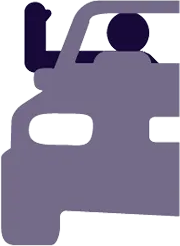
A. Turn left.
B. Turn right.
C. Come to a stop.
D. Go straight ahead.