Dmv Permit Test 46

By Teacher David Global  •  Free

1. When approaching a traffic signal displaying a steady green arrow, drivers:
A. Should merge into a lane in the direction of the arrow.
B. Should slow to a stop, if it is safe to do so.
C. May turn in the direction of the arrow after yielding to traffic and pedestrians already in the intersection.
D. May drive straight through the intersection.
2. A solid white line on the right edge of the highway slants in to the left. That shows that:
A. There is an intersection just ahead.
B. You are approaching a construction area.
C. You will be required to turn left just ahead.
D. The road will get narrower.
3. When approaching a traffic signal displaying a steady yellow arrow, drivers:
A. Should merge into a lane in the direction of the arrow.
B. Should slow to a stop, if it is safe to do so.
C. May turn left after yielding to oncoming traffic and pedestrians.
D. Have the right-of-way and may expect oncoming traffic to stop for them.
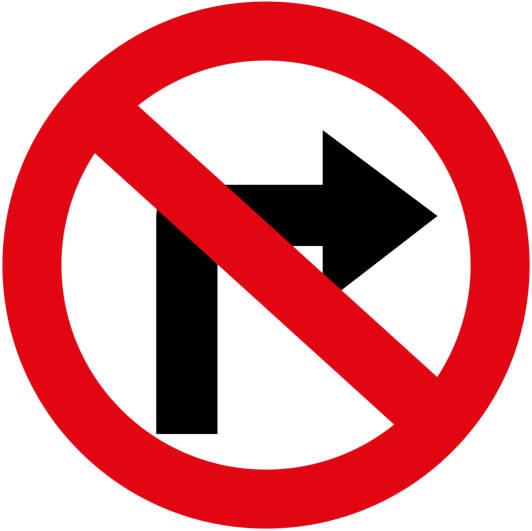
4. This sign means:
A. No right turn.
B. You must turn right.
C. Watch for traffic on your right.
D. Don’t park on the right side of the street.
5. What is the minimum mandatory jail sentence for a first-time DUI conviction?
A. Three days
B. 10 days
C. 20 hours
D. 96 hours
6. You may cross solid yellow lines:
A. To pass traffic moving in the same direction.
B. During daylight hours only.
C. At any time.
D. When making turns.
7. Pennant-shaped signs indicate:
A. School zones.
B. No passing zones.
C. Speed limits.
D. Railroad crossings.
8. You are driving in the left lane and want to move into the right lane. You should:
A. Check your mirrors, signal, and look over your left shoulder for other vehicles before changing lanes.
B. Check your mirrors, signal, and look over your right shoulder for other vehicles before changing lanes.
C. Check your mirrors, signal, and look over both shoulders for other vehicles before changing lanes.
D. Check your mirrors, signal, and change lanes.
9. You should be cautious when passing a bicycle because:
A. You are moving faster than the bicycle.
B. The bicycle always has the right-of-way.
C. Oncoming traffic may not see you pull out to pass the bicycle.
D. The cyclist may have to swerve into traffic to avoid an object on the road.
10. When parking your vehicle downhill on a two-way street:
A. Turn your wheels to the right.
B. Turn your wheels to the left.
C. Keep your wheels pointed straight ahead.
D. Leave your transmission in neutral.
11. On each vehicle registered to the state, Alaska requires:
A. One license plate on the back.
B. Two license plates: one on the front and one on the back.
C. No specified number of license plates.
D. One license plate on the front.
12. A speed restriction sign:
A. May be ignored in rainy, snowy, or icy conditions.
B. Has a triangular shape.
C. Is blue with black lettering.
D. Shows a recommended speed for a curve or turn.
13. If you are convicted of a DUI, your license will be revoked for not less than:
A. 30 days.
B. 60 days.
C. Six months.
D. 90 days.
14. A conviction of reckless driving will result in:
A. A $50 fine and four points on your driving record.
B. A warning for the first occurrence, and a $50 fine for a second.
C. Suspension of your driving privileges.
D. Revocation of your driving privileges.
15. Which of the following statements is not true?
A. Driving at high speeds can cause tire wear.
B. Constantly driving at the same speed causes monotony and road hypnosis.
C. Driving at high speeds results in poor gasoline mileage.
D. You may not drive below the posted speed limit.
16. A driver who fails to restrain passengers under the age of 16 in their moving vehicle may receive a fine of up to ____ per passenger.
A. $100
B. $50
C. $15
D. $30
17. The correct way to use a freeway exit ramp is to:
A. Slow down before entering the exit ramp.
B. Slow down once moving onto the exit ramp.
C. Keep your speed constant once in the exit ramp.
D. Pass slower traffic in the exit ramp.
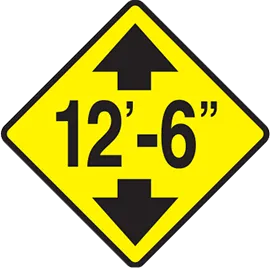
18. This sign means:
A. Low clearance.
B. Fines double in a work zone.
C. No left turn.
D. Do not block intersection.
19. As a pedestrian, you should:
A. Always insist on the right-of-way over a vehicle when using a crosswalk.
B. Never enter a street or crosswalk when vehicles are approaching.
C. Enter a crosswalk at any time because it is the vehicle driver’s responsibility to stop.
D. Use crosswalks only if they are convenient.
20. Certain highway signs require drivers to obey an indicated instruction. Such signs are known as:
A. Regulatory signs.
B. Warning signs.
C. Information signs.
D. Guide signs.