Dmv Permit Test 45

By Teacher David Global  •  Free

1. Which of the following best ensures your safety and the safety of those around you when you are backing your vehicle?
A. Honk your horn right before shifting into reverse.
B. Check behind the vehicle before you get into the driver's seat.
C. Check your rearview mirrors to see what is behind you.
D. Turn up the car radio before backing up to get the attention of anyone who may be around you.
2. When exiting a highway, you should slow down:
A. On the main road, just before the exit lane.
B. Once you see a toll booth.
C. Once you have moved into the exit lane.
D. When you first see the exit sign.
3. Your vehicle's stopping distance increases when stopping:
A. On a wet or icy road.
B. On paved highways.
C. When driving at night.
D. All of the above.
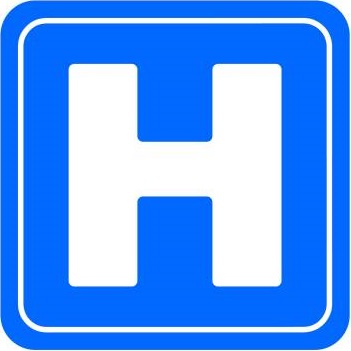
4. This sign means:
A. Highway changes ahead and to the right.
B. Hiking trails ahead and to the right.
C. Hotel ahead and to the right.
D. Hospital ahead and to the right.
5. You must indicate your intention to turn at least ____ before turning.
A. 100 feet
B. 50 feet
C. 200 feet
D. 300 feet
6. Guide signs are ____ signs that provide directional and mileage information to drivers.
A. Yellow
B. Red
C. Green
D. White
7. When parallel parking between two cars, you should first:
A. Turn your wheels to the left.
B. Turn your wheels to the right.
C. Pull up even with the car in front of your desired parking space.
D. Back slowly.
8. You are driving on a highway divided by two solid yellow lines. You may:
A. Cross these lines only to make a left turn into or from an alley, private road, or driveway.
B. Cross these lines to pass other vehicles, but only if there is no oncoming traffic.
C. Cross these lines under no circumstances.
D. Cross these lines only to make a U-turn.
9. It is important to be alert to motorcycles because:
A. They are more difficult to see than cars.
B. They rarely use their headlights.
C. Motorcyclists are less skilled drivers than other motorists.
D. All of the above.
10. You are approaching an intersection when the traffic light changes from green to solid yellow. You should:
A. Consider it the same as a caution sign and continue through the intersection.
B. Stop immediately.
C. Stop before entering the intersection, unless you are too close to stop safely.
D. Speed up to get through the intersection before the red light appears.
11. Traffic signals sometimes display arrows to control turns from specific lanes. A solid red arrow:
A. Is never used as a traffic signal.
B. Has the same meaning as a circular red traffic light.
C. Means that drivers may turn in the direction indicated by the arrow.
D. Means that the traffic the arrow is pointing toward must stop.
12. If a green arrow turns into a solid green light, you:
A. May still turn, but you must yield to oncoming traffic.
B. May no longer turn and must proceed straight.
C. Still have the right-of-way to turn.
D. No longer have to turn in the direction that the arrow indicated.
13. The road surface often becomes especially slippery during the first half hour of rain because:
A. Dust and oil on the road have not yet washed away.
B. Tires have not yet absorbed the water.
C. Water tends to pool the most at the beginning of a rainfall.
D. It rains hardest during that time.
14. If you’re going to turn left onto a one-way street, you should complete the turn into:
A. The right lane.
B. The lane closest to your previous lane.
C. Either lane.
D. Neither lane.
15. On a road which has no sidewalks, a pedestrian should walk on the:
A. Side of the road which has the lightest traffic.
B. Same side of the road on which traffic is moving.
C. Side of the road facing oncoming traffic.
D. Side of the road which has the heaviest traffic.
16. You are coming to an intersection with a flashing yellow light. You should:
A. Stop and wait for the light to change.
B. Make a U-turn because the intersection is closed.
C. Drive carefully through the intersection.
D. Prepare to stop; the light is about to turn red.
17. A driver approaching a stopped school bus that is displaying flashing amber lights should always:
A. Stop and remain stopped until the bus has passed.
B. Slow down and prepare to stop.
C. Sound their horn and pass slowly.
D. Speed up and pass quickly.
18. What color are pavement markings that separate traffic lanes moving in opposite direction?
A. Yellow
B. White
C. Yellow and white
D. Yellow, white, and black
19. What is the first thing you should adjust, if needed, when you get into a car to drive?
A. Your seat belt
B. The steering wheel
C. Your rearview mirror
D. Your seat
20. You come to an intersection that is blocked by other traffic. You should:
A. Go slowly until the traffic ahead moves.
B. Get as close as possible to the car in front of you.
C. Stay out of the intersection until you can pass through.
D. Sound your horn to make the cars move up.