Dmv Permit Test 44

By Teacher David Global  •  Free

1. If another car is in danger of hitting you, you should:
A. Sound your horn.
B. Wave your arms.
C. Use your emergency lights.
D. Flash your headlights.
2. When turning left, drivers must yield the right-of-way to:
A. Other drivers who are already in the intersection.
B. Oncoming traffic.
C. Pedestrians who are already in the intersection.
D. All of the above.
3. If you stop at a railroad crossing with more than one track:
A. Wait to proceed until you have a clear view of all tracks.
B. Stop on the first railroad track and watch for another train.
C. Go through as soon as the train passes.
D. Go through when one of the tracks is free.
4. A driver can legally pass on the right side of another vehicle:
A. If the vehicle is waiting to turn left and there is an available passing lane.
B. Even if it means driving off the pavement.
C. On a narrow bridge.
D. At any time.
5. Under ideal driving conditions, maintain a following distance of at least:
A. Four seconds.
B. 500 feet.
C. Six seconds.
D. 300 yards.
6. Which drugs may have an effect on your ability to drive?
A. Over-the-counter allergy and cold medication
B. Prescription headache medication
C. Illegal substances
D. All of the above

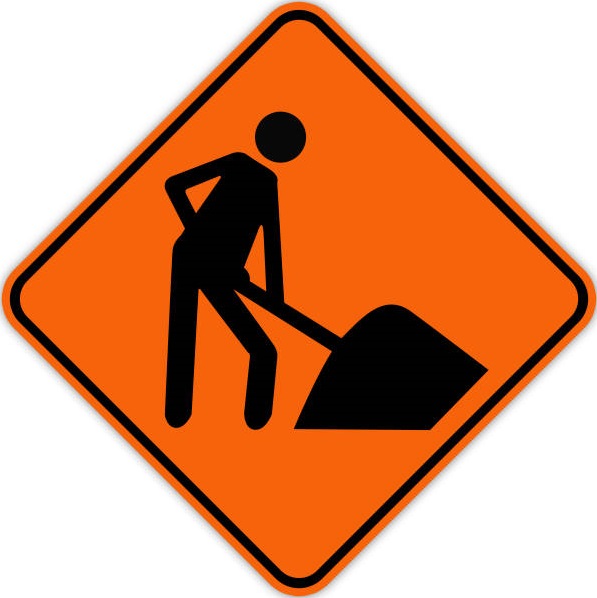
7. This sign means that:

8. When meeting a car with blinding headlights, you should:
A. Use your bright lights until the other vehicle dims theirs.
B. Flash your lights on and off to warn the other driver.
C. Dim your lights and then speed up to pass quickly.
D. Look toward the right side of the road.
9. Distracted driving is:
A. Very uncommon.
B. Extremely risky behavior.
C. Nothing to be concerned about.
D. No less safe than driving under any other conditions.
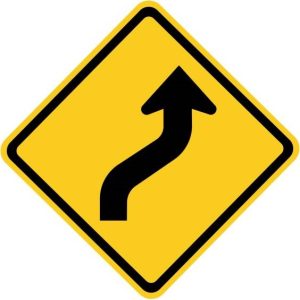
10. This road sign means:
A. Road construction ahead.
B. The road ahead curves left, then right
C. The road ahead curves right, then left.
D. Steep grade ahead.
11. Slow down, yield, and be prepared to stop for pedestrians:
A. Only if a traffic light is yellow or red.
B. As they are crossing or walking on the roadway.
C. Only if they are in marked crosswalks.
D. Only if they are crossing the roadway.
12. A steady yellow light at an intersection means:
A. Go.
B. Yield to other cars.
C. Slow down and prepare to stop.
D. Stop.
13. Two solid white lines painted across a traffic lane show the boundaries of a crosswalk. As a driver, you should know that:
A. Motor vehicles have the right-of-way over pedestrians in crosswalks.
B. When pedestrians are in crosswalks, they should be given the right-of-way.
C. No one has the right-of-way in a crosswalk.
D. Pedestrians are responsible to stay out of the way of all traffic.
14. Distracted drivers are at a greater risk of a crash when they are using which of the following?
A. CD player
B. Radio
C. Cell phone
D. All of the above
15. To help prevent crashes, you should:
A. Communicate with other road users.
B. Ignore other drivers on the road.
C. Drive only on side streets and back roads.
D. Avoid driving during rush hour.
16. Statistics show that alcohol is:
A. Involved in almost half of all traffic crashes that result in death.
B. Rarely involved in any traffic crashes.
C. The cause of all traffic crashes.
D. Involved only in traffic crashes that do not result in death.
17. If someone has consumed alcoholic drinks, what will help the person overcome the influence of those drinks?
A. Tomato juice and lime
B. Hot coffee
C. Fresh air
D. Only time
18. You are stopped at a railroad crossing where a train has just passed. You should:
A. Look and listen for another approaching train, then cross the tracks if they are clear.
B. Assume no other trains are approaching.
C. Quickly start to cross the tracks.
D. Wait 20 seconds before crossing the tracks.
19. Refusal to submit to chemical testing when requested by law enforcement:
A. Will add 10 points against your license.
B. Will result in revocation of your license.
C. Is a criminal offense.
D. All of the above.
20. If two drivers arrive at the same time to a four-way intersection controlled by stop signs:
A. The driver on the right has the right-of-way.
B. The driver on the left has the right-of-way.
C. One driver may continue driving without stopping.
D. One driver should honk to indicate that they are giving up the right-of-way.