Dmv Permit Test 43

By Teacher David Global  •  Free

1. A license may be suspended for:
A. Driving in violation of license restrictions.
B. Repeated violations of motor vehicle laws.
C. Operating an uninsured vehicle.
D. All of these.
2. It is illegal to park within ____ of a fire hydrant.
A. 25 feet
B. 15 feet
C. 30 feet
D. 20 feet
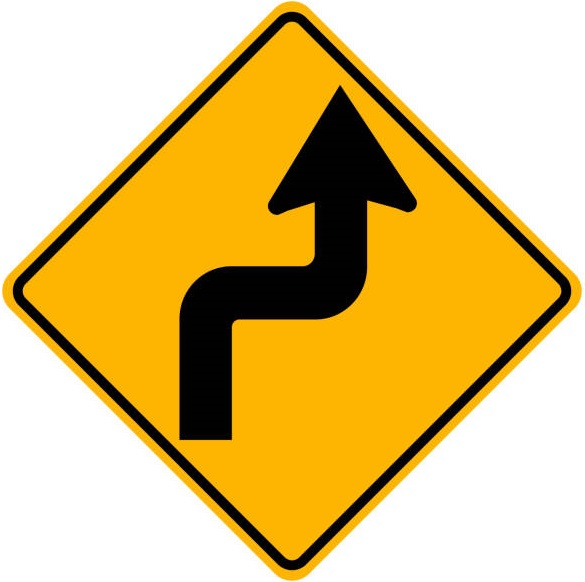
3. This road sign means:
A. The road ahead turns sharply right, then left.
B. The road ahead turns sharply left, then right.
C. The road ahead curves to the left.
D. Construction ahead.
4. You are waiting in the intersection to complete a left turn. You should:
A. Signal and keep your wheels turned to the left.
B. Signal and keep your wheels straight.
C. Flash your headlights so drivers will let you through.
D. Drive around the rear of a car if it blocks you.
5. You are approaching a railroad crossing that has no visible gates or flashing lights, but has a standard crossbuck. You should:
A. Approach all tracks with extreme caution and cross only when you know that there is no train coming.
B. Turn your radio down to hear if there may be an approaching train.
C. Only continue once cleared to do so by a flagger, if applicable.
D. All of the above.
6. As you enter an intersection, the traffic light turns yellow. You should:
A. Stop and back up.
B. Accelerate.
C. Stop as quickly as possible.
D. Cautiously pass through the intersection.
7. To help relieve fatigue on a long trip, it is a good idea to:
A. Stop and rest every two hours.
B. Do arm exercises every hour.
C. Drive with one eye open at a time.
D. Change feet on the gas pedal.
8. To safely pass a bicycle, you should:
A. Honk at the bicyclist to let them know you're trying to pass.
B. Drive in the bicycle lane until you get a chance to pass.
C. Slow down and give them as much space as possible.
D. Rush ahead to pull in front of the bicyclist.
9. The “No zone” is:
A. A term used to describe blind spots around a truck or bus.
B. A special speed zone.
C. A roadway with restrictions on vehicle stereo volume.
D. The television show that replaced The Twilight Zone.
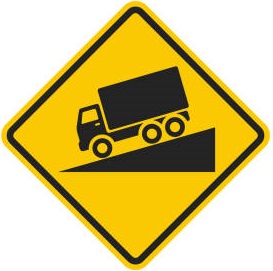
10. This sign means:
A. Steep downgrade.
B. Crossroad ahead.
C. No right turn.
D. Narrow bridge.
11. When the driver behind you wants to pass, you should:
A. Speed up.
B. Go the same speed.
C. Slow down to allow room in front of your vehicle for the other driver to complete the pass easily.
D. Change lanes.
12. You are approaching a flashing red traffic light. You should:
A. Come to a complete stop.
B. Proceed only when it is safe to do so.
C. Approach the light as if it were a stop sign.
D. All of these.
13. You may park or stop along the shoulder of the freeway:
A. As long as you turn on your four-way (emergency) flashers.
B. If no part of your vehicle is on the road.
C. If you need to look at a map for directions.
D. Only if you have an emergency.
14. To avoid being in a truck or bus driver’s blind spot, you should:
A. Never pass them.
B. Avoid driving alongside them and avoid tailgating.
C. Flash your lights at them.
D. Sound your horn.
15. You must submit proof of insurance to the DMV within 15 days of a crash in which you were involved:
A. Only if property damage exceeds $2,000.
B. If the crash results in personal injury, death, or property damage of at least $501.
C. Only if property damage exceeds $1,000.
D. Only if there is death or personal injury
16. An orange triangle with red borders positioned on the rear of a vehicle means the vehicle is:
A. A slow-moving vehicle.
B. Broken.
C. A school bus.
D. An ambulance.
17. When driving in fog, you should use your:
A. Low beam headlights.
B. High beam headlights.
C. Parking lights.
D. Hazard flashers.
18. A flashing yellow traffic signal means:
A. Slow down and proceed with caution.
B. Continue ahead at your current speed.
C. Stop.
D. No left turn.
19. If your vehicle begins to skid, you should:
A. Overcorrect.
B. Turn your steering wheel into traffic.
C. Turn your steering wheel in the direction of the skid.
D. Release the steering wheel.
20. On long trips, you can prevent drowsiness by:
A. Turning on your car radio.
B. Slowing down.
C. Stopping at regular intervals for a rest.
D. Moving your eyes from side to side as you drive.