Dmv Permit Test 42

By Teacher David Global  •  Free

1. You must stop at an intersection when you see a:
A. Flashing red light.
B. Steady yellow light.
C. Yellow arrow.
D. Flashing yellow light.
2. What should you do when you are going to enter a roadway from a private road?
A. Blow your horn to warn cars you are entering the roadway.
B. Stop with part of your car on the roadway to alert other drivers.
C. Drive out fast to merge smoothly with the traffic.
D. Yield the right-of-way to pedestrians and roadway traffic.
3. Double solid yellow lines painted down the middle of the road mean:
A. Railroad crossing ahead.
B. Pedestrian crossing ahead.
C. Passing is not permitted from either direction.
D. Passing is permitted from either direction.
4. What kinds of drugs can affect your driving ability?
A. Allergy medicine
B. Marijuana
C. Cold remedies
D. All of these choices
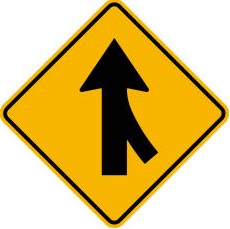
5. This sign means:
A. One-way traffic.
B. Intersection ahead.
C. Merging traffic from the right.
D. Highway curves ahead.
6. When faced with an oncoming car to the left and a bicyclist to the right, you should:
A. Pull onto the shoulder.
B. Split the difference.
C. Let the car pass and then pass the bike.
D. Pass the bike quickly.
7. Which of the following must you obey over the other three?
A. A steady red light
B. A police officer
C. A stop sign
D. A flashing red light
8. Motorcycles are entitled to:
A. The bicycle lane.
B. The same full lane width as other motor vehicles.
C. Half the width of a lane.
D. The width of the sidewalk.
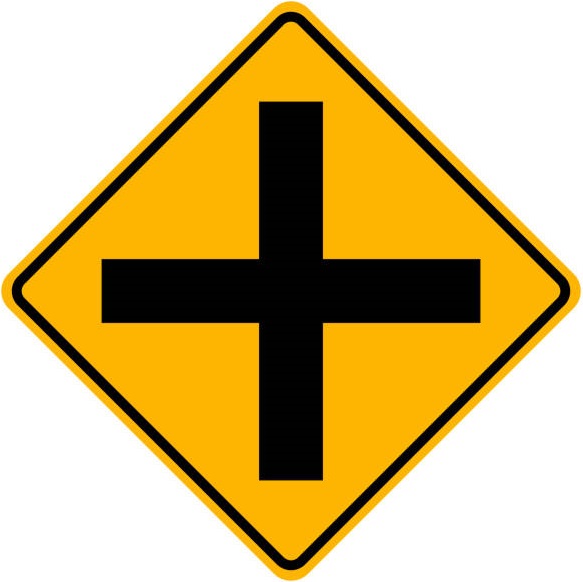
9. This sign means:
A. Crossroad ahead.
B. Flagger ahead.
C. Lane ends.
D. Turn right or go straight.
10. While driving on a two-lane road without bicycle lanes, you encounter a bicyclist traveling in the same direction. What is the safest way to pass the bicyclist?
A. Slow down and wait until there is no traffic approaching, then pass the bicyclist while leaving him or her sufficient space.
B. Continue driving straight. It is the bicyclist’s responsibility to get out of your way.
C. Do not pass the bicyclist until you come to a traffic signal or stop sign.
D. Honk at the bicyclist to let him or her know you are about to pass.
11. You must adjust your driving speed to accommodate for:
A. Existing road conditions.
B. Weather conditions.
C. Other traffic.
D. All of these.
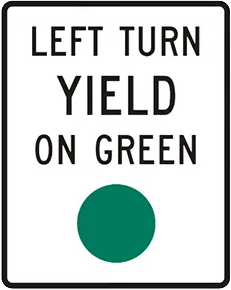
12. This road sign means:
A. You are about to enter a one-way street the wrong way.
B. School crossing ahead.
C. Do not drive in this lane.
D. Traffic turning left on the green light must yield to oncoming traffic.
13. A driver entering interstate traffic from an entrance or acceleration ramp:
A. Should yield to drivers already on the interstate.
B. Has the right-of-way.
C. May force their way into traffic.
D. Can assume that other drivers will change lanes to make room.
14. What does a single dashed yellow line separating traffic mean?
A. Drivers may pass if it is safe to do so.
B. Both lanes travel in the same direction.
C. Drivers may not pass.
D. Drivers may pass, even if it could be dangerous.
15. You are presumed to be driving under the influence if your blood alcohol concentration (BAC) is a minimum of:
A. 0.02 percent.
B. 0.1 percent.
C. 0.05 percent.
D. 0.08 percent.
16. If your wheels drop off the pavement and onto the shoulder of the road, you should:
A. Brake hard and turn sharply back onto the pavement.
B. Stop your car on the edge of the road.
C. Slow down and very carefully turn back onto the pavement.
D. Maintain your speed and turn sharply back onto the pavement.
17. Parking lights may only be used:
A. When a vehicle is parked.
B. When visibility is poor.
C. Within one hour of sunset or sunrise.
D. When a vehicle is being driven under the speed limit.
18. You are driving when your power steering stops working. You should:
A. Honk your horn and turn off the ignition.
B. Turn on your hazard lights and brace yourself.
C. Work hard to steer, reduce your speed, drive to a safe area, and stop.
D. Slam on your brakes.
19. Increasing your vehicle’s speed:
A. Increases your field of vision.
B. Decreases your field of vision.
C. Makes it easier to see cross traffic.
D. Has no effect on your field of vision.
20. When the road is marked with a solid yellow line and a broken yellow line, with the broken line next to your lane, you may pass:
A. Only in an emergency.
B. If you are on an expressway.
C. If traffic is clear.
D. Only at an intersection.