Dmv Permit Test 41

By Teacher David Global  •  Free

1. Which of the following statements about railroad crossings is true?
A. It is against the law to go around lowered gates at a crossing.
B. You must stop at a railroad crossing when directed to do so by a flagger.
C. Not all railroad crossings are equipped with flashing red signals and gates.
D. All of the above.
2. When is it illegal to drive below the speed limit?
A. When driving slowly disrupts the normal flow of traffic
B. When in heavy traffic in a construction zone
C. Only when driving in rural areas.
D. When driving under adverse weather conditions
3. Drivers may not pass from either side of a ____ centerline.
A. Combination solid and broken yellow
B. Single broken yellow
C. Double solid yellow
D. Single broken white
4. Which of the following statements is true?
A. Signal at least 100 feet before changing lanes to pass and ensure there is no oncoming traffic.
B. Use your mirrors and look over your left shoulder to check your blind spot when passing to the left.
C. When passing, wait until you can see both headlights of the passed car in your rearview mirror before returning to your original lane.
D. All of the above.
5. You are driving in the right lane of a multilane highway and want to move into the left lane. You should:
A. Look in your rearview mirror for traffic behind you before changing lanes.
B. Look over your left shoulder for traffic in your blind spot before changing lanes.
C. Look in your side mirror for traffic and turn on your directional signal.
D. All of the above.
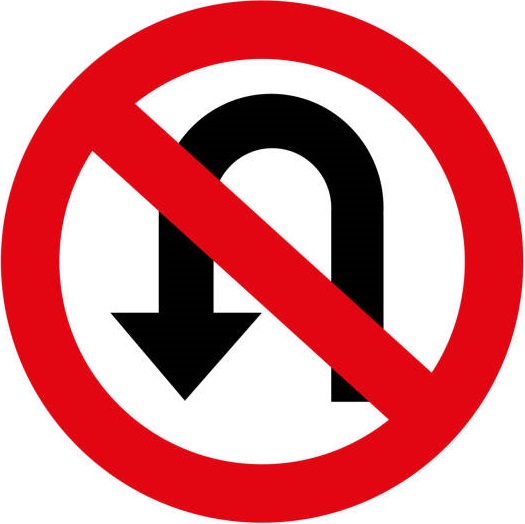
6. This sign means:
A. U-turns are prohibited.
B. U-turns are permitted.
C. Winding road ahead.
D. Sharp left turn ahead.
7. When driving on slippery roads, you should:
A. Use alternate routes.
B. Drive as you would on dry roads.
C. Increase your following distance.
D. Avoid crossing bridges or intersections.
8. To safely drive after drinking alcohol, you should:
A. Wait a period of time.
B. Drink black coffee or another caffeinated beverage.
C. Take a cold shower.
D. None of these.
9. You cannot pass safely on a two-way, two-lane street unless:
A. You are able to clearly see the road ahead.
B. You can return to your lane before meeting oncoming traffic.
C. Your vehicle is capable of the speed necessary to pass.
D. All of the above.
10. ____ limit your concentration, perception, judgment, and memory.
A. Only a blood alcohol level greater than the legal limit can
B. Alcohol does not
C. Even the smallest amount of alcohol can
D. Only a blood alcohol level greater than 0.05 percent can
11. To avoid collisions with vehicles in your blind spots, you should:
A. Quickly turn your head to see if your blind spot is clear before changing lanes.
B. Adjust your rearview mirrors every few minutes.
C. Honk your horn right before turning or changing lanes.
D. None of the above.
12. You may drive around a railroad crossing gate that is being lowered:
A. Under no circumstances.
B. If the gate is malfunctioning.
C. If you have plenty of time to cross before the gate is fully lowered.
D. If there is a shoulder to the right of the gate.
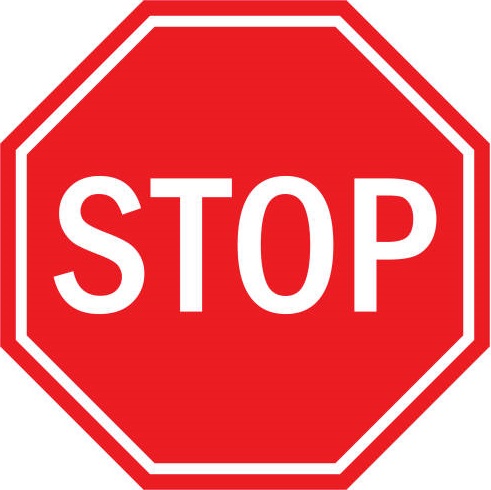
13. When you see this sign, you must:
A. Stop completely and check for pedestrians and cross traffic.
B. Slow down without coming to a complete stop.
C. Stop completely and wait for a green light.
D. Slow down and check for traffic.
14. Passing is prohibited:
A. On hills and curves.
B. At intersections.
C. At railroad crossings.
D. All of the above.
15. You are driving on a narrow road when you meet an oncoming vehicle. You must:
A. Pull completely off the road and stop.
B. Allow the oncoming vehicle at least one-half of the main-traveled portion of the road.
C. Demand the other vehicle pull over to make room.
D. Turn on your high beam headlights to make sure the other vehicle sees you.
16. If you drive past your desired destination while in heavy traffic on a city street, you should:
A. Stop where you are.
B. Back up to where you should have stopped.
C. Signal and make a U-turn.
D. Drive around the block.
17. If your car breaks down on a highway, you should:
A. Sit in your car and wait for help.
B. Use your four-way flashers to warn other drivers.
C. Sound your horn at passing motorists.
D. Flash your headlights at oncoming traffic.
18. To stay safe while driving under poor weather conditions, you should:
A. Increase your following distances.
B. Not drive on bald tires.
C. Slow down.
D. All of these.
19. When a traffic signal light turns green, you should:
A. Yield the right-of-way to pedestrians.
B. Accelerate as quickly as possible.
C. Back up slowly.
D. Not move until another driver waves you on.
20. A solid yellow line on your side of the centerline means:
A. Slow down.
B. Pass with caution.
C. Do not pass.
D. Keep right on hills.