Dmv Permit Test 40

By Teacher David Global  •  Free

1. Work zone signs mean:
A. It is summer.
B. You must immediately stop and back up.
C. Less than ideal conditions are present for driving.
D. You should drive faster to get out of the work zone.
2. Fog can greatly reduce the visibility of other vehicles, pedestrians, and traffic signals. When driving in fog, you should:
A. Drive cautiously and reduce your speed.
B. Not use your high beam headlights.
C. Use low beam headlights to better illuminate the road and objects.
D. All of the above.
3. At a light rail intersection, always:
A. Look both ways before crossing tracks.
B. Pay attention and obey all traffic signals.
C. Share the road with pedestrians and bicyclists.
D. All of these.
4. A dashed yellow line on a roadway indicates:
A. A speed zone.
B. A safe passing area.
C. A no passing zone.
D. A residential district.
5. If you are driving in another driver's blind spot, you should:
A. Move forward or drop back so the other driver can see you.
B. Keep a steady pace.
C. Stay in the driver's blind spot.
D. Honk to let them know you are there.
6. At night, it is hardest to see:
A. Road signs.
B. Pedestrians.
C. Other motorists.
D. Street lights.
7. On slippery roads, you should:
A. Slow down.
B. Drive more quickly.
C. Drive the speed limit, with caution.
D. Not drive more quickly than 20 mph.
8. You must stop for a school bus:
A. That is parked on the shoulder of the road with no one in it.
B. When it approaches you, even if its lights are not flashing.
C. If you are both driving on a two-lane highway and its red lights are flashing.
D. Whenever the driver waves at you.
9. If your turn signals fail, you should use ____ to indicate that you are turning.
A. Your horn
B. Your headlights
C. Hand signals
D. Your emergency flashers
10. When parked facing downhill, the front wheels of your vehicle should be:
A. Turned toward the curb or shoulder.
B. Pointed straight ahead.
C. Aiming any direction.
D. Turned away from the curb.
11. If you are driving so slowly that traffic is backing up behind you, you should:
A. Decrease your speed.
B. Pull off the right side of the road and let traffic pass.
C. Not let the other cars pass your vehicle.
D. Use your four-way flashers.
12. Double solid yellow centerlines mean:
A. A dangerous curve is ahead.
B. Passing is not permitted.
C. A residential district is ahead.
D. Passing is permitted when safe.
13. What are the colors of signs that tell you the distance to the next exit on a highway?
A. Yellow with black letters
B. Black with white letters
C. Red with white letters
D. Green with white letters
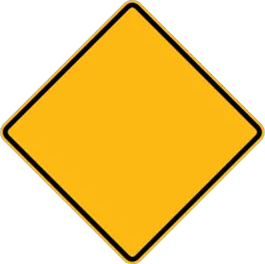
14. This sign is a:
A. Service sign.
B. Regulatory sign.
C. Warning sign.
D. Stop sign.
15. You have the right-of-way when turning left on which of the following traffic signals?
A. A solid green light
B. A flashing yellow light
C. A green arrow pointing left
D. A flashing red light
16. When you are in a line of traffic that is crossing a railroad track that has no signals or gates:
A. You have the right-of-way and do not need to check for trains.
B. You may pass slower drivers while crossing the track.
C. You need to make sure there is space for your vehicle to get all the way across the tracks without stopping.
D. All of the above
17. You want to back out of your driveway. You see children playing nearby. Before you start to move your car, you should:
A. Rev your engine to warn the children that you are moving.
B. Sound your horn so the children will hear you.
C. Walk to the back of the car to be sure the way is clear.
D. Tell the children to stay away from the driveway.
18. When approaching a school bus that is displaying flashing red lights, a driver should:
A. Sound their horn and pass slowly.
B. Stop, make sure it is safe to pass the bus, then proceed.
C. Slow down and proceed with caution.
D. Stop and remain stopped until the flashing lights extinguish.
19. When driving in fog:
A. Use your parking lights.
B. Use your low beams.
C. Use your high beams.
D. It makes no difference which lights you use.
20. When changing lanes on a multilane roadway, you should:
A. Honk your horn to let drivers behind you know you might not be able to see them.
B. Slow down to shrink your blind spot.
C. Look in your mirrors before staring straight ahead.
D. None of these.