Dmv Permit Test 9

By Teacher David Global  •  Free

1. Alcohol in any concentration is:
A. A stimulant.
B. A depressant.
C. Neither of the above.
2. Which of these statements is true about roadwork zones?
A. Fines are the same for violations committed in work zones as they are under normal traffic conditions.
B. You must "Slow for the Cone Zone."
C. Slow down only if you think workers are present.
3. If you have trouble seeing other vehicles because of dust or smoke blowing across the roadway, you should drive more slowly and turn on your:
A. Emergency flashers.
B. Parking lights.
C. Headlights.
4. To see vehicles in your blind spots, you should check:
A. The inside rearview mirror.
B. The outside rearview mirror.
C. Over your shoulders.
5. You must show proof of insurance to law enforcement:
A. Only if you are involved in a collision.
B. If you are involved in a collision or stopped for a citation.
C. Only if you are stopped and cited.
6. If you want to pass a pedestrian who is walking along the roadway and an oncoming vehicle is approaching, you should:
A. Slow down and let the oncoming vehicle pass before you pass the pedestrian.
B. Keep driving at a steady speed. The oncoming vehicle must stop for you.
C. Honk your horn to get the pedestrian to move over.
7. You are involved in a minor collision at an intersection. There are no injuries and there is very little vehicle damage. You should:
A. Leave your vehicle in the traffic lane until law enforcement arrives.
B. Move your vehicle out of the traffic lane, if possible.
C. Not move your vehicle for any reason.
8. Which of the following statements about blind spots is true?
A. They are eliminated if you have one outside mirror on each side of the vehicle.
B. Large trucks have bigger blind spots than most passenger vehicles.
C. Blind spots can be checked by looking in your rearview mirrors.
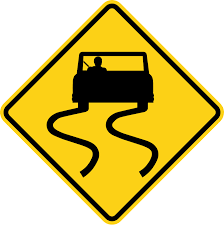
9. This sign means:
A. Do not drink and drive.
B. Slippery when wet.
C. Road curves ahead.
10. When parking your vehicle on any hill:
A. One of your rear wheels should touch the curb.
B. Use your parking brake and leave the vehicle in "park."
C. Your front wheels should be parallel to the road, if there is no curb.
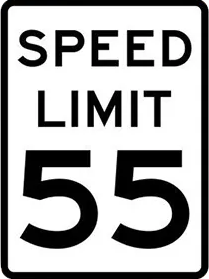
11. This road sign means:
A. You must travel through the intersection at the posted speed limit.
B. The maximum speed limit under ideal conditions is 55 mph.
C. You must not travel below the speed indicated.
12. When passing on the left of a vehicle, it is safe to move back into the right lane:
A. After about three seconds.
B. When you can no longer see the vehicle over your right shoulder.
C. When you can see the front of the vehicle in your rearview mirror.
13. Fatigue increases the risk of:
A. Missing an exit.
B. Being late for an appointment.
C. Falling asleep behind the wheel and crashing.
14. You are driving behind a motorcycle and want to pass. You must:
A. Stay in the right lane as much as possible because the motorcycle is small and doesn't use all of the lane.
B. Blow your horn to make the motorcycle move onto the shoulder so that you can pass.
C. Have your vehicle entirely in the left lane before and during the pass.
15. If you see a pedestrian using a guide dog or carrying a white cane:
A. The pedestrian must yield the right-of-way.
B. You must yield the right-of-way.
C. Honk your horn to let them know you are there.
16. Regulatory signs are:
A. Green.
B. Yellow.
C. White.
17. When entering the interstate on a short entrance ramp where there is no acceleration lane, you should:
A. Immediately enter the far-right traffic lane on the interstate and speed up to match the flow of traffic.
B. Use the shoulder of the main road to get up to the speed of traffic.
C. Speed up and enter the interstate only after you have identified a gap in traffic.
18. An orange-colored sign like this means:
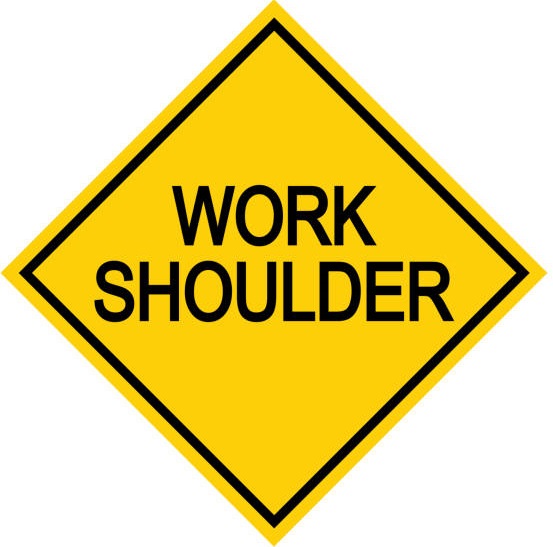
A. There is roadwork ahead.
B. You must change lanes ahead.
C. There is a detour ahead.
19. Prior to entering a curve:
A. Activate your turn signal.
B. Reduce your speed.
C. Brake hard.
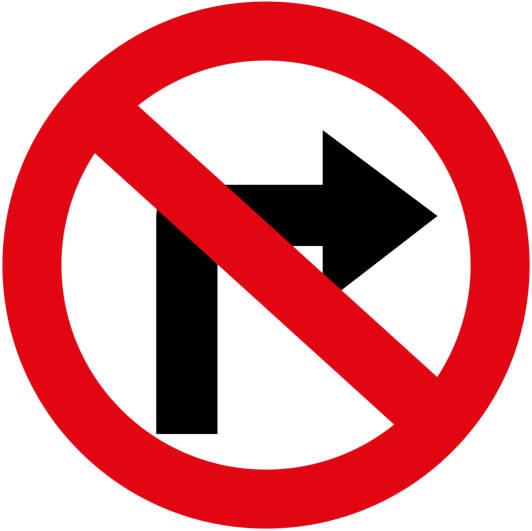
20. This sign means:
A. No U-turn.
B. No left turn.
C. No right turn.
21. If your vehicle starts to lose traction because of water on the road, you should:
A. Drive at a constant speed to gain better traction.
B. Apply the brakes firmly to prevent your vehicle from sliding.
C. Slow down gradually and not apply the brakes.
22. Posters and signs on car windows:
A. Are a fun way to personalize your vehicle.
B. Are prohibited by state law if they obstruct a driver's view of the road.
C. Are allowed only if they do not contain offensive language.
23. If weather or light conditions require you to have your lights on while driving:
A. Use your parking lights.
B. Use your high beams.
C. Use your low beams.
24. A dashed white line down the center of a two-lane road indicates:
A. Lanes are moving in opposite directions and drivers are not permitted to pass.
B. Lanes are moving in the same direction and drivers are not permitted to pass.
C. Lanes are moving in the same direction and drivers are permitted to pass.
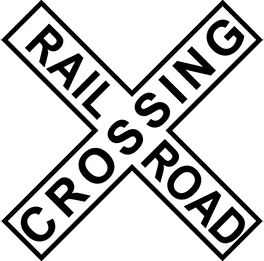
25. This white sign means:
A. The railroad crossing is controlled. Continue at your regular speed.
B. Look, listen, and prepare to stop at the crossing if necessary.
C. Stop at the railroad tracks and wait for a signal before crossing.
26. To turn left from a multilane one-way street onto a one-way street, you should start your turn from:
A. Any lane (as long as it is safe).
B. The lane closest to the left curb.
C. The lane in the center of the road.
27. When you drive through a construction zone, you should:
A. Stop to watch the workers.
B. Decrease your following distance.
C. Pass the construction zone carefully and not “rubberneck."
28. When double solid yellow lines separate lanes of traffic:
A. Passing is permitted from the left.
B. Passing is permitted from the right.
C. Passing is not permitted from either direction.
29. This sign means:
A. No right turn.
B. Stop sign ahead.
C. Divided highway.
30. A steady red arrow displayed on a traffic light means:
A. Drivers cannot turn in the indicated direction.
B. Drivers may turn in the indicated direction after coming to a complete stop.
C. Drivers may turn in the indicated direction.
31. You should increase the distance between your vehicle and the vehicle ahead when you:
A. Are following a small passenger vehicle.
B. Are being tailgated by another driver.
C. Are driving more slowly than the posted speed limit.
32. Give your name, address, and vehicle registration information to other drivers involved in a collision:
A. Only if the collision caused injury.
B. When property damage totals above $500.
C. Every time you are involved in a collision.
33. If worried, nervous, or angry, drivers:
A. Should let someone else drive.
B. Are more in touch with their senses and will be more precise drivers.
C. Will drive no differently than they would if they were thinking clearly.
34. You are approaching a green traffic light and traffic is blocking the intersection. What is the best thing to do?
A. Partially enter the intersection to establish your right-of-way.
B. Don't enter the intersection until you can get completely across.
C. Continue into the intersection and wait for traffic to clear.
35. Vehicles are required to be covered by liability insurance:
A. Only when used on an interstate.
B. Only when operated by a minor.
C. At all times.
36. Drivers turning left must yield to:
A. Overtaking cars.
B. Oncoming cars.
C. No one.
37. A red arrow pointing to the right on a traffic light means you may:
A. Turn in that direction after slowing and checking for traffic.
B. Not turn in that direction until the light turns green.
C. Turn in that direction after you come to a complete stop.
38. A green traffic signal indicates that approaching drivers should:
A. Come to a complete stop.
B. Increase their speed to quickly clear the intersection.
C. Continue driving straight through the intersection, turn left, or turn right.
39. In traffic moving at 50 to 55 mph, you are least likely to have an accident if you:
A. Drive a few miles per hour faster than most other vehicles.
B. Stay within that speed range.
C. Drive a few miles per hour slower than most other vehicles.
40. A red traffic signal indicates that approaching drivers should:
A. Come to a complete stop.
B. Increase their speed to quickly clear the intersection.
C. Continue driving through the intersection without stopping.