Dmv Permit Test 8

By Teacher David Global  •  Free

1. If you are continually being passed on the right and the left while driving in the center lane of an expressway, you should:
A. Stay in the center lane.
B. Move to the lane on your right.
C. Move to the lane on your left.
2. When passing another vehicle, it is safe to return to your lane if you:
A. Cannot see the vehicle directly to your right.
B. See the vehicle’s headlights in your rearview mirror.
C. Have passed the other vehicle’s front bumper.
3. To pass on a two-lane road, you should:
A. Sound your horn as you pass.
B. Flash your headlights as you pass.
C. Judge the distance to any oncoming vehicles.
4. You can help keep the driver behind you a safe distance away from your vehicle by:
A. Driving 10 mph faster than the car behind you.
B. Driving 10 mph slower than the car behind you.
C. Maintaining a steady speed.
5. Which of these is a safe driving technique?
A. Using your high beam lights in the fog.
B. Staring at the road ahead of your vehicle.
C. Checking your rearview mirrors frequently.
6. When driving under low-visibility conditions due to fog, you should:
A. Turn on your high beam headlights.
B. Slow down and use your low beam headlights.
C. Increase your speed so you do not cause an accident.
7. You are on the freeway and traffic is merging into your lane. You should:
A. Make room for the merging traffic, if possible.
B. Assert your right-of-way by driving faster.
C. Always maintain your position.
8. After you have passed a vehicle moving in the same direction, it is safe to move back into the right lane:
A. After about three seconds.
B. When you can no longer see the passed vehicle over your right shoulder.
C. When you can see the entire front of the passed vehicle in your rearview mirror.
9. To help avoid skidding on slippery surfaces, you should:
A. Shift to a lower gear after starting down a steep hill.
B. Speed up to enter curves and slow down to exit them.
C. Slow down before entering curves and intersections.
10. You should signal continuously while turning because it:
A. Is illegal to turn off your signal before completing a turn.
B. Lets other drivers know what your intentions are.
C. Is always unsafe to turn off a signal before completing a turn.
11. When driving in work zones, you should:
A. Follow the driver in front of you closely.
B. Pass the driver in front of you as soon as you can.
C. Avoid tailgating and keep a safe following distance.
12. The proper way to make a right turn is to:
A. Signal, slow down, and get into the lane closest to the centerline before turning.
B. Signal, slow down, and get into the lane closest to the right curb before turning.
C. Approach the corner in the lane nearest the right curb, but move over toward the middle of the street before turning.
13. As your speed increases, it is important to:
A. Turn on your headlights.
B. Look well ahead of your vehicle.
C. Change lanes frequently.
14. You exit the freeway on a ramp that curves downhill. You should:
A. Slow to a safe speed before the curve.
B. Slow to the posted speed limit for the freeway.
C. Wait until you have entered the curve to begin braking.
15. At intersections, crosswalks, and railroad crossings, you should always:
A. Stop, listen, and proceed cautiously.
B. Look to the sides of your vehicle to see what is coming.
C. Slowly pass vehicles that seem to be stopped for no reason.
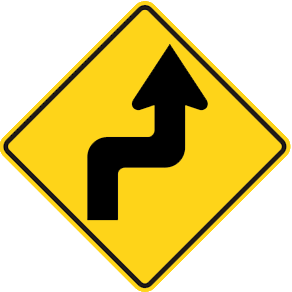
16. This road sign means:
A. Sharp right turn ahead.
B. A road joins from the right.
C. The road ahead turns sharply right then sharply left.
17. As you approach an intersection with a flashing yellow light:
A. Stop before crossing the intersection.
B. Slow down and proceed with caution.
C. Wait for a green light before proceeding.
18. When driving in fog, you should:
A. Use your high beam headlights.
B. Use your parking lights.
C. Use your low beam headlights.
19. Continuous hard braking on ice and snow often:
A. Helps you stop faster.
B. Locks the front wheels of a vehicle, causing a loss of steering.
C. Keeps the brakes from freezing.
20. Hydroplaning occurs when tires ride on a thin film of water instead of on the surface of the road. To prevent hydroplaning in rainy weather, you should:
A. Put on your cruise control to maintain a constant speed.
B. Decrease your speed.
C. Move to the shoulder of the road as soon as it starts to rain.
21. A school bus is stopped ahead of you in your lane with its red lights flashing. You should:
A. Stop and proceed when you think all of the children have exited the bus.
B. Slow to 25 mph and pass cautiously.
C. Stop for as long as the red lights are flashing.
22. What does a traffic signal with a yellow left arrow indicate?
A. Drivers should prepare to yield to oncoming traffic.
B. The protected left turn is about to end.
C. Both of the above.
23. Streets and highways are most slippery:
A. When it has been raining hard for several hours.
B. When they are clean and dry.
C. Just after it starts to rain.
24. If a road is slippery, maintain a following distance that is:
A. No different than normal.
B. Farther from the car ahead than normal.
C. Closer to the car ahead than normal.
25. When should you yield your legal right-of-way?
A. Often, even at controlled intersections.
B. Whenever it helps prevent collisions.
C. Never. It confuses other drivers.
26. You are driving on a one-way street. You may only turn left onto another one-way street if:
A. You increase your speed before the turn.
B. Traffic on the street moves to the right.
C. Traffic on the street moves to the left.
27. Winter driving is more dangerous than driving during other seasons because:
A. Road conditions can be affected by freezing temperatures, ice, snow, and fog.
B. There are increased hours of darkness.
C. Both of the above.
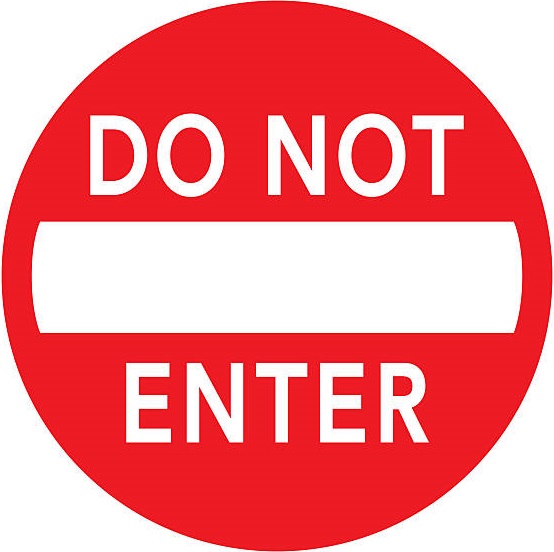
28. This road sign means:
A. You are about to enter a one-way street from the wrong direction.
B. U-turns are prohibited.
C. You may proceed if the way is clear.
29. You can drive off the road to pass another vehicle:
A. If the vehicle ahead is turning left.
B. If there are two or more lanes traveling in your direction.
C. Under no circumstances.
30. Sudden wind gusts on highways:
A. Generally affect only the movement of large vehicles.
B. Only cause visibility problems.
C. Can cause problems for all vehicles.
31. When a gate at a railroad crossing is lowering, you should:
A. Speed up and cross the tracks before the gate lowers completely.
B. Come to a complete stop and wait.
C. Drive around the gate.
32. When you see this road sign, you should:
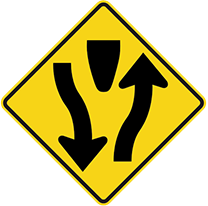
A. Keep right.
B. Keep left.
C. Pass with caution.
33. Use your headlights on rainy, snowy, or foggy days:
A. To keep your engine warm.
B. So others can see your vehicle.
C. To warn others of bad weather conditions.
34. If your vehicle has a two-part safety belt system, you should:
A. Use only the lap belt.
B. Use both the lap and shoulder belts.
C. Use only the shoulder belt.
35. You must yield the right-of-way to an emergency vehicle that is using its siren and flashing lights by:
A. Driving as closely to the right edge of the road as possible and stopping.
B. Moving into the right lane and driving slowly until it has passed.
C. Stopping immediately, even if you are within an intersection.
36. When approaching an intersection controlled by a flashing yellow light, you must:
A. Come to a complete stop at the intersection.
B. Maintain your normal speed.
C. Slow down and proceed with caution.
37. At a red traffic light with a green arrow, you may proceed in the direction of the arrow if:
A. You first come to a complete stop.
B. You wait until the light changes.
C. You are in the proper lane and the roadway is clear.
38. Check your rearview mirrors:
A. Often to see how traffic is moving behind you.
B. To see if a vehicle is in your blind spot.
C. Only when you are slowing down.
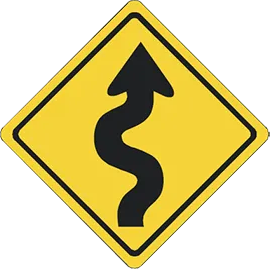
39. This sign tells you that:
A. No turns are allowed on the road.
B. The road narrows ahead.
C. There is a series of curves ahead.
40. To avoid glare from the headlights of an approaching car:
A. Look briefly toward the right side of the road.
B. Stay focused on the centerline on the road.
C. Flash your high beams.