Dmv Permit Test 10

By Teacher David Global  •  Free

1. When approaching a person who is crossing the street while using a white cane or guide dog, you should:
A. Stop until the person is well away from your path of travel.
B. Honk your horn as you proceed past them.
C. Carefully drive around them.
2. A blood alcohol concentration of 0.02 percent:
A. Won't have any effect on your driving.
B. Won't put other drivers at risk.
C. Will double your chances of having an accident.
3. A distraction when driving is:
A. Anything that causes evasive action while driving.
B. Anything that takes your attention away from driving.
C. Anything that causes you to pay more attention to driving.
4. Adjust your rearview and side mirrors:
A. Before you start driving.
B. Whenever you need to use them.
C. Before you get into the car.
5. If you find yourself in a skid:
A. Brake lightly.
B. Stay off the brakes.
C. Brake abruptly.
6. Hydroplaning occurs when tires ride on a thin film of water instead of on the road. To prevent hydroplaning in wet weather, you should:
A. Put on your cruise control to maintain a constant speed.
B. Slow down.
C. Move to the shoulder of the road as soon as it starts to rain.
7. Trucks' blind spots are:
A. Directly behind the body.
B. On the immediate left of the cab.
C. Both on the immediate left of the cab and directly behind the body.
8. You are driving on the freeway. The vehicle in front of you is a large truck. You should drive:
A. Closely behind the truck in bad weather because the driver can see farther ahead than you can.
B. Farther behind the truck than you would when following a passenger vehicle.
C. No more than one car length behind the truck so the driver can see you.
9. You reach an intersection with stop signs on all four corners at the same time as the driver on your left. Who has the right-of-way?
A. The driver on your left has the right-of-way.
B. You have the right-of-way.
C. Whoever is signaling to make a turn has the right-of-way.
10. At a school crossing sign, you should:
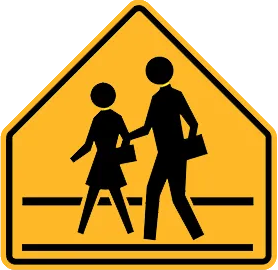
A. Always stop, whether there is a stop sign or not.
B. Watch for children and be ready to stop.
C. Always sound your horn when you see children.
11. To improve visibility lowered by rain or fog, drivers should use their:
A. Low beam headlights.
B. High beam headlights.
C. Parking lights.
12. Vehicles stopped behind a school bus with its red lights flashing must remain stopped until:
A. All students are off the bus.
B. The stop arm is retracted.
C. The stop arm is retracted and the bus resumes motion.
13. You are coming to an intersection with a flashing red light. You should:
A. Slow down and yield the right-of-way.
B. Slow down and drive carefully through the intersection.
C. Come to a complete stop, check the traffic, and go when it is safe to do so.
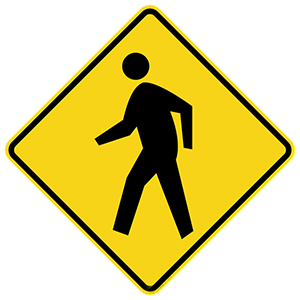
14. This road sign means:
georgia-pedestrian crossing
A. School crossing.
B. Pedestrian crossing.
C. Jogging trail.
15. Children on bicycles should be given extra space by motor vehicle operators because:
A. They do not have the same physical reflexes as adults.
B. They are smaller and more difficult to see than adults.
C. Both of the above.
16. A broken yellow line beside a solid yellow line indicates that passing is:
A. Permitted from the side next to the solid yellow line.
B. Not permitted from either direction.
C. Permitted from the side next to the broken yellow line.
17. Give the right-of-way to any pedestrian who is:
A. In a marked crosswalk.
B. In any crosswalk or intersection.
C. Crossing any street.
18. When driving behind another vehicle at night, you should:
A. Keep your headlights on the low beam setting.
B. Use your high beam headlights until you are within 10 feet of the vehicle ahead.
C. Use your high beam headlights.
19. When entering an interstate highway, you should:
A. Stop, check for cars, and enter when safe.
B. Check for cars and reduce your speed to 25 mph before entering the traffic lane.
C. Check for cars, increase your speed to match the flow of traffic, and merge when the way is clear.
20. On a multilane road, a dashed yellow line next to a solid yellow line means:
A. Passing is prohibited from both directions.
B. Passing is permitted from both directions.
C. Passing is permitted only from the direction next to the dashed line.
21. You hit a parked vehicle and can't find the owner. What must you do?
A. Call your insurance company when you get home.
B. Wait for the owner to return.
C. Leave a note with your name and address on the parked vehicle.
22. When parking next to a curb, you should use your turn signals:
A. Only when pulling away from the curb.
B. When pulling next to, but not away from, the curb.
C. When pulling next to or away from the curb.
23. When a pedestrian guided by a dog or carrying a white cane is crossing the street:
A. You must always yield the right-of-way.
B. You must tell them where to cross the street.
C. You only have to yield the right-of-way if you are at a corner.
24. When stopped at a red traffic light with a green arrow, you may proceed in the direction of the arrow if you:
A. First come to a complete stop.
B. Wait until the light changes.
C. Are in the proper lane and the intersection is clear.
25. Which of the following statements about driving speed is true?
A. As your speed increases, the chance of a fatality increases.
B. As your speed increases, so should your following distance.
C. Both of the above.
26. You enter a designated turn lane to make a left turn at an upcoming intersection. There is oncoming traffic. You should:
A. Move to the left of the center lane.
B. Signal before you arrive at the intersection.
27. If you must park your vehicle in an area not usually used for parking:
A. Park with your reverse lights on.
B. Make sure your vehicle is visible to drivers approaching from any direction.
C. Park five feet from the curb.
28. There are oncoming vehicles to your left and a row of parked vehicles to your right. You should steer:
A. Closer to the oncoming vehicles than the parked vehicles.
B. Closer to the parked vehicles than the oncoming vehicles.
C. A middle course between the oncoming and parked vehicles.
29. You are crossing an intersection and an emergency vehicle is approaching while using its siren and flashing lights. You should:
A. Stop immediately in the intersection until it passes.
B. Pull to the right of the intersection and stop.
C. Continue through the intersection, pull to the right, and stop.
30. Always stop before crossing railroad tracks when:
A. There isn't room on the other side for you to completely cross the tracks.
B. The railroad crossing is located in a city or town that has frequent train traffic.
C. You are transporting two or more young children in a passenger vehicle.
31. If you see orange construction signs and cones on a freeway, you must:
A. Slow down because the lane ends ahead.
B. Be prepared for workers and equipment ahead.
C. Change lanes and maintain your current speed.
32. When crossing a sidewalk to enter traffic from an alley or driveway, drivers should:
A. Stop only if pedestrians are on the sidewalk.
B. Stop before driving onto the sidewalk or sidewalk area.
C. Expect pedestrians on the sidewalk to yield the right-of-way.
33. A solid yellow line next to a broken yellow line means that vehicles:
A. Driving in both directions may pass.
B. Next to the broken line may pass.
C. Next to the solid line may pass.
34. When merging onto the freeway, you should be driving:
A. At or near the speed of the freeway traffic.
B. At the legal speed limit.
C. More slowly than the freeway traffic.
35. From top to bottom, the following is the proper order for traffic lights:
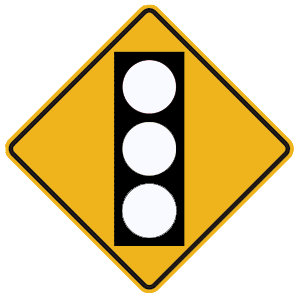
pennsylvania-traffic signal ahead blank
A. Red, yellow, green.
B. Red, green, yellow.
C. Green, red, yellow.
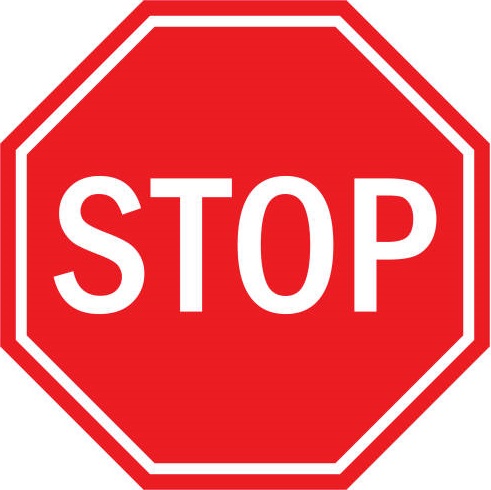
36. This road sign means:
A. Slow down or stop.
B. Stop if necessary.
C. You must come to a complete stop.
37. When a school bus is stopped ahead on your side of the road with its red lights flashing, you must:
A. Slow to a speed no faster than 10 mph.
B. Stop until the lights stop flashing.
C. Change lanes and pass cautiously.
38. At an intersection with stop signs on all corners, yield the right-of-way to any driver:
A. On your left.
B. Who arrived before you.
C. Across from your vehicle.
39. To enter a gap in highway traffic:
A. Watch only the vehicles behind the gap.
B. Check behind you, then watch the vehicle ahead.
C. Speed up and let the other vehicles make way.
40. Double solid yellow lane markings mean that:
A. Neither lane may pass.
B. Both lanes may pass.
C. The lane to the right may pass.