Dmv Permit Test 7

By Teacher David Global  •  Free

1. This sign indicates:
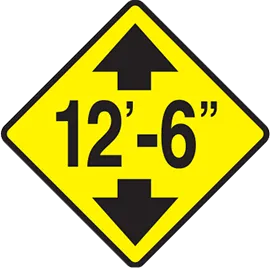
A. The distance from road surface to a bridge or overpass.
B. The maximum legal height of a vehicle allowed in this state.
C. The maximum width of a vehicle allowed on the highway.
2. You may cross double yellow lines to pass another vehicle if the:
A. Vehicle in front of you moves to the right to let you pass.
B. Yellow line next to your side of the road is broken.
C. Yellow line next to the opposite side of the road is broken.
3. To help others see you when daylight begins to fade, you should use your:
A. Parking lights.
B. Low beam headlights.
C. Emergency flashers.
4. If you come to an intersection controlled by a flashing yellow light, you must:
A. Wait for the green light before proceeding.
B. Slow down and cross the intersection carefully.
C. Stop before crossing the intersection.
5. If you become drowsy while driving, you should:
A. Try to fight it.
B. Take a break.
C. Take some caffeine pills.
6. There are two traffic lanes moving in your direction. You are driving in the left lane and many vehicles are passing you on the right. If the driver behind you wishes to drive faster, you should:
A. Stay in your lane so you don't impede the flow of traffic.
B. Drive onto the left shoulder to let the other vehicles pass.
C. Move into the right lane when it is safe.
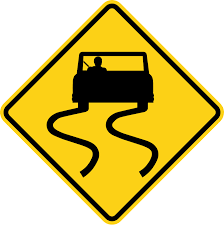
7. This road sign means:
A. When pavement is wet, reduce your speed.
B. The road ahead winds in a series of turns or curves.
C. Traffic increases ahead.
8. When you are behind a motorcycle, you should:
A. Be ready to use your horn.
B. Drive more slowly.
C. Allow a larger following distance.
9. When driving at night on a dimly lit street, you should:
A. Drive slowly enough that you can stop within the area illuminated by your headlights.
B. Turn on your high beam headlights to better see the vehicles ahead of you.
C. Keep the instrument panel lights bright to be more visible to other drivers.
10. Roads are slippery after it first starts to rain. When the road is slippery, you should:
A. Avoid making turns and stops while driving at high speeds.
B. Test your tires' traction while going uphill.
C. Decrease the distance you look ahead of your vehicle.
11. When you are merging onto the freeway, you should be driving:
A. At or near the speed of traffic on the freeway.
B. Five to 10 mph slower than the speed of traffic on the freeway.
C. The posted speed limit for freeway traffic.
12. If a motorist sees pedestrians in an upcoming crosswalk, what should the motorist do?
A. Continue ahead. The motorist has the right-of-way.
B. Wait for the pedestrians to cross the street.
C. Pull to the right and go around the pedestrians.
13. If your car's suspension is bad, it can cause:
A. Vehicle control problems.
B. Squealing brakes.
C. Slack in the steering.
14. What message will be found on this yellow pennant-shaped sign?
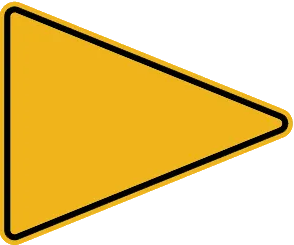
A. Right turns only.
B. Right turns permitted.
C. No passing zone.
15. When involved in a collision, you should:
A. Avoid moving the injured unless absolutely necessary.
B. Move the injured to their desired location.
C. Insist the injured are fine without immediate medical attention.
16. You want to park uphill on a two-way road and there is no curb. Which direction do you turn your front wheels?
A. Straight ahead
B. Right, toward the side of the road
C. Left, toward the center of the road
17. A vehicle suddenly cuts in front of you, creating a hazard. What should you do first?
A. Honk and step on the brake firmly.
B. Take your foot off the gas pedal.
C. Swerve into the lane next to you.
18. After passing a vehicle, it is safe to return to your driving lane when
A. The driver you passed signals for you to return to your lane.
B. You signal your intention for three seconds.
C. You see the headlights of the passed vehicle in your rearview mirror.
19. You may legally block an intersection:
A. If you entered the intersection on the green light.
B. During rush hour traffic.
C. Under no circumstances.
20. In which of the following scenarios should your wheels not be pointed straight ahead?
A. When waiting to make a left turn at a traffic light.
B. When parked on a hill or sloping driveway.
C. When parked on the side of a level roadway where there is no curb.
21. Stopping distances and severity of crashes:
A. Decrease as vehicle speed increases.
B. Are not affected by vehicle speed.
C. Increase as vehicle speed increases.
22. A steady yellow traffic signal light is a warning that the light is about to change to red. If you are already within the intersection when a green light changes to yellow, you should:
A. Stop.
B. Continue moving and clear the intersection safely.
C. Increase your speed so as not to cause an accident.
23. Motorcycles, scooters, and mopeds are not easy to see; therefore, you should:
A. Slow down when driving.
B. Make constant visual checks.
C. Share a lane with a motorcycle.
24. A driver should:
A. Stare directly in front of their car.
B. Only focus on the middle of the road.
C. Watch beside, ahead, and to the rear of their car.
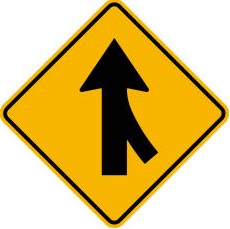
25. This road sign means:
A. Cars in the right lane must slow down.
B. No left turn.
C. Merge.
26. When should drivers yield the right-of-way to pedestrians in a crosswalk?
A. Only if the pedestrians first wave to the driver.
B. Only if the pedestrians are not texting while walking.
C. At all times.
27. When changing lanes, you can check your blind spot by:
A. Using the inside rearview mirror.
B. Turning your head and looking over your shoulder.
C. Using your side mirror.
28. You drive defensively when you:
A. Put one car length between you and the car ahead.
B. Look only at the car in front of you while driving.
C. Keep your eyes moving to look for possible hazards.
29. When passing a large truck, you should:
A. Re-enter your original lane and immediately slow down.
B. Give the truck plenty of space before re-entering the lane.
C. Re-enter the lane whenever you feel like it.
30. Highway pavement will be particularly treacherous and most slippery:
A. If it has been raining several hours.
B. If it has just begun to rain.
C. If it has been raining for one to two hours.
31. Motorcycles are entitled to:
A. The same full lane width as other motor vehicles.
B. The width of the sidewalk.
C. One-half of the width of a lane.
32. To know where traffic is behind you:
A. Frequently check your rearview mirror.
B. Turn and look out your back window.
C. Keep other vehicles out of your blind spots.
33. Before switching on the ignition, you should:
A. Buckle your safety belt.
B. Be sure all passengers have buckled their safety belts.
C. Both of the above.
34. Yellow lines separate:
A. Traffic lanes on one-way streets.
B. Traffic moving in opposite directions on two-way roads.
C. All carpool lanes from regular traffic lanes.
35. Make room for cars that are entering the freeway by:
A. Slowing down.
B. Merging into a different lane.
C. Maintaining your speed and position.
36. If a child is riding a bicycle near your vehicle:
A. Beep your horn.
B. Expect the child to be in total control of the bicycle.
C. Expect the unexpected.
37. When you see this black and yellow sign, it means:
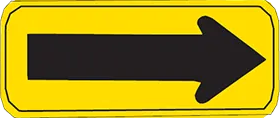
A. The road to the right is for one-way traffic only.
B. There is a detour to the right due to road construction.
C. The road ahead changes direction at an extreme angle.
38. The center of the roadway is marked with one solid yellow line and one broken yellow line. If the broken yellow line is directly next to your traffic lane, it means:
A. You are not allowed to pass in this area.
B. You are in a passing zone and it is safe for you to pass other vehicles on the left if no oncoming traffic is present.
C. You are only allowed to make right turns in this area.
39. A driver should:
A. Assume all drivers automatically obey the right-of-way rules.
B. Assume most drivers obey the right-of-way rules.
C. Always be prepared to yield the right-of-way.
40. Your license can be suspended if you are under 21 and drive with a blood alcohol level of:
A. 0.15 percent or more.
B. 0.08 percent or more.
C. Any amount.