Dmv Permit Test 17

By Teacher David Global  •  Free

1. There are oncoming vehicles to your left and a row of parked vehicles to your right. You should steer:
A. Closer to the oncoming vehicles than the parked vehicles.
B. Closer to the parked vehicles than the oncoming vehicles.
C. A middle course between the oncoming and parked vehicles.
2. Roads are slippery after it first starts to rain. When the road is slippery, you should:
A. Avoid making turns and stops while driving at high speeds.
B. Test your tires' traction while going uphill.
C. Decrease the distance you look ahead of your vehicle.
3. When driving in a construction zone:
A. Slightly increase your speed.
B. Expect the unexpected.
C. Expect construction workers to yield to motorists.
4. Various traffic control devices in construction and maintenance work areas are the color:
A. Red.
B. Orange.
C. Yellow.
5. Continuous hard braking on ice and snow often:
A. Helps you stop faster.
B. Locks the front wheels of a vehicle, causing a loss of steering.
C. Keeps the brakes from freezing.
6. When backing up:
A. Look through the rear window.
B. Press hard on the gas pedal.
C. Rely only on your rearview mirror.
7. To turn left from a multilane one-way street onto a one-way street, you should start your turn from:
A. Any lane (as long as it is safe).
B. The lane closest to the left curb.
C. The lane in the center of the road.
8. When driving under low-visibility conditions due to fog, you should:
A. Turn on your high beam headlights.
B. Slow down and use your low beam headlights.
C. Increase your speed so you do not cause an accident.
9. A broken yellow line beside a solid yellow line indicates that:
A. Passing is permitted from the lane next to the solid yellow line.
B. Passing is not permitted from either direction.
C. Passing is permitted from the lane next to the broken yellow line.
10. Motorcycles, scooters, and mopeds are not easy to see; therefore, you should:
A. Slow down when driving.
B. Make constant visual checks.
C. Share a lane with a motorcycle.
11. Hydroplaning occurs when tires ride on a thin film of water instead of on the road. To prevent hydroplaning in wet weather, you should:
A. Put on your cruise control to maintain a constant speed.
B. Slow down.
C. Move to the shoulder of the road as soon as it starts to rain.
12. When parking next to a curb, you should use your turn signals:
A. Only when pulling away from the curb.
B. When pulling next to, but not away from, the curb.
C. When pulling next to or away from the curb.
13. To avoid carbon monoxide poisoning, a driver should:
A. Have their exhaust system checked regularly to be sure there are no leaks.
B. Keep their engine turned off when their vehicle is enclosed in a garage.
C. Both of the above.
14. You are approaching a green traffic light and traffic is blocking the intersection. What is the best thing to do?
A. Partially enter the intersection to establish your right-of-way.
B. Don't enter the intersection until you can get completely across.
C. Continue into the intersection and wait for traffic to clear.
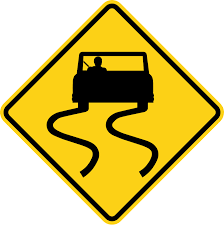
15. This sign means:
A. Slippery when wet.
B. Stop sign ahead.
C. No U-turn.
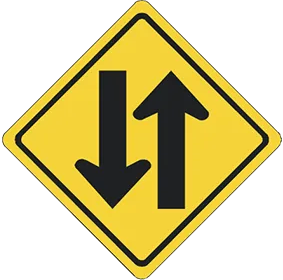
16. This sign means:
A. You can travel in either direction in this lane.
B. There is two-way traffic.
C. You are approaching a divided highway.
17. You are on the freeway and traffic is merging into your lane. You should:
A. Make room for the merging traffic, if possible.
B. Assert your right-of-way by driving faster.
C. Always maintain your position.
18. You can drive off the road to pass another vehicle:
A. If the vehicle ahead is turning left.
B. If there are two or more lanes traveling in your direction.
C. Under no circumstances.
19. You may cross double yellow lines to pass another vehicle if the:
A. Vehicle in front of you moves to the right to let you pass.
B. Yellow line next to your side of the road is broken.
C. Yellow line next to the opposite side of the road is broken.
20. Stopping distances and severity of crashes:
A. Decrease as vehicle speed increases.
B. Are not affected by vehicle speed.
C. Increase as vehicle speed increases.
21. When double solid yellow lines separate lanes of traffic:
A. Passing is permitted from the left.
B. Passing is permitted from the right.
C. Passing is not permitted from either direction.
22. When driving in work zones, you should:
A. Follow the driver in front of you closely.
B. Pass the driver in front of you as soon as you can.
C. Avoid tailgating and keep a safe following distance.
23. When passing another vehicle, it is safe to return to your lane if you:
A. Cannot see the vehicle directly to your right.
B. See the vehicle’s headlights in your rearview mirror.
C. Have passed the other vehicle’s front bumper.
24. You drive defensively when you:
A. Put one car length between you and the car ahead.
B. Look only at the car in front of you while driving.
C. Keep your eyes moving to look for possible hazards.
25. When a school bus is stopped on the road ahead to load or unload children, you must:
A. Come to a complete stop until all the children have left the bus.
B. Come to a complete stop until the red lights stop flashing and the stop arm is withdrawn.
C. Change lanes, drive slowly, and pass the bus cautiously.
26. If you are continually being passed on the right and the left while driving in the center lane of an expressway, you should:
A. Stay in the center lane.
B. Move to the lane on your right.
C. Move to the lane on your left.
27. Driving under the influence of any medication which impairs your driving is permitted:
A. Under no circumstances.
B. If you don't feel drowsy.
C. If it is prescribed by a physician.
28. On a green arrow, you must:
A. Yield to any vehicle, bicycle, or pedestrian in the intersection.
B. Yield to pedestrians only in the intersection.
C. Wait four seconds before proceeding.
29. While driving at night, a vehicle coming toward you has its high beams on, making it hard for you to see the road ahead. You should:
A. Look ahead toward the left edge of your lane.
B. Look ahead toward the right edge of your lane.
C. Look straight ahead in your lane.
30. You enter a designated turn lane to make a left turn at an upcoming intersection. There is oncoming traffic. You should:
A. Move to the left of the center lane.
B. Signal before you arrive at the intersection.
C. Turn your front wheels to the left to be prepared to turn.
31. If you come to an intersection controlled by a flashing yellow light, you must:
A. Wait for the green light before proceeding.
B. Slow down and cross the intersection carefully.
C. Stop before crossing the intersection.
32. You exit the freeway on a ramp that curves downhill. You should:
A. Slow to a safe speed before the curve.
B. Slow to the posted speed limit for the freeway.
C. Wait until you have entered the curve to begin braking.
33. Where is it safe to pass another vehicle?
A. Within an intersection where there are no oncoming vehicles
B. Wherever signs and/or pavement markings permit passing
C. Within a curve where there are no oncoming vehicles
34. Give your name, address, and vehicle registration information to other drivers involved in a collision:
A. Only if the collision caused injury.
B. When property damage totals above $500.
C. Every time you are involved in a collision.
35. Which of these statements is true about drinking alcohol and driving?
A. If you can walk in a straight line after drinking, it is safe to drive.
B. If you are under the legal blood alcohol concentration limit, your driving isn't impaired.
C. Alcohol affects judgement, which is needed to drive safely.
36. A red traffic signal indicates that approaching drivers should:
A. Come to a complete stop.
B. Increase their speed to quickly clear the intersection.
C. Continue driving through the intersection without stopping.
37. Water on the road can cause a vehicle to hydroplane. Your car may hydroplane at speeds as low as:
A. 45 miles per hour.
B. 35 miles per hour.
C. 40 miles per hour.
38. You are driving on a city street and see an emergency vehicle with flashing lights behind you. What should you do?
A. Drive to the right edge of the road and slow down.
B. Drive to the right edge of the road and stop.
C. Stay in your lane, slow down, and let it pass.
39. A solid yellow line next to a broken yellow line means that vehicles:
A. Driving in both directions may pass.
B. Next to the broken line may pass.
C. Next to the solid line may pass.
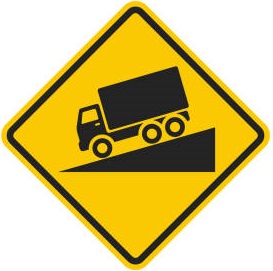
40. This sign means:
A. Upcoming downgrade or hill.
B. Road construction area.
C. Upcoming narrowing of roadway.