Dmv Permit Test 13

By Teacher David Global  •  Free

1. You should yield to a pedestrian:
A. Only if they are in a crosswalk.
B. At all times, even if the pedestrian is not obeying traffic laws.
C. Only if the traffic lights are in the pedestrian's favor.
2. To know where traffic is behind you:
A. Frequently check your rearview mirror.
B. Turn and look out your back window.
C. Keep other vehicles out of your blind spots.
3. You want to park downhill on a two-way road and there is no curb. Which way do you turn your front wheels?
A. Straight ahead
B. Right, toward the side of the road
C. Left, toward the center of the road
4. If weather or light conditions require you to have your lights on while driving:
A. Use your parking lights.
B. Use your high beams.
C. Use your low beams.
5. A blood alcohol concentration of 0.02 percent:
A. Won't have any effect on your driving.
B. Won't put other drivers at risk.
C. Will double your chances of having an accident.
6. To pass on a two-lane road, you should:
A. Sound your horn as you pass.
B. Flash your headlights as you pass.
C. Judge the distance to any oncoming vehicles.
7. When a school bus is picking up or dropping off children, you must:
A. Stop, regardless of your direction of travel.
B. Stop if you are driving in the same direction.
C. Slow down and be prepared to stop.
8. You must yield the right-of-way to an emergency vehicle that is using its siren and flashing lights by:
A. Driving as closely to the right edge of the road as possible and stopping.
B. Moving into the right lane and driving slowly until it has passed.
C. Stopping immediately, even if you are within an intersection.
9. You may pass a vehicle when:
A. You are on a hill or curve.
B. You are on a road with a solid line next to your lane.
C. You are on a road with a broken line next to your lane.
10. Only ____ can reduce blood alcohol content (BAC) and alcohol's effects on the body.
A. Drinking caffeine
B. Eating foods high in fat
C. Time
11. Which of these statements is true about drugs and driving?
A. Any prescription drug is safe to use if you don't feel drowsy.
B. Even over-the-counter drugs can impair your driving.
C. Only illegal drugs can impair your driving.
12. If you are driving and the rear end of your car starts skidding to the left, you should:
A. Steer to the right.
B. Steer to the left.
C. Tap your brakes lightly and shift into neutral.
13. When parking your vehicle on any hill:
A. One of your rear wheels should touch the curb.
B. Use your parking brake and leave the vehicle in "park."
C. Your front wheels should be parallel to the road, if there is no curb.
14. If your vehicle has a mechanical problem:
A. Signal and pull into the slow lane.
B. Stop in your lane and put on your hazard lights.
C. Put on your hazard lights and pull off the road.
15. Double solid yellow lane markings mean that:
A. Neither lane may pass.
B. Both lanes may pass.
C. The lane to the right may pass.
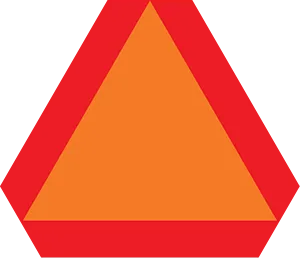
16. This symbol is used for:
A. Dangerous intersections.
B. Slow-moving vehicles.
C. Yield signs.
17. A solid yellow arrow on a traffic signal means:
A. You should speed up so you can make the turn before the light changes.
B. You do not need to signal to turn from the indicated lane.
C. You should prepare to stop and yield the right-of-way to oncoming traffic.
18. When entering the interstate on a short entrance ramp where there is no acceleration lane, you should:
A. Immediately enter the far-right traffic lane on the interstate and speed up to match the flow of traffic.
B. Use the shoulder of the main road to get up to the speed of traffic.
C. Speed up and enter the interstate only after you have identified a gap in traffic.
19. When you drive through a construction zone, you should:
A. Stop to watch the workers.
B. Decrease your following distance.
C. Pass the construction zone carefully and not “rubberneck."
20. If you are driving and you see animals standing near the roadway:
A. Speed up to scare them away.
B. Slow down and proceed with caution.
C. Quickly swerve into the next lane.
21. It is very foggy. You should slow down and:
A. Turn on your emergency flashers.
B. Turn your lights to their high beam setting.
C. Turn your lights to their low beam setting.
22. When driving on the highway, consistently looking far ahead of your vehicle:
A. Helps you keep up with traffic.
B. Reduces the need for last-minute braking or turning.
C. Allows you to spot upcoming police officers.
23. Adjust your rearview and side mirrors:
A. Before you start driving.
B. Whenever you need to use them.
C. Before you get into the car.
24. Which of these statements is true about roadwork zones?
A. Fines are the same for violations committed in work zones as they are under normal traffic conditions.
B. You must "Slow for the Cone Zone."
C. Slow down only if you think workers are present.
25. When a school bus is stopped ahead on your side of the road with its red lights flashing, you must:
A. Slow to a speed no faster than 10 mph.
B. Stop until the lights stop flashing.
C. Change lanes and pass cautiously.
26. After passing a vehicle, it is safe to return to your driving lane when:
A. The driver you passed signals for you to return to your lane.
B. You signal your intention for three seconds.
C. You see the headlights of the passed vehicle in your rearview mirror.
27. When stopped at a red traffic light with a green arrow, you may proceed in the direction of the arrow if you:
A. First come to a complete stop.
B. Wait until the light changes.
C. Are in the proper lane and the intersection is clear.
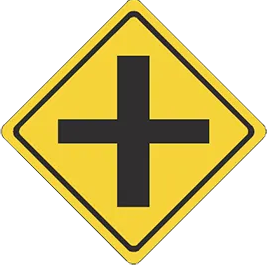
28. This sign means:
A. Crossroad ahead.
B. Merge.
C. Stop.
29. You drive defensively when you:
A. Put one car length between you and the car ahead.
B. Look only at the car in front of you while driving.
C. Keep your eyes moving to look for possible hazards.
30. Highway pavement will be particularly treacherous and most slippery:
A. If it has been raining several hours.
B. If it has just begun to rain.
C. If it has been raining for one to two hours.
31. You reach an intersection with stop signs on all four corners at the same time as the driver on your left. Who has the right-of-way?
A. The driver on your left has the right-of-way.
B. You have the right-of-way.
C. Whoever is signaling to make a turn has the right-of-way.
32. When approaching a person who is crossing the street while using a white cane or guide dog, you should:
A. Stop until the person is well away from your path of travel.
B. Honk your horn as you proceed past them.
C. Carefully drive around them.
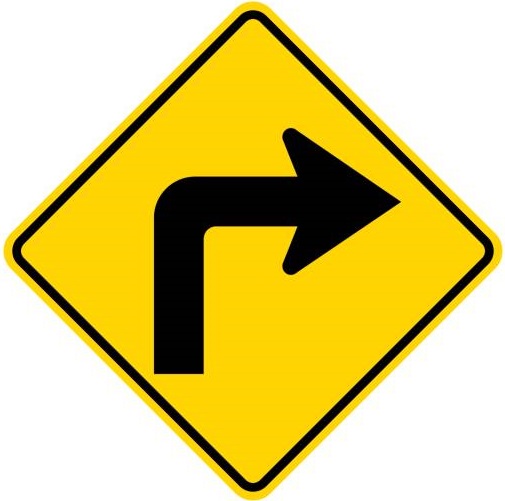
33. This yellow sign means:
A. There is a sharp turn to the right.
B. The lane must turn right.
C. A right turn is permitted on a green arrow only.
34. A steady red arrow displayed on a traffic light means:
A. Drivers cannot turn in the indicated direction.
B. Drivers may turn in the indicated direction after coming to a complete stop.
C. Drivers may turn in the indicated direction.
35. What should you do when approaching a pedestrian who is being led by a guide dog or using a white cane?
A. Honk so they know to clear the way.
B. Yield the right-of-way.
C. Swerve quickly around them.
36. If you become drowsy while driving, you should:
A. Try to fight it.
B. Take a break.
C. Take some caffeine pills.
37. If you are driving near a large commercial vehicle, you should:
A. Follow the large vehicle closely to reduce wind drag on your vehicle.
B. Avoid driving beside it for long stretches of time.
C. Drive on its right side when on curves and hills.
38. You have allowed the wheels of your vehicle to run off the edge of the pavement. What should you do first?
A. Turn the front wheels slightly to the left to edge the car back onto the pavement.
B. Hold the steering wheel firmly, release the gas pedal, and gently apply the brakes.
C. Apply the brakes and turn the front wheels sharply to the left.
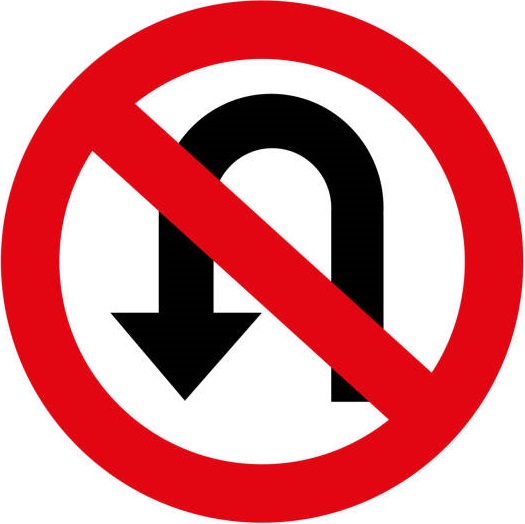
39. This sign means:
A. No U-turn.
B. No turning.
C. No left turn.
40. Drivers turning left must yield to:
A. Overtaking cars.
B. Oncoming cars.
C. No one.