Dmv Permit Test 12

By Teacher David Global  •  Free

1. If there is a deep puddle on the road ahead, you should:
A. Maintain the posted speed to make it through the water.
B. Avoid the puddle if possible.
C. Shift into neutral as you drive through the water.
2. If you see a pedestrian using a guide dog or carrying a white cane:
A. The pedestrian must yield the right-of-way.
B. You must yield the right-of-way.
C. Honk your horn to let them know you are there.
3. The center of the roadway is marked with one solid yellow line and one broken yellow line. If the broken yellow line is directly next to your traffic lane, it means:
A. You are not allowed to pass in this area.
B. You are in a passing zone and it is safe for you to pass other vehicles on the left if no oncoming traffic is present.
C. You are only allowed to make right turns in this area.
4. When a pedestrian guided by a dog or carrying a white cane is crossing the street:
A. You must always yield the right-of-way.
B. You must tell them where to cross the street.
C. You only have to yield the right-of-way if you are at a corner.
5. If your vehicle starts to lose traction because of water on the road, you should:
A. Drive at a constant speed to gain better traction.
B. Apply the brakes firmly to prevent your vehicle from sliding.
C. Slow down gradually and not apply the brakes.
6. Construction zone signs are generally:
A. Round or octagonal with black and yellow coloring.
B. Diamond-shaped or rectangular with orange and black coloring.
7. When you are merging onto the freeway, you should be driving:
A. At or near the speed of traffic on the freeway.
B. Five to 10 mph slower than the speed of traffic on the freeway.
C. The posted speed limit for freeway traffic.
8. This sign is used to warn drivers about:
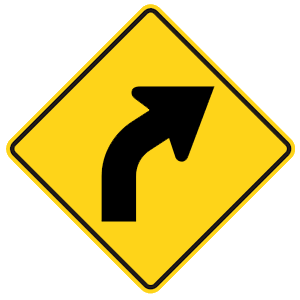
georgia-curve right
A. Upcoming intersections.
B. Road construction.
C. Road curves ahead.
9. The proper way to make a right turn is to:
A. Signal, slow down, and get into the lane closest to the centerline before turning.
B. Signal, slow down, and get into the lane closest to the right curb before turning.
C. Approach the corner in the lane nearest the right curb, but move over toward the middle of the street before turning.
10. To avoid glare from the headlights of an approaching car:
A. Look briefly toward the right side of the road.
B. Stay focused on the centerline on the road.
C. Flash your high beams.
11. You enter a designated turn lane to make a left turn at an upcoming intersection. There is oncoming traffic. You should:
A. Move to the left of the center lane.
B. Signal before you arrive at the intersection.
C. Turn your front wheels to the left to be prepared to turn.
12. An orange and red triangular sign on a vehicle always means:
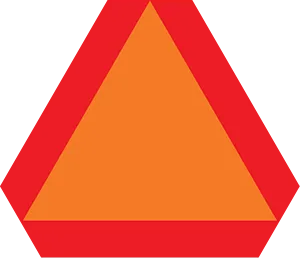
A. The vehicle has the right-of-way.
B. Slow-moving vehicle.
C. Shoulder work ahead.
13. A red arrow pointing to the right on a traffic light means you may:
A. Turn in that direction after slowing and checking for traffic.
B. Not turn in that direction until the light turns green.
C. Turn in that direction after you come to a complete stop.
14. Check your rearview mirrors:
A. Often to see how traffic is moving behind you.
B. To see if a vehicle is in your blind spot.
C. Only when you are slowing down.
15. When entering traffic after being parked at a curb, you:
A. Should drive more slowly than other traffic for 200 feet.
B. Should wait for a large enough gap to get up to the speed of traffic.
C. Should wait for the first two vehicles to pass, then drive into the lane.
16. You are approaching a green traffic light and traffic is blocking the intersection. What is the best thing to do?
A. Partially enter the intersection to establish your right-of-way.
B. Don't enter the intersection until you can get completely across.
C. Continue into the intersection and wait for traffic to clear.
17. Driving under the influence of any medication which impairs your driving is permitted:
A. Under no circumstances.
B. If you don't feel drowsy.
C. If it is prescribed by a physician.
18. At intersections, crosswalks, and railroad crossings, you should always:
A. Stop, listen, and proceed cautiously.
B. Look to the sides of your vehicle to see what is coming.
C. Slowly pass vehicles that seem to be stopped for no reason.
19. This sign means:
A. Slow-moving vehicle.
B. Road construction/maintenance area.
C. Traffic signal ahead.
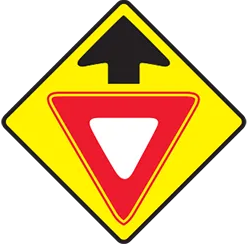
21. This sign means:
A. Yield sign ahead.
B. Side road entering from left.
C. Stop sign ahead.
22. A driver should:
A. Stare directly in front of their car.
B. Only focus on the middle of the road.
C. Watch beside, ahead, and to the rear of their car.
23. If you want to pass a pedestrian who is walking along the roadway and an oncoming vehicle is approaching, you should:
A. Slow down and let the oncoming vehicle pass before you pass the pedestrian.
B. Keep driving at a steady speed. The oncoming vehicle must stop for you.
C. Honk your horn to get the pedestrian to move over.
24. When passing a large truck, you should:
A. Re-enter your original lane and immediately slow down.
B. Give the truck plenty of space before re-entering the lane.
C. Re-enter the lane whenever you feel like it.
25. Work zone barriers, drums, cones, and signs are used to:
A. Make drivers angry about slow traffic.
B. Inconvenience drivers.
C. Keep traffic out of hazardous work zones.
26. Alcohol in any concentration is:
A. A stimulant.
B. A depressant.
C. Neither of the above.
27. Trucks' blind spots are:
A. Directly behind the body.
B. On the immediate left of the cab.
C. Both on the immediate left of the cab and directly behind the body.
28. You are approaching an intersection at the posted speed limit when the signal turns yellow. You should:
A. Slow down and proceed through the intersection without caution.
B. Speed up to cross the intersection before the light turns red.
C. Stop before entering the intersection, if you can do so safely.
29. You are involved in a minor collision at an intersection. There are no injuries and there is very little vehicle damage. You should:
A. Leave your vehicle in the traffic lane until law enforcement arrives.
B. Move your vehicle out of the traffic lane, if possible.
C. Not move your vehicle for any reason.
30. When approaching an intersection controlled by a flashing yellow light, you must:
A. Come to a complete stop at the intersection.
B. Maintain your normal speed.
C. Slow down and proceed with caution.
31. A broken yellow line between two lanes of traffic means:
A. Both lanes of traffic are going in the same direction.
B. Passing is permitted when it's safe.
C. Passing is not permitted.
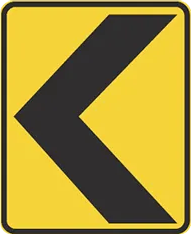
32. This sign means:
A. Change in direction or narrowing of roadway.
B. No right turn.
C. No passing zone.
33. Regulatory signs are usually ____ and should always be obeyed.
A. White
B. Blue
C. Green
34. Regulatory signs are:
A. Green.
B. Yellow.
C. White.
35. To enter a gap in highway traffic:
A. Watch only the vehicles behind the gap.
B. Check behind you, then watch the vehicle ahead.
C. Speed up and let the other vehicles make way.
36. When approaching a school bus stopped with its stop arm extended and red lights flashing, drivers should:
A. Come to a complete stop and wait to proceed.
B. Honk their horn before passing the bus on its left.
C. Continue driving when they think most kids are probably done exiting the bus.
37. If you must park your vehicle in an area not usually used for parking:
A. Park with your reverse lights on.
B. Make sure your vehicle is visible to drivers approaching from any direction.
C. Park five feet from the curb.
38. You exit the freeway on a ramp that curves downhill. You should:
A. Slow to a safe speed before the curve.
B. Slow to the posted speed limit for the freeway.
C. Wait until you have entered the curve to begin braking.
39. What does a traffic signal with a yellow left arrow indicate?
A. Drivers should prepare to yield to oncoming traffic.
B. The protected left turn is about to end.
C. Both of the above.
40. When should drivers yield the right-of-way to pedestrians in a crosswalk?
A. Only if the pedestrians first wave to the driver.
B. Only if the pedestrians are not texting while walking.
C. At all times.