Dmv Permit Test 1

By Teacher David Global  •  Free

1. When you see this black and yellow sign, it means:
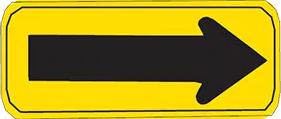
A. The road to the right is for one-way traffic only.
B. There is a detour to the right due to road construction.
C. The road ahead changes direction at an extreme angle.
2. You should yield to a pedestrian:
A. Only if they are in a crosswalk.
B. At all times, even if the pedestrian is not obeying traffic laws.
C. Only if the traffic lights are in the pedestrian's favor.
3. If a road is slippery, maintain a following distance that is:
A. No different than normal.
B. Farther from the car ahead than normal.
C. Closer to the car ahead than normal.
4. Any amount of alcohol in the blood may affect a driver's:
A. Right-of-way privileges.
B. Judgment and physical coordination.
C. Knowledge.
5. Which of the following are factors commonly contributing to traffic crashes?
A. Exceeding the posted speed limit and driving too fast for conditions or circumstances.
B. Getting adequate rest and staying alert.
C. Scanning the environment and staying focused on the driving task.
6. Using a cell phone while operating a motor vehicle is considered a distraction because:
A. It causes the driver to be concerned about the cost of the call.
B. It occupies the driver's hands, eyes, and mind.
C. It is an activity that draws the attention of other drivers.
7. When stopped for a traffic violation or at an equipment check, a driver must produce:
A. Only their insurance and registration.
B. Only their license.
C. Their license, insurance, and registration.
8. Night driving presents unique problems because:
A. The speed limit is increased at night.
B. There are fewer cars on the roads at night.
C. Distance and vehicle speed are difficult to judge in the dark.
9. If you experience a tire blowout:
A. Tap or pump the brakes.
B. Slow down gradually and use your brakes lightly.
C. Apply the brakes firmly and quickly.
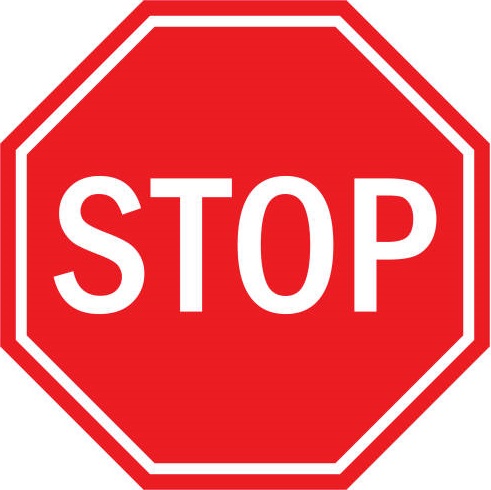
10. This road sign means:
A. Drive with caution and be ready to stop.
B. You must come to a complete stop.
C. Stop, if necessary.
11. Collisions are more likely to happen when:
A. All vehicles are traveling at about the same speed.
B. One lane of traffic is traveling faster than the other lanes.
C. One vehicle is traveling faster or slower than the flow of traffic.
12. Motorcycles are entitled to:
A. The same full lane width as other motor vehicles.
B. The width of the sidewalk.
C. One-half of the width of a lane.
13. If the roadway is wet or icy, you should:
A. Reduce your speed.
B. Drive at the posted speed.
C. Speed up.
14. If there is no crosswalk and you see a pedestrian crossing your lane, you should:
A. Make sure the pedestrian can see you before proceeding.
B. Cautiously drive around the pedestrian.
C. Stop and let the pedestrian finish crossing.
15. Distracted driving is:
A. Anything that causes evasive action while driving.
B. Anything that takes your attention away from driving.
C. Anything that causes you to pay more attention to driving.
16. Tailgating other drivers (driving too closely to their rear bumper):
A. Can frustrate other drivers and make them angry.
B. Cannot result in a traffic citation.
C. Reduces collisions by preventing being "cut off."
17. Which of the following driving skills is/are affected by the use of alcohol and/or drugs?
A. Alertness.
B. Coordination.
C. Both of the above.
18. At a crosswalk:
A. You must yield to pedestrians.
B. Pedestrians must yield to you.
C. Construction workers must yield to you.
19. This sign means:
A. Stop.
B. Merge.
C. Upcoming change in direction.
20. Blind spots are:
A. Spots in your vision when you become fatigued.
B. Areas of the road that cannot be seen in a vehicle's mirrors.
C. Traffic control devices.
21. When passing another vehicle:
A. Pass the vehicle as slowly as possible.
B. Drive at the same speed as the vehicle you are passing.
C. Pass the vehicle as safely and as quickly as possible.
22. A green traffic signal indicates that approaching drivers should:
A. Come to a complete stop.
B. Increase their speed to quickly clear the intersection.
C. Continue driving straight through the intersection, turn left, or turn right.
23. You are driving on the freeway behind a large truck. You should drive:
A. Closer behind the truck than you would if following a passenger vehicle.
B. Farther behind the truck than you would if following a passenger vehicle.
C. To the right side of the truck and wait to pass.
24. When approaching an intersection controlled by a flashing yellow light, you must:
A. Come to a complete stop at the intersection.
B. Maintain your normal speed.
C. Slow down and proceed with caution.
25. When turning left at an intersection:
A. You should always yield to oncoming traffic and pedestrians.
B. Oncoming traffic and pedestrians should yield to you.
C. You should never yield to oncoming traffic and pedestrians.
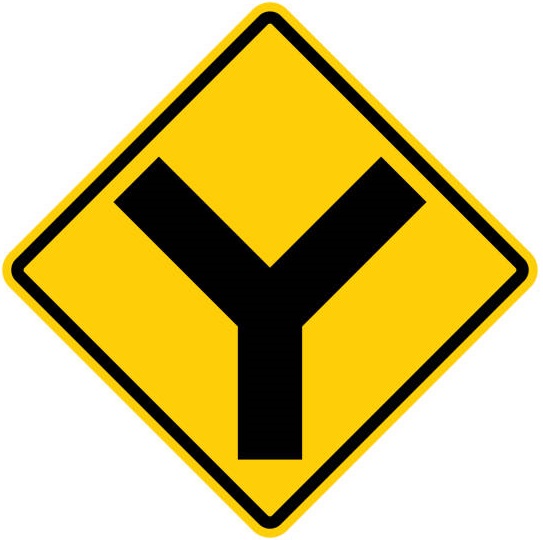
26. This road sign means:
A. The roadway ends ahead.
B. Drivers must bear either right or left.
C. A four-way intersection is ahead.
27. There is no crosswalk and you see a pedestrian crossing your lane ahead. You should:
A. Make eye contact with and then pass the pedestrian.
B. Slow down as you pass the pedestrian.
C. Stop and let the pedestrian finish crossing the street.
28. To avoid traction loss on wet roads, you should:
A. Make abrupt turns.
B. Apply the brakes firmly.
C. Slow down.
29. Backing your vehicle is:
A. Always dangerous.
B. Dangerous if you have a helper.
C. Only dangerous in large vehicles.
30. At a railroad crossing, you must:
A. Watch for vehicles that must stop at all railroad crossings (school buses, trucks carrying hazardous materials, etc.).
B. Watch for multiple trains.
C. Both of the above.
31. If you come to a railroad crossing with lowered gates and flashing warning lights, you should:
A. Drive around the crossing gates if you can't see a train.
B. Come to a complete stop well behind the gates, wait for the tracks to clear, and proceed once the gates are lifted.
C. Slow down and drive around the gates.
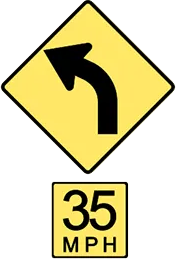
32. This sign means:
A. There is a 35 mph speed zone after the curve ahead.
B. Drive no slower than 35 mph around the upcoming curve.
C. Approach the upcoming curve at a speed of 35 mph or slower.
33. To pass on a two-lane road, you should:
A. Sound your horn as you pass.
B. Flash your headlights as you pass.
C. Judge the distance to any oncoming vehicles.
34. Blue traffic signs offer information on:

A. Motorist services.
B. Construction and maintenance.
C. Mileage information, such as distances to specific locations.
35. Which of the following is a dangerous habit when driving in work zones?
A. Tailgating another vehicle
B. Failing to carefully watch for workers and moving equipment
C. Both of the above
36. Which of these statements is true about large trucks?
A. They take longer to stop than passenger vehicles.
B. They all have air brakes that allow them to stop quickly.
C. They are more maneuverable than passenger vehicles.
37. Which of the following statements about blind spots is true?
A. Blind spots are eliminated if you have one outside mirror.
B. Large trucks have bigger blind spots than most passenger vehicles.
C. Blind spots can be checked by looking in your rearview mirror.
38. You should not make sudden stops in front of large trucks and buses because:
A. Small vehicle drivers cannot adequately see large trucks and buses in their rearview mirrors.
B. Large trucks and buses, due to their size and weight, require longer distances to stop than smaller passenger vehicles.
C. Large trucks and buses travel at a higher speeds than small vehicles.
39. If a tire suddenly blows out while you are driving, you should:
A. Grip the steering wheel firmly, slow down, and exit the traffic lane.
B. Pump the brakes rapidly.
C. Brake hard and steer toward the right edge of the roadway.
40. You should drive on the shoulder to pass a car:
A. If the vehicle ahead of you is turning left.
B. Under no circumstances.
C. If the shoulder is wide enough.