Dmv Permit Test 32

By Teacher David Global  â€¢  Free

1. If your turn signals fail, you should use ____ to indicate that you are turning.
A. Your horn
B. Your headlights
C. Hand signals
D. Your emergency flashers
2. A traffic light displaying a green arrow and a red light means that:
A. You may only drive straight ahead.
B. You may drive only in the direction of the green arrow.
C. You must wait for a solid green light to proceed in any direction.
D. Vehicles moving in any direction must stop.
3. A stop sign is shaped like a(n):
A. Rectangle.
B. Square.
C. Circle.
D. Octagon.
4. Under Alaskan law, seat belts are required to be used:
A. Only by children under the age of 16.
B. Only by a person riding in the front seat of a vehicle.
C. By everyone in a moving vehicle at all times.
D. Only when traveling at speeds above 50 mph.
5. You need to use extra caution when driving near a pedestrian using a white cane because:
A. He or she is deaf.
B. He or she is a police officer.
C. He or she is blind.
D. He or she has poor balance.
6. How can you help prevent rear-end collisions?
A. Avoid sudden stops.
B. Before stopping, check your mirrors and blind spots for traffic.
C. Release the gas pedal and let your vehicle slow before applying the brakes.
D. All of the above.
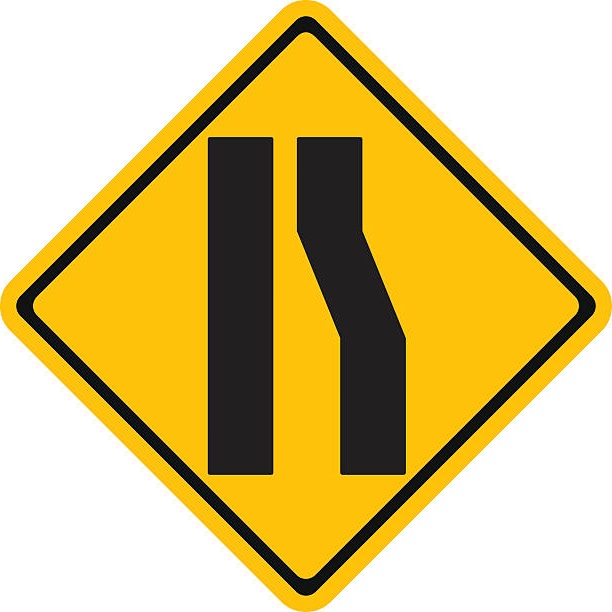
7. This sign is used to warn drivers:
A. That the right lane ends and traffic should merge left.
B. That the road curves ahead.
C. About upcoming intersections.
D. About road construction.
8. You are approaching a flashing red traffic light. You should:
A. Come to a complete stop.
B. Proceed only when it is safe to do so.
C. Approach the light as if it were a stop sign.
D. All of these.
9. Your tire blows out while you are driving. You should:
A. Slam on your brakes.
B. Hold your steering wheel tightly and slow to a stop.
C. Keep driving normally.
D. Turn on your emergency flashers and continue driving.
10. When changing lanes on a multilane roadway, you should:
A. Honk your horn to let drivers behind you know you might not be able to see them.
B. Slow down to shrink your blind spot.
C. Look in your mirrors before staring straight ahead.
D. None of these.
11. An octagonal sign is always a:
A. Speed limit sign.
B. Stop sign.
C. Hospital sign.
D. Railroad warning sign.
12. You are turning onto a two-lane road divided by a broken yellow line. You know immediately that:
A. You are on a two-way road.
B. You are on a one-way road.
C. The road is under repair.
D. You must stay to the left of the broken yellow lines.
13. While driving on a two-lane road without bicycle lanes, you encounter a bicyclist traveling in the same direction. What is the safest way to pass the bicyclist?
A. Slow down and wait until there is no traffic approaching, then pass the bicyclist while leaving him or her sufficient space.
B. Continue driving straight. It is the bicyclist’s responsibility to get out of your way.
C. Do not pass the bicyclist until you come to a traffic signal or stop sign.
D. Honk at the bicyclist to let him or her know you are about to pass.
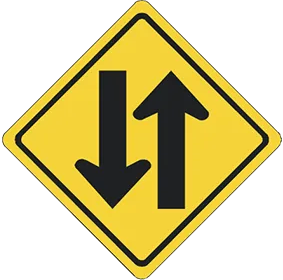
14. This sign means:
A. Two-way traffic.
B. Lane shifting.
C. Low clearance.
D. Added lane.
15. When you are in a line of traffic that is crossing a railroad track that has no signals or gates:
A. You have the right-of-way and do not need to check for trains.
B. You may pass slower drivers while crossing the track.
C. You need to make sure there is space for your vehicle to get all the way across the tracks without stopping.
D. All of the above
16. When driving past a vehicle that has just stopped in a parked position on the side of the road, you should:
A. Assume that the driver will open the car door as you approach.
B. Speed up.
C. Slam on your brakes.
D. Assume that the driver will wait for you to pass before opening the door.
17. Two solid yellow lines on the pavement mean:
A. Passing is allowed for drivers from both directions.
B. Passing is not allowed.
C. Passing is allowed if you are at the top a hill.
D. Passing is allowed during daylight only.
18. If your car breaks down on a highway, you should:
A. Sit in your car and wait for help.
B. Use your four-way flashers to warn other drivers.
C. Sound your horn at passing motorists.
D. Flash your headlights at oncoming traffic.
19. On slippery roads, you should:
A. Slow down.
B. Drive more quickly.
C. Drive the speed limit, with caution.
D. Not drive more quickly than 20 mph.
20. What does a single dashed yellow line separating traffic mean?
A. Drivers may pass if it is safe to do so.
B. Both lanes travel in the same direction.
C. Drivers may not pass.
D. Drivers may pass, even if it could be dangerous.