Dmv Permit Test 31

By Teacher David Global  •  Free

1. The act of turning your head and checking your blind spot before changing lanes, driving away from a curb, or merging your vehicle into traffic is:
A. A bad driving habit.
B. A good driving habit.
C. Unnecessary.
D. Not necessary if you use the rearview mirror.
2. When meeting a car with blinding headlights, you should:
A. Use your bright lights until the other vehicle dims theirs.
B. Flash your lights on and off to warn the other driver.
C. Dim your lights and then speed up to pass quickly.
D. Look toward the right side of the road.
3. Fog can greatly reduce the visibility of other vehicles, pedestrians, and traffic signals. When driving in fog, you should:
A. Drive cautiously and reduce your speed.
B. Not use your high beam headlights.
C. Use low beam headlights to better illuminate the road and objects.
D. All of the above.
4. Two solid white lines painted across a traffic lane show the boundaries of a crosswalk. As a driver, you should know that:
A. Motor vehicles have the right-of-way over pedestrians in crosswalks.
B. When pedestrians are in crosswalks, they should be given the right-of-way.
C. No one has the right-of-way in a crosswalk.
D. Pedestrians are responsible to stay out of the way of all traffic.
5. A driver can legally pass on the right side of another vehicle:
A. If the vehicle is waiting to turn left and there is an available passing lane.
B. Even if it means driving off the pavement.
C. On a narrow bridge.
D. At any time.
6. Allowing a space cushion between your vehicle and its surroundings is important because it:
A. Prevents distractions from other vehicles.
B. Allows you time to react to unexpected situations.
C. Keeps traffic flowing at a safe pace.
D. Keeps other drivers alert.
7. When approaching a flashing yellow light, drivers should:
A. Increase their speed.
B. Come to a complete stop.
C. Turn on their headlights.
D. Slow down and proceed with caution.
8. You have the right-of-way when turning left on which of the following traffic signals?
A. A solid green light
B. A flashing yellow light
C. A green arrow pointing left
D. A flashing red light
9. When entering a street from a driveway, you:
A. Must drive slowly to allow approaching vehicles and pedestrians time to get out of your way.
B. Must honk your horn so approaching vehicles and pedestrians know to give you room.
C. Must stop and proceed only when there are no pedestrians or vehicles approaching.
D. Can disregard any pedestrians if there is no sidewalk.
10. If you reach an intersection where you wish to turn but you are not in the proper lane, you should:
A. Quickly cut across traffic to make your turn.
B. Turn on your blinker and make the turn from your current lane.
C. Drive to the next intersection and make your turn then.
D. Safely change lanes then put your vehicle in reverse to go back to the intersection.
11. What do speed limit signs indicate?
A. Potential driving speeds for the area
B. The maximum or minimum speed that is legally allowed to be driven
C. The speed drivers should drive in heavy traffic
D. The speed drivers should drive under poor conditions
12. You are driving on a narrow road when you meet an oncoming vehicle. You must:
A. Pull completely off the road and stop.
B. Allow the oncoming vehicle at least one-half of the main-traveled portion of the road.
C. Demand the other vehicle pull over to make room.
D. Turn on your high beam headlights to make sure the other vehicle sees you.
13. To help relieve fatigue on a long trip, it is a good idea to:
A. Stop and rest every two hours.
B. Do arm exercises every hour.
C. Drive with one eye open at a time.
D. Change feet on the gas pedal.
14. A solid yellow line on your side of the centerline means:
A. Slow down.
B. Pass with caution.
C. Do not pass.
D. Keep right on hills.
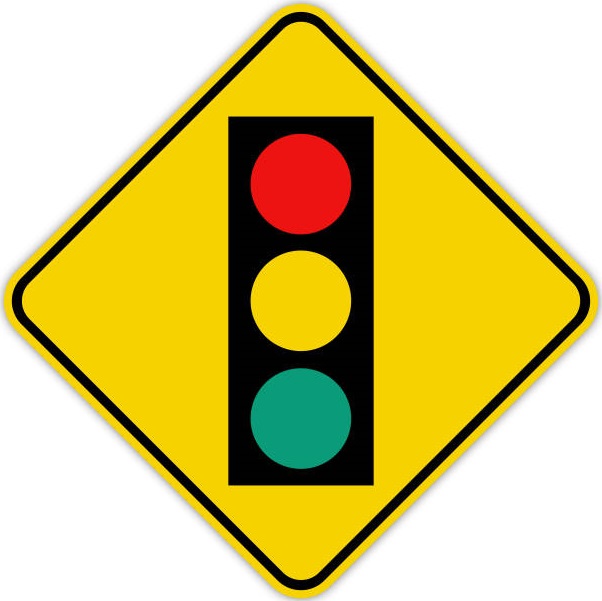
15. This road sign means:
A. Roundabout ahead.
B. No passing zone.
C. Left turn yield on green.
D. Traffic signal ahead.
16. You may honk your horn when you:
A. Have to stop quickly.
B. Are passing another car.
C. Have lost control of your car.
D. Are passing a bicyclist.
17. When merging onto a freeway, it is usually best to:
A. Proceed slowly while waiting for an opening.
B. Accelerate to a speed that is faster than the speed of traffic.
C. Turn on your hazard lights until safely on the freeway.
D. Accelerate to the speed of freeway traffic.
18. You must adjust your driving speed to accommodate for:
A. Existing road conditions.
B. Weather conditions.
C. Other traffic.
D. All of these.
19. When a stop is required at an intersection and no markings appear to indicate a stop line or crosswalk, a driver:
A. Is not required to stop.
B. Is required to slow down to make sure crossing traffic is clear.
C. Should stop only at a place where they can see at least 200 feet on either side, even if they have to enter the intersecting roadway.
D. Should stop where they have a clear view of approaching traffic before they enter the intersecting roadway.
20. When driving on slippery roads, you should:
A. Use alternate routes.
B. Drive as you would on dry roads.
C. Increase your following distance.
D. Avoid crossing bridges or intersections.