Dmv Permit Test 30

By Teacher David Global  •  Free

1. If you are driving so slowly that traffic is backing up behind you, you should:
A. Decrease your speed.
B. Pull off the right side of the road and let traffic pass.
C. Not let the other cars pass your vehicle.
D. Use your four-way flashers.
2. You must stop at an intersection when you see a:
A. Flashing red light.
B. Steady yellow light.
C. Yellow arrow.
D. Flashing yellow light.
3. When turning left, drivers must yield the right-of-way to:
A. Other drivers who are already in the intersection.
B. Oncoming traffic.
C. Pedestrians who are already in the intersection.
D. All of the above.
4. When dealing with pedestrians, a driver must:
A. Make sure the pedestrian is aware of their vehicle.
B. Always yield the right-of-way, even if the pedestrian is in the wrong.
C. Yield the right-of-way only when the pedestrian is legally entitled to it.
D. Slow down and sound their horn near a crosswalk.
5. If two drivers arrive at the same time to a four-way intersection controlled by stop signs:
A. The driver on the right has the right-of-way.
B. The driver on the left has the right-of-way.
C. One driver may continue driving without stopping.
D. One driver should honk to indicate that they are giving up the right-of-way.
6. Increasing your vehicle’s speed:
A. Increases your field of vision.
B. Decreases your field of vision.
C. Makes it easier to see cross traffic.
D. Has no effect on your field of vision.
7. The first thing affected after drinking alcohol is a person's:
A. Vision.
B. Balance.
C. Speech.
D. Judgment.
8. To prepare for anything coming up on the road ahead, you should:
A. Continually scan the entire road and all roadsides.
B. Stare straight ahead at all times.
C. Drive with your left foot resting lightly on the brake pedal.
D. Maintain focus toward the middle of the road.
9. When driving near heavy trucks, other drivers and highway users must make allowances for:
A. The increased stopping distance required by large vehicles.
B. The decreased stopping distance required by large vehicles.
C. The decreased noise of larger vehicles.
D. The increased speed of larger vehicles.
10. Driving at night requires increased caution because:
A. Traffic moves faster at night.
B. There is a larger volume of traffic at night.
C. Drivers cannot see as well at night.
D. Accidents occur more frequently at night.
11. Drivers may not pass from either side of a ____ centerline.
A. Combination solid and broken yellow
B. Single broken yellow
C. Double solid yellow
D. Single broken white
12. On long trips, you can prevent drowsiness by:
A. Turning on your car radio.
B. Slowing down.
C. Stopping at regular intervals for a rest.
D. Moving your eyes from side to side as you drive.
13. A steady green light at an intersection means that you:
A. Must slow down and prepare to stop.
B. Must stop and check for oncoming traffic before proceeding.
C. May drive through the intersection if the road is clear.
D. May not turn right.
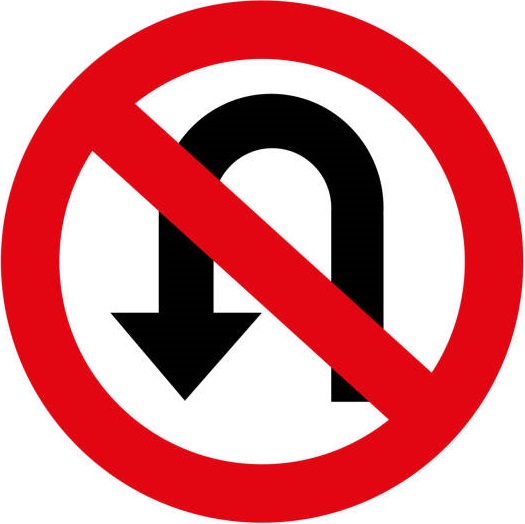
14. This road sign means:
A. Do not enter.
B. No parking.
C. No U-turn.
D. No left turn.
15. Slower-moving traffic on a multilane highway should:
A. Drive in the right lane.
B. Drive in any lane.
C. Drive in the left lane.
D. Drive in the lane with the least amount of traffic.
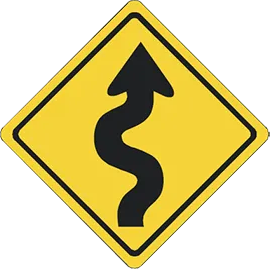
16. This sign tells you that:
A. No turns are allowed on this road.
B. The road narrows ahead.
C. There are a series of curves ahead.
D. The road may be slippery when wet.
17. You may park or stop along the shoulder of the freeway:
A. As long as you turn on your four-way (emergency) flashers.
B. If no part of your vehicle is on the road.
C. If you need to look at a map for directions.
D. Only if you have an emergency.
18. A flashing yellow traffic signal means:
A. Slow down and proceed with caution.
B. Continue ahead at your current speed.
C. Stop.
D. No left turn.
19. A license may be suspended for:
A. Driving in violation of license restrictions.
B. Repeated violations of motor vehicle laws.
C. Operating an uninsured vehicle.
D. All of these.
20. This sign means:
A. No left turn.
B. No stopping.
C. No U-turn.
D. Detour ahead.