Dmv Permit Test 28

By Teacher David Global  •  Free

1. You are coming to an intersection and have a green light. Pedestrians are crossing against the red. You should:
A. Honk your horn.
B. Speed up and pass in front of the pedestrians.
C. Stop to let the pedestrians cross safely.
D. Drive close to the pedestrians and frighten them so they’ll think twice before crossing against a red light.
2. If involved in an accident, a driver should:
A. Stop their vehicle at or near the scene.
B. Not stand or walk in traffic lanes.
C. Turn off the ignitions of wrecked vehicles.
D. All of the above.
3. A yellow and black diamond-shaped sign:
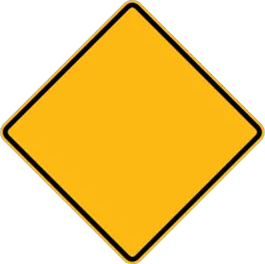
A. Warns you about conditions on or near the road.
B. Helps direct you to cities and towns ahead.
C. Tells you about traffic laws and regulations.
D. Tells you about road construction ahead.
4. Drivers who have consumed alcohol before getting behind the wheel:
A. Are always aware of the risks they are taking.
B. Do not have sufficient control over their bodies and minds or the vehicles being driven.
C. Are better drivers because they are more careful than sober drivers.
D. Have quicker reaction times.
5. When you hear a fire engine siren behind you, you must:
A. Slow down until it passes you.
B. Drive with your flashers on.
C. Pull over to the side of the road and stop.
D. Speed up and take the nearest exit.
6. Do not pass:
A. On a hill or curve.
B. When school bus lights are flashing.
C. When approaching an intersection.
D. All of the above.
7. Which of the following is true regarding seat belts and child restraints in vehicles?
A. You should never place an infant or small child in the front seat of a vehicle with airbags.
B. An airbag can be dangerous to an infant or small child, even in a low-speed collision.
C. You should always make sure all your passengers are using a seat belt or child restraint.
D. All of the above.
8. To check your blind spot before changing lanes:
A. Look into the left side mirror.
B. Look into the right side mirror.
C. Look into the rearview mirror.
D. Look over your shoulder in the direction you plan to move.
9. When approaching railroad tracks, you should:
A. Look, listen, slow down, and be prepared to stop.
B. Speed up to cross the tracks before the gate is lowered.
C. Try to drive around a lowered gate.
D. Not pay attention to how many tracks there are to cross.
10. When backing up your vehicle, you should:
A. Turn your head and body to the right to look out the rear window.
B. Use only your rearview mirror to look for obstacles to the rear of your vehicle.
C. Honk your horn so pedestrians and other vehicles know what you are doing.
D. None of these.
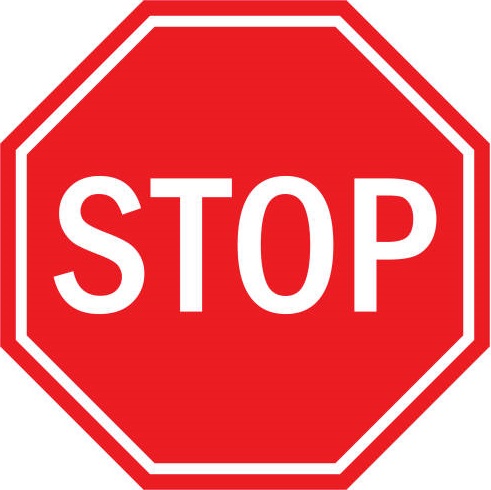
11. What does this road sign mean?
A. Slow down and prepare to stop if cars are approaching you.
B. Come to a full stop and go when it is safe to do so.
C. Proceed carefully through the intersection, not always stopping.
D. Stop only for traffic on an intersecting road.
12. If you are involved in a serious motor vehicle crash:
A. Stop.
B. Call the police.
C. Determine if anyone is injured.
D. All of the above.
13. If you are about to miss your exit on a highway or freeway, you should:
A. Signal, break, and move sharply to the right.
B. Continue on to the next exit.
C. Pull to the right and carefully back up to the exit ramp.
D. Cross over the median to exit from the opposite direction.
14. You are involved in an accident. You should:
A. Stop immediately.
B. Help the injured.
C. Call the police.
D. All of the above.
15. At a four-way stop:
A. The driver to arrive first has the right-of-way.
B. The driver to arrive last has the right-of-way.
C. One driver should continue driving without stopping.
D. One driver should wave the other drivers ahead.
16. Don’t follow other cars too closely because:
A. You may not see the road between the cars.
B. You may not have time to stop if the vehicle in front of you slows or stops suddenly.
C. You may not see the vehicle's turn signals.
D. You may not see the other vehicle’s brake lights.
17. You may drive around or under a gate that is being lowered or raised at a railroad crossing:
A. As long as an approaching train is not too close.
B. If your vehicle can do so without damaging the gate.
C. If you first look carefully in both directions.
D. Under no circumstances.
18. What does alcohol do to your driving skills and judgement?
A. It helps driving skills but harms your judgement.
B. It harms both driving skills and judgement.
C. It has no effect on either driving skills or judgement.
D. It has no effect on judgement but it harms driving skills.
19. When getting ready to change lanes, you should:
A. Check your side view mirror.
B. Check your rearview mirror.
C. Quickly turn your head to check for other vehicles.
D. All of the above.
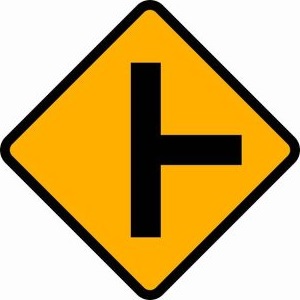
20. This sign means:
A. Side road.
B. Low clearance.
C. Merging traffic.
D. Prepare to stop.