Dmv Permit Test 26

By Teacher David Global  •  Free

1. In which of the following ways can alcoholic beverages affect you?
A. It slows your reaction time.
B. It gives you a feeling of false confidence.
C. It impairs your thinking ability.
D. All of the above.
2. At an intersection with a traffic light displaying a green arrow, you should:
A. Wait to proceed until the light turns green.
B. Stop, then turn in the direction indicated by the arrow.
C. Turn in the direction indicated by the arrow when the intersection is clear.
D. Accelerate and quickly turn.
3. If a crossing guard is directing traffic in a school zone, you must:
A. Follow the directions given by the crossing guard.
B. Copy what surrounding traffic is doing, despite the crossing guard's instructions.
C. Assume the guard is not supposed to be directing traffic.
D. Follow rules that would be in place if no children were present.
4. Road rage and aggressive driving may be reduced by:
A. Allowing extra travel time.
B. Obeying posted speed limits.
C. Using proper turn signals.
D. All of the above.
5. “Highway hypnosis” is a driving condition that can result from:
A. Staring at the roadway for long periods of time.
B. Frequent rest stops.
C. Too much sleep the night before your trip.
D. Short trips on expressways.
6. Highway markings:
A. Are usually not important.
B. Are only found in construction zones.
C. Provide information for drivers.
D. Are usually red and blue in color.
7. This sign means:
A. You must drive slowly and sound your horn.
B. A bus stop is ahead.
C. You are entering a school's parking lot.
D. A school zone is ahead.
8. Night driving can be more difficult than driving during the day because:
A. Cars overheat more quickly at night.
B. Visibility is reduced in the dark.
C. It is more likely to be raining at night.
D. You are more likely to encounter a motorcycle at night.
9. To drive safely at night, you should:
A. Increase your following distance.
B. Not drive if you are tired.
C. Make sure your headlights are working properly.
D. All of the above.
10. To avoid colliding with the car in front of you, you should:
A. Watch for hazards ahead.
B. Watch for brake lights ahead.
C. Use the four-second rule.
D. All of the above.
11. To ensure that your physical condition does not cause you to drive in an unsafe manner, you should:
A. Keep physically fit and have regular physical examinations.
B. Know the effect of any medicine on your driving ability.
C. Drive within your physical limitations.
D. All of the above.
12. When turning or changing lanes, you must:
A. Always signal your intentions, even when no visible traffic is present.
B. Signal only if there is visible traffic.
C. Signal only when driving at night.
D. Signal only when driving in heavy traffic at night.
13. Always signal when:
A. Changing lanes.
B. Pulling into or out of a parking space.
C. Pulling into traffic from an alley or parking area.
D. All of the above.
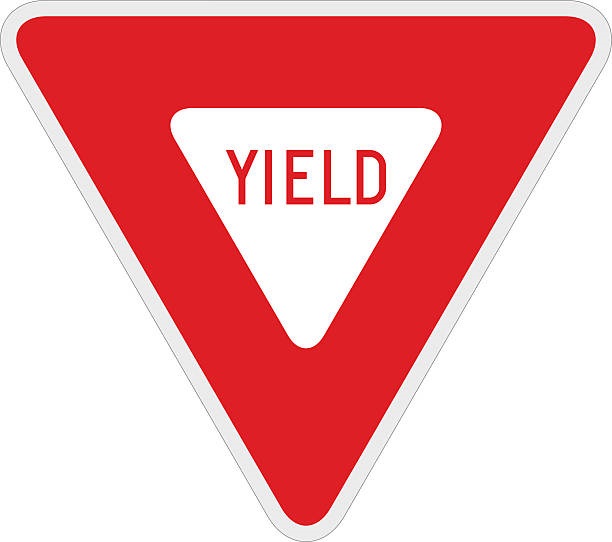
14. This sign means:
A. Slow down if an emergency vehicle is approaching.
B. Look both ways as you cross the intersection.
C. Always come to a full stop at the intersection.
D. Slow down and be prepared to stop if necessary.
15. If you begin to feel tired while driving, the best thing to do is to:
A. Get some coffee.
B. Open your window.
C. Stop driving.
D. Turn on the radio.
16. Traffic signs and pavement markings:
A. Must always be obeyed.
B. Are merely suggestions.
C. Must be followed only when there is other traffic.
D. Must be followed only when a police officer is present.
17. Worn or bald tires:
A. Can make turning more difficult.
B. Are likely to hydroplane.
C. Can increase your stopping distance.
D. All of the above.
18. When changing lanes on a highway, you should:
A. Signal a lane change.
B. Check your rearview and outside mirrors.
C. Check your blind spot by glancing over your shoulder.
D. All of the above.
19. Always signal when:
A. Changing lanes.
B. Pulling into or out of a parking space.
C. Pulling into traffic from a parking area or alley.
D. All of the above.
20. If someone is driving aggressively behind you, you should:
A. Try to get out of the aggressive driver’s way.
B. Stare at the driver as he or she is passing you.
C. Speed up as he or she is passing you.
D. Block the passing lane.